
Introduction
By Falyn Marsella, Jeffery Gramata, Ali Aryakia

The purpose of this webquest is to present differentiated instruction techniques to classroom teachers who are unsure how to implement differentiated instruction into their lesson plans while providing small group instruction.
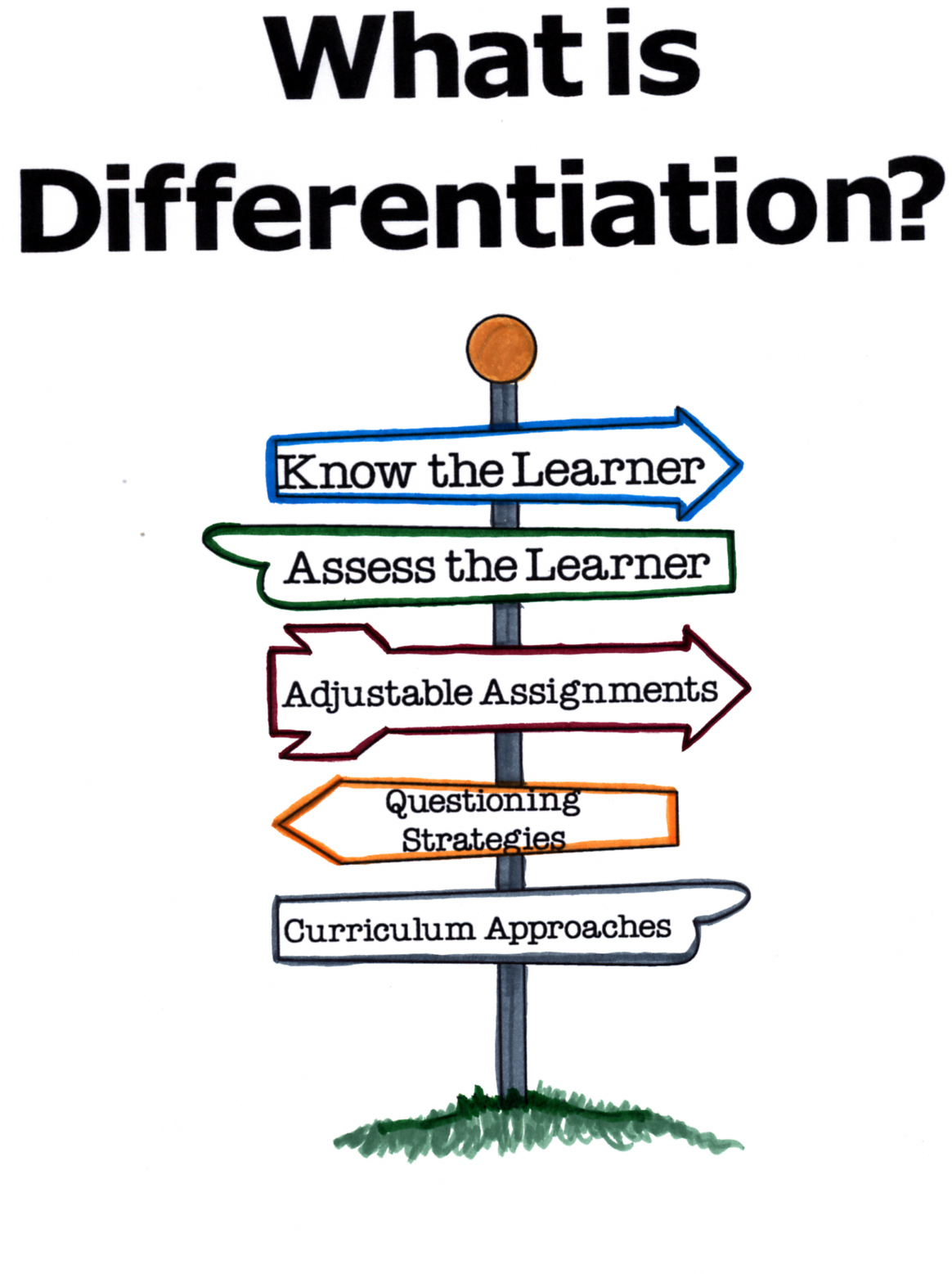
Differentiation refers to a wide variety of teaching techniques and lesson adaptations that educators use to instruct a diverse group of students, with diverse learning needs, in the same course, classroom, or learning environment.
Task

The importance of differentiated instruction is to meet the needs of all students.
Your task is to evaluate the practices that you are currently using in your classroom. See where differentiated instruction can help you create an effective learning environment while teaching in a small group.
Process

Four Main Elements of Differentiated Instruction
There are four main elements in which differentiated instruction works on:
I. Content – This is what the student needs to learn or how the student will get access to the information.
II. Process – These are the activities the students work on in order to make sense of and to master the content being provided.
III. Products – These are the culminating projects which ask the students to rehearse, apply, and extend what they have learned in the unit.
IV. Learning environment – This is the way the classroom works and feels.
Examples on the Elementary Level
Here are some examples on the elementary level which can put these elements into perspective:
I. Content
- Using reading materials which are at varying reading levels.
- Have text recorded on tape/digital recording.
- Providing spelling/vocabulary lists for students at varying levels.
- Providing information using both auditory and visual examples.
- Using reading buddies.
- Having students gather in small groups to re-teach the material to struggling learners or to extend the thinking or skills of advanced learners.
II. Process
- Create tiered activities in which all students work on the same important understandings and skills, but progress with different levels of support, challenges, or complexity.
- Provide students with interest centers, which will encourage them to explore subsets of the topic being taught or of particular interest to them.
- Develop personal agendas for students to keep that has tasks written by the teacher, and contains both common work for the entire class, as well as work for the individual needs of the students. This can either be completed during a specific time, or as students complete other work early.
- Offer students manipulatives or other hands-on supports for students who need them.
- Provide varying lengths of time for students to complete the assignments in order to provide additional support for struggling learners, and to encourage an advanced learner to pursue a topic in greater depth.
III. Products
- Give students the option of how to express required learning, such as creating a puppet show, writing a letter, or developing a mural with labels.
- Create and use rubrics which match and extend students varied skills levels.
- Allow students to work alone or in small groups on their products.
- Encourage students to create their own product assignments as long as the assignments contain required elements.
IV. Learning environment
- Make sure you have places in your classroom to work quietly and without any distractions, as well as places where students can work collaboratively.
- Provide students with the materials that reflect a variety of cultures and home settings.
- Set clear guidelines for students to work independently that will match their individual needs.
- Develop routines in your classroom that allow students to get help when the teacher is busy with other students and cannot help them immediately.
- Help the students in your class understand that some students learn better by moving around the room, while others learn better while sitting quietly.
Differentiated Instruction in Small Groups
Differentiated instruction is meant to allow students to learn in a variety of ways, and it acknowledges that all groupings, whether they be large groups, small groups, teams, partners, and individual work, all have value because the each expose the students to a different way of learning. It is important to group students appropriately, which is to place them in groups where they will have the opportunity to work with students whose needs are similar. For students who are struggling, the small groups would be smaller than for students who are not struggling, which can be placed in slightly larger groups.
- Establish classroom management
- Assess and establish groups
- Know what you need to teach
- Plan lessons to mastery
- Create effective and meaningful activities
Evaluation


|
Exemplary 4 |
Accomplished 3 |
Developing 2 |
Beginner 1 |
Score |
|
|---|---|---|---|---|---|
|
Learning Styles
|
Includes three or more strategies for addressing each of the three ways that people learn | Includes two strategies for addressing each of the three ways that people learn | Includes one strategy for addressing each of the three ways that people learn | Does not address strategies for addressing each of the three ways that people learn | |
|
Multiple Intelligences
|
Includes three or more strategies for addressing at least three of the multiple intelligences | Includes two strategies for addressing at least three of the multiple intelligences | Includes one strategy for addressing at least three of the multiple intelligences | Does not address strategies for addressing at least three of the multiple intelligences | |
|
Assessment
|
Includes three or more methods of assessing learning beyond quiz or test | Includes two methods of assessing learning beyond quiz or test | Includes one method of assessing learning beyond quiz or test | Does not include methods of assessing learning beyond quiz or test | |
|
Learner Levels and Content Variation |
Provides two or more activities. Content levels meet the needs of slower learners through Gifted learners. | Provides two or more activities. Content levels meet the needs of slower learners and middle of the road learners. | Provides more than one activity. Content levels are the same throughout for all learners. | Does not tailor content or provide options to address the needs of learner levels in the classroom |
Conclusion
Although student learning is accomplished through several different styles and methods, the essential ideas they learn are the same. The only difference is the path each student takes to get there. Every teacher should be conscious of the efforts they make to ensure they meet the needs of all of their students. Every student should be treated with equity and awarded the same opportunities to succeed regardless of their ability. This is accomplished through differentiating instruction. Differentiating instruction can take place at three levels, content, process, and product. Each has its own value and allows the educator to address the needs of their students by tailoring the content, styles of learning, or modes of delivery. Differentiation is not the dumbing down of information. In addition to differentiating instruction, all educators should constantly assess their strategies and analyze data to identify ways to improve student performance. Data analysis is essential to promote long-term student growth by identifying effective pedagogical strategies, students that need intervention, and to guide further lessons. Through data analysis, lessons can be differentiated to help students at every level of comprehension. The highest performing students can benefit from an increase in rigor, while the lowest performing students would benefit from varied instruction and more support. Together, data analysis and differentiation of instruction would improve student-teacher relationships, as well as the classroom environment. All students would be continuously engaged while completing their customized assignments matching their skill level. This would prevent the highfliers from finishing early and distracting their peers, and ensuring other students do not give up because of the difficulty of the task. Ultimately, running a differentiated classroom would improve the overall efficiency and effectiveness of a teacher, which would allow them to provide meaningful feedback and recognize achievements in a timely manner.
Credits
References
De Jesus, O. (2012). Differentiated Instruction: Can Differentiated Instruction Provide Success for All Learners? National Teacher Education Journal, 5(3), 5-11.
Ford, M. (n.d.). Differentiation and Acceleration Through Small-Group Reading Instruction. Lead21, 1-30.
Reis, S., Renzulli, J. (1992). Curriculum compacting: the complete guide to modifying the regular curriculum for high ability students. Mansfield Center, CT: Creative Learning Press.
Tomlinson, C.A ( August, 2000). Differentiation of Instruction in the Elementary Grades. Eric Digest. ERIC Clearinghouse on Elementary and Early Childhood Education.