
Introduction
Poetry is used all over the world to do many things! Poems can express your thoughts, feelings, emotions, and ideas on a piece of paper with lyrical language. There are so many different types of poems you can write. Ranging from the free-for-all free verse or the structured limerick or haiku. So, what are you waiting for? Start exploring these different types of poems to find out which one fits YOU so you can start writing your very own poems!
Task
Task 1: Matching Terms
Match the type of poem with the correspond definition or example. Website links are included in the "Process" tab under Task 1 to read about the different types of poems.
|
____ 1. Haiku
____ 2. Ballad ____ 3. Epic ____ 4. Free Verse ____ 5. Limerick ____ 6. Quatrain ____ 7. Sonnet ____ 8. Acrostic ____ 9. Couplet
|
A. A poem with 5 lines and has an AABA rhyme scheme. B. Example of Poem: Whitecaps on the bay: A broken signboard banging In the April wind. C. A poem that traditionally has 14 lines and written in lines with five metrial foot of an unaccented syllable followed by an accented syllable. (Iambic Pentameter) D. This type of poem is created by vertically lining up the first letter of each line to create a word. Often, the word is usually the poem's theme or central topic. E. This poem has four lines and can have a number of rhyme schemes including ABAB, AABB, AABA, or ABCB. F. This poem has a minimum of two lines that rhymes with each other. A number of these poems can be combined to make a longer poem. G. The Odyssey is an example of this type of poem. H. This type of poem have no rules, no rhyme scheme, no metrical rhythm etc. I. A poem that switches between 3 and 4 beats in each line and often tells a story. It is usually written in quatrains with an ABAB rhyme scheme. |
Task 2:
Read and evaluate the following poems. Respond to the questions below for each poem.
1. Make a guess about what the poem will be about just by reading the title of the poem.
2. Are there any literary devices in this poem? Ex. Alliteration, metaphors, similies etc. If so, list at least three.
3. Jot down key/important words that you feel is essential to the poem.
4. How does this poem make your feel?
5. What do you think is the theme of the poem?
Poem #1:
Where the Sidewalk Ends by Shel Silverstein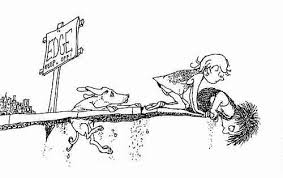 There is a place where the sidewalk ends
And before the street begins,
And there the grass grows soft and white,
And there the sun burns crimson bright,
And there the moon-bird rests from his flightTo cool in the peppermint wind.
Let us leave this place where the smoke blows black
And the dark street winds and bends.
Past the pits where the asphalt flowers grow
We shall walk with a walk that is measured and slow,And watch where the chalk-white arrows goTo the place where the sidewalk ends.
Yes we'll walk with a walk that is measured and slow,
And we'll go where the chalk-white arrows go,
For the children, they mark, and the children, they know
The place where the sidewalk ends.
Poem #2:
The Road Not Taken by Robert Frost_3.jpeg) Two roads diverged in a yellow wood,
Two roads diverged in a yellow wood,
And sorry I could not travel both
And be one traveler, long I stood
And looked down one as far as I could
To where it bent in the undergrowth;
Then took the other, as just as fair,
And having perhaps the better claim,
Because it was grassy and wanted wear;
Though as for that the passing there
Had worn them really about the same,
And both that morning equally lay
In leaves no step had trodden black.
Oh, I kept the first for another day!
Yet knowing how way leads on to way,
I doubted if I should ever come back.
I shall be telling this with a sigh
Somewhere ages and ages hence:
Two roads diverged in a wood, and I-
I took the one less traveled by,
And that has made all the difference.Poem #3:
Nothing Gold Can Stayby Rudyard Kipling_3.jpeg) Nature’s first green is gold,
Nature’s first green is gold,
Her hardest hue to hold.
Her early leaf’s a flower;
But only so an hour.
Then leaf subsides to leaf.
So Eden sank to grief,
So dawn goes down to day.
Nothing gold can stay.
Process
Task 1:
1. Matching the letters (definiton/example) with the numbers (type of poem). Write the letter in the blank next to the number. Listed below the links to help you define the type of poem.
http://www.kathimitchell.com/poemtypes.html
http://www.webexhibits.org/poetry/explore_famous_limerick_examples.html
http://www.chegg.com/homework-help/definitions/epic-poem-39
http://www.kidzone.ws/poetry/haiku.htm
http://www.poetryarchive.org/glossary/ballad
http://www.poets.org/poetsorg/text/poetic-form-sonnet
http://examples.yourdictionary.com/what-are-different-types-of-poems.ht…
Task 2:
1. Read the poems and analyze them by answering all the 5 questions for each poem.
Conclusion
.jpeg)
Congratulations! You've finished this webquest and hopefully you're more aware about the beauty of poetry. So, happy exploring and writing!