
Introduction
Communicable diseases spread from one person to another or from an animal to a person. The spread often happens via airborne viruses or bacteria, but also through blood or other bodily fluid. In this webquest you will work in pairs to make use of internet resources to complete tasks relating to:
-Hepatitis B
- Hepatitis A
- Measles
- And Chicken Pox (varicella).
These are diseases that can affect YOU so it is important that we are able to understand these diseases in order to recognise and treat them if needed! The tasks will involve exploring all four of the diseases as well as learning about internet resources.
---------------------------------------------------------------------------------------------------------
Introduction:
Hepatitis B: Hepatitis B is a viral infection that causes liver inflammation and can lead to serious illness or death.
Hepatitis A: Hepatitis A is a viral disease that affects the liver. It is spread by direct contact with items that have been handled and contaminated with faeces (poo) from an infected person.
Brainstorming questions to get you started: (please discuss in pairs and type up some quick ideas)
- What do you already know about hepatitis?
- What have you heard about hepatitis
- What do you think are the differences between hepatitis A and B?
- Have you ever heard of someone having hepatitis?
- How do you think people catch Hepatitis A and B from one another?
Measles: Measles is a contagious viral illness that causes a skin rash and fever. Serious and sometimes fatal complications include pneumonia and brain inflammation.
Chicken Pox: Chickenpox (varicella) is a highly contagious viral disease caused by the varicella-zoster virus (VZV). The main symptom is a blistering skin rash.
Brainstorming questions to get you started: (please discuss in pairs and type up some quick ideas)
- Have you had/or know someone who has had chickenpox or measles?
- What have you heard about chickenpox?
- What have you heard about measles?
- What do you think are the main differences between chickenpox and measles?
- Do you know what chickenpox looks like on the skin?
- What symptoms do you think come with the measles?
Task
Your job is to work in pairs to investigate websites and locate information needed to answer questions and create a poster. You have three afternoon sessions (1 hour each) to complete the task.
Aims:
- Use websites effectively- explore websites rather than reading first page
- Identify relevant information (work through information to find what you're looking for)
- Work effectively as a team
- Use WORD correctly
- Research own websites
- Stay on task
- Ask for help if needed
Process
1) In your groups of two, you will equally work on the following steps to complete your web quest.
Your task is to work through the resources provided to learn about the diseases. You must click on at least two of the links for each disease to address the questions for each disease. EXPLORE the websites- don’t just read the first page that opens. Click on tabs, links, images and EXPLORE. Copy and paste the following headings and questions for each disease into a WORD document. For each question under each disease heading type few sentences to answer, using the resources to find the answers.
Chickenpox:
-what causes chickenpox?
- What are the symptoms of chickenpox?
- How is chickenpox treated?
- When is chickenpox dangerous?
- discuss immunisation
- what do you do if you think you have chickenpox?
Measles:
- What are the causes of measles?
- What are the symptoms?
- How is it treated?
- Is it dangerous/serious?
- Discuss immunisation
- What are the similarities and differences between chickenpox and measles?
- what do you do if you think you have Measles?
Hepatitis A
- What are the causes of Hepatitis A?
- How is it passed on from one person to the next?
- What are the symptoms?
- How is it treated?
- Is it dangerous/serious?
- Discuss immunisation
- what do you do if you think you have Hepatitas A?
Hepatitis B
- What are the causes of Hepatitis B?
- How is it passed on from one person to the next?
- What are the symptoms?
- How is it treated?
- Is it dangerous/serious?
- Discuss immunisation
- What are the differences between hepatitis A and B?
- what do you do if you think you have Hepatitas B?
2. Choose ONE disease: chickenpox, measles, Hepatitis A OR Hepatitis B to create a poster that could be hung around the school to teach kids about the diseases. Use WORD to create your poster and copy and paste images from the links provides titled: images. Use colours for headings and change fonts and sizes to make the poster visually appealing so that people notice it! Use text boxes to break up your poster and make it understandable.
What to include in your poster
1- A SHORT summary of disease that explains what it is (1-2 sentences)
2- Signs and symptoms ( 1-2 sentences or dot points)
3- Pictures of the disease
4- 2 – 5 interesting facts about the disease
** To find your 1 or 2 interesting facts about the diseases, you must RESEARCH ON YOUR OWN. This means you need to find your own website/s with information about the diseases. You may use google to search but do not use Wikipedia or Youtube. You are also more than welcome to use the internet to find different pictures**
RESOURCES (COPY AND PASTE THE LINKS INTO THE WEB ADDRESS LINE)
Chickenpox
http://www.health.nsw.gov.au/Infectious/factsheets/Pages/Chickenpox.aspx
http://www.betterhealth.vic.gov.au/bhcv2/bhcarticles.nsf/pages/chickenpox
Images: http://www.cdc.gov/chickenpox/about/photos.html
Measles
http://www.betterhealth.vic.gov.au/bhcv2/bhcarticles.nsf/pages/measles
http://www.cdc.gov/measles/resources/parents-caregivers.html
http://www.ncirs.edu.au/immunisation/education/mmr-decision/symptoms.php
Images: http://dermatology.about.com/od/infectionvirus/ig/Measles/
Hepatitis A
http://www.betterhealth.vic.gov.au/bhcv2/bhcarticles.nsf/pages/Hepatitis_A_affects_the_liver
http://www.healthywa.wa.gov.au/Healthy-WA/Articles/F_I/Hepatitis-A
http://www.webmd.com/hepatitis/hepa-guide/digestive-diseases-hepatitis-a
Images: http://www.webmd.com/hepatitis/ss/slideshow-hepatitis-overview
Hepatitis B
http://www.betterhealth.vic.gov.au/bhcv2/bhcarticles.nsf/pages/Hepatitis_B_the_facts
http://healthywa.wa.gov.au/Healthy-WA/Articles/F_I/Hepatitis-B
http://www.mayoclinic.org/diseases-conditions/hepatitis-b/basics/definition/con-20022210
Images: http://www.medicinenet.com/image-collection/hepatitis_b_picture/picture…
Evaluation
RUBRICK
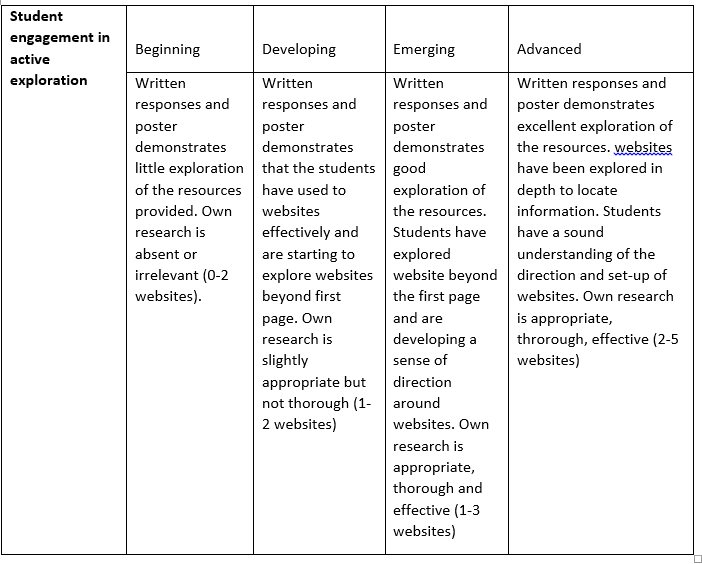
|
Creation of posters |
Poster illustrates some relevant information. Use of word, images, font , sizing and text has little to no effect and use. |
Poster illustrates some relevant information. Use of word, images, font , sizing and text has little to some effect and use. |
Poster illustrates good level of relevant information. Use of word, images, font , sizing and text has good effect and use. |
Poster illustrates relevant information in depth. Use of word, images, font , sizing and text has a high level of effect and use.. |
|
Student written responses to answers |
Written responses show little to no correct answers. The responses have several spelling and grammatical errors. |
Written responses show basic understanding with some correct answers. The responses have some spelling and grammatical errors. |
Written responses show good understanding with mostly correct answers. The responses have some to no spelling and grammatical errors. |
Written responses deep understanding with all correct answers. The responses have very little spelling and grammatical errors. |
Conclusion
CONCLUSION
WELL DONE! Through the web quest you have learned all about the following diseases disease: chickenpox, measles, Hepatitis A and Hepatitis B. You have also learned about websites and used your own exploring to navigate websites and research your own webpages.
ONE LAST TASK.
Before we finish, answer these questions in pairs and type up 1-2 sentences for each answer. These are the same discussion questions you were given with your introduction.
Hepatitis A and B
- What do you know about hepatitis?
- What have you heard about hepatitis
- What do you think are the differences between hepatitis A and B?
- Have you ever heard of someone having hepatitis?
- How do you think people catch Hepatitis A and B from one another?
Chicken pox and measles
- Have you had/or know someone who has had chickenpox or measles?
- What have you heard about chickenpox?
- What have you heard about measles?
- What do you think are the main differences between chickenpox and measles?
- Do you know what chickenpox looks like on the skin?
- What symptoms do you think come with the measles?
Next- discuss with your partner how much your thoughts and knowledge has changed. How much have you learnt? Now we will have a class discussion and each group needs to tell the class at least one thing they previously thought before the web quest- and what they have learned now.
Teacher Page
Curriculum links
Health and Physical Education
Being healthy, safe and active
Investigate community resources and strategies to seek help about health, safety and wellbeing (ACPPS053)
Plan and practise strategies to promote health, safety and wellbeing (ACPPS054)
Contributing to healthy and active communities
Investigate the role of preventive health in promoting and maintaining health, safety and wellbeing for individuals and their communities(ACPPS058)
English
Expressing and developing ideas
Identify and explain how analytical images like figures, tables, diagrams, maps and graphs contribute to our understanding of verbal information in factual and persuasive texts(ACELA1524)
Investigate how vocabulary choices, including evaluative language can express shades of meaning, feeling and opinion (ACELA1525)
Understand how to use banks of known words, word origins, base words, suffixes and prefixes, morphemes, spelling patterns and generalisations to learn and spell new words, for example technical words and words adopted from other languages (ACELA1526)
Literature and context
Make connections between students’ own experiences and those of characters and events represented in texts drawn from different historical, social and cultural contexts(ACELT1613)
Examining literature
Identify, describe, and discuss similarities and differences between texts, including those by the same author or illustrator, and evaluate characteristics that define an author’s individual style (ACELT1616)
Creating literature
Create literary texts that adapt or combine aspects of texts students have experienced in innovative ways (ACELT1618)
Interacting with others
Participate in and contribute to discussions, clarifying and interrogating ideas, developing and supporting arguments, sharing and evaluating information, experiences and opinions (ACELY1709)
Interpreting, analysing, evaluating
Use comprehension strategies to interpret and analyse information and ideas, comparing content from a variety of textual sources including media and digital texts (ACELY1713)
Creating texts
Use a range of software, including word processing programs, learning new functions as required to create texts (ACELY1717)
General capabilities:
ITC:
- Applying social and ethical protocols and practices when using ICT
- Investigating with ICT
- Creating with ICT
- Communicating with ICT
- Managing and operating ICT
LITERACY:
- Text knowledge
- Grammar knowledge
- Word knowledge
- Visual knowledge
CRITICAL AND CREATIVE THINKING
- Inquiring – identifying, exploring and organising information and ideas
- Generating ideas, possibilities and actions
- Reflecting on thinking and processes
- Analysing, synthesising and evaluating reasoning and procedures
TEACHER RESOUCRES: (RUBRIC TEMPLATE FOR MARKING) http://www.rubrics4teachers.com/rubric_general_inquiry.php
You can also visit http://rubistar.4teachers.org/ to make a rubric using online tools.
webquest advice: http://webquest.org/index-create.php)