
Introduction
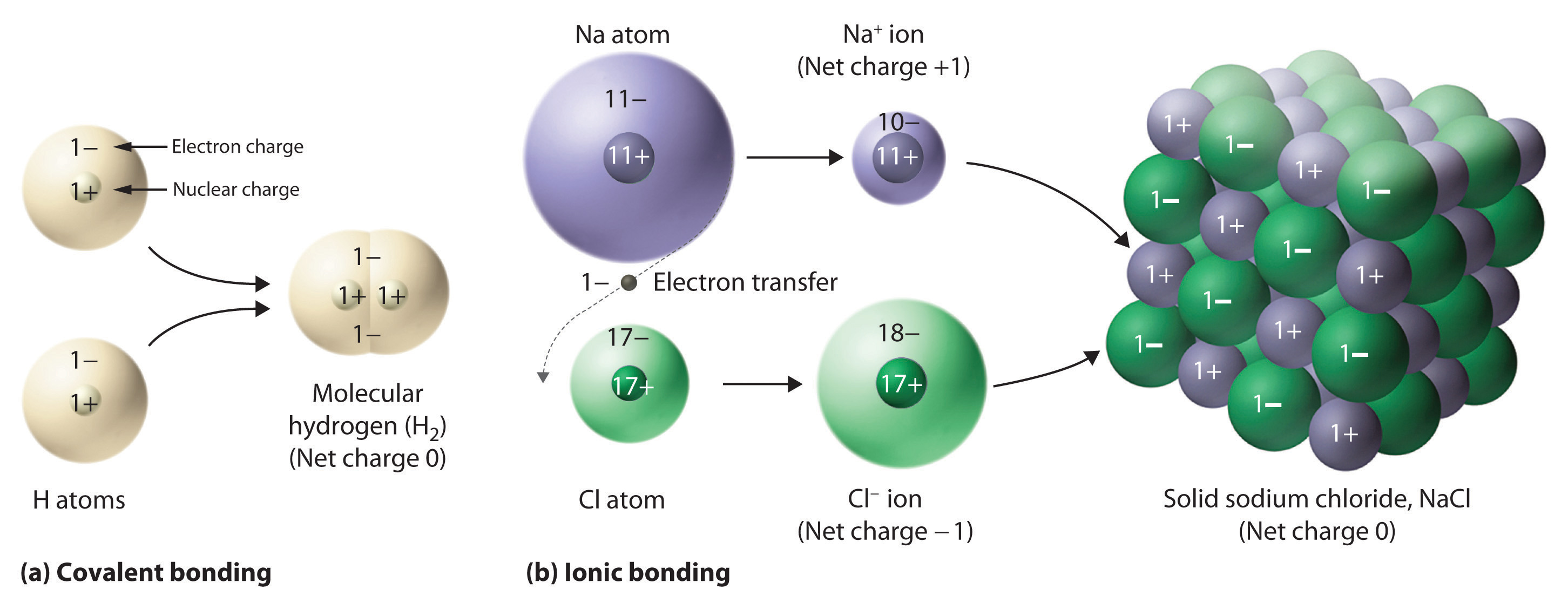
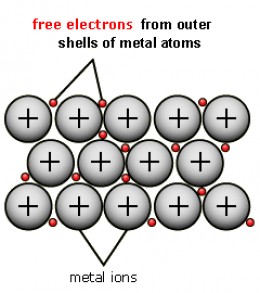
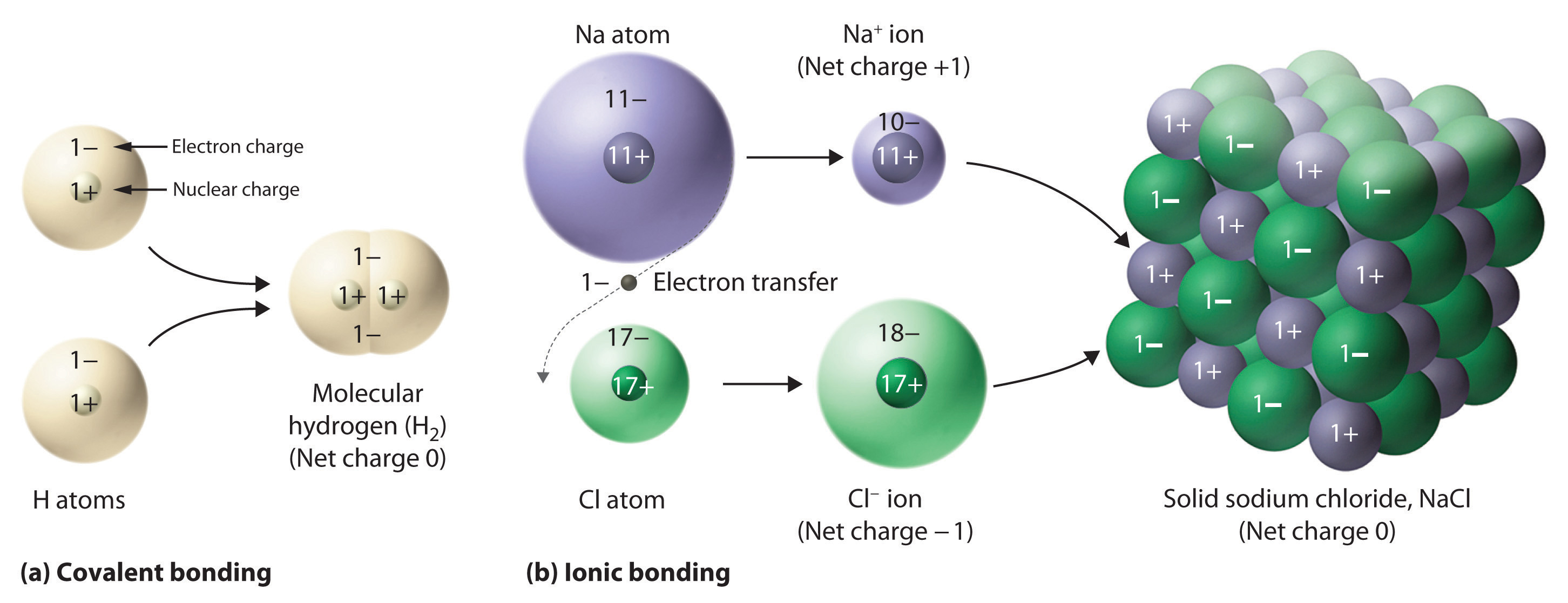
There are different types of bonds in chemistry.
We have Ionic Bonds. Those are between postive and negative ions. Or simply put, metals and nonmetals. Needless to say, they don't like to share electrons. Instead they "transfer" the electron.
Then there are Covalent Bonds. Those are between negative ions, or nonmetals. Here the electron is shared between the nonmetals since theses elements love electrons so much they have to learn to share.
Finally we have Metallic Bonds.This is between metals. In this case, we are dealing with a 'sea of electrons'.
Task
Go to this website to learn all about Ionic Bonding http://www.teachersdomain.org/asset/lsps07_int_ionicbonding/
This website will explain Covalent Bonding http://www.teachersdomain.org/asset/lsps07_int_covalentbond/
Your mission is to create a video/vine explaing the nature of bonding.
Find some friends to help, and give your friends new names like Sodium, Chlorine, Hydrogen, Oxygen, Carbon, Flourine, Potassium, Neon, Magnesium, Zinc.
Trick them by telling them they are going to a "Bonding Party". The more friends the better. You should have more than one Hydrogen, Chlorine, Carbon etc.
Process
You must create the following compounds using your friends:
NaCl
MgCl2
O2
H2O
HCl
CCl4
CCl3F
CH4
How are you going to show the transfer or sharing of the electron?
How is the viewer going to know what elements are bonding?
After you have created these compounds, show me what happens when you mix these compounds with other elements or compounds.
1. What happens when you mix HCl and Mg? What is occuring when they are being mixed? What compounds are created?
2. What type of interaction will occur between Neon and Hydrogen? Explain.
3. What element can seperate O2? Show this in your video.
4. How would you seperate NaCl? Explain the process.
Evaluation
|
Points |
4 |
3 |
2 |
1 |
|
Voice - Consistency |
Voice quality is clear and consistently audible throughout the presentation. |
Voice quality is clear and consistently audible throughout the majority of the presentation. |
Voice quality is clear and consistently audible through some of the presentation. |
Voice quality needs more attention. |
|
Images/Diagrams/ Animation |
Images/Diagrams/Animations are appropriate and help aid in the understanding of your topic |
Images/Diagrams/Animations are appropriate and help aid in the understanding of your topic. The images are mostly appropriate for the task at hand. |
An attempt was made to use appropriate Images/Diagrams/Animations but it needed more work. Image choice is usually logical. |
Little or no attempt to create an appropriate Images/Diagrams/ Animations |
|
Quality of Work |
Provides work of the highest quality. |
Provides high quality work. |
Provides work that occasionally lacks quality. |
Provides work that consistently lack quality |
|
Scientific Knowledge |
Explanations by the student indicate a clear and accurate understanding of their topic. |
Explanations by the student indicate a relatively accurate understanding of their topic. |
Explanations by the student indicate some difficulty in understanding of their topic. |
Explanations by the student indicate little understanding of their topic. |
Conclusion
[video:http://youtu.be/HDw4gk5pYl8]
I hope you were able to fulfill your task and completed the assignment.
Chemicals interact much like you do with your friends and people around you. Sometimes you get along with people and other times you don't. Sometimes the intereactions between people can be violent, while other times there is absolutely no interaction. Could the root cause of how you interact with another person be chemical? Interesting thought isn't it...
Credits
Benchmark for Science Literacy Standards:American Association for the Advancement of Science (1993,2009).Benchmarks online, The Nature of Science. Accessed online Feburary 2015 from
http://www.project2061.org/publications/bsl/online/index.php?chapter=1#…
Krathwohl revision of Bloom's Taxonomy: Wilson, L. (2015). The Second Priciple. Accessed online Feburary 2015 from
http://thesecondprinciple.com/creativity/creativetraits/levels-of-creat…
Metallic Bond Image: http://s1.hubimg.com/u/6192236_f260.jpg

Ionic and Covalent Bond Image: http://2012books.lardbucket.org/books/principles-of-general-chemistry-v…
Teacher Page
APPENDIX 1
This assignment is aligned with The Texas Knowledge and Skills Reporting category 3 titled: Bonding and Chemical Reactions.
This assignment is aligned with the following Benchmarks for Science Literacy:
- Science is based on the assumption that the universe is a vast single system in which the basic rules are everywhere the same and that the things and events in the universe occur in consistent patterns that are comprehensible through careful, systematic study. 1A/H1
- Investigations are conducted for different reasons, including to explore new phenomena, to check on previous results, to test how well a theory predicts, and to compare theories. 1B/H1
APPENDIX 2
The student is allowed to be as creative as possible. They should not be confined to the assignments specification. If a student is able to go above and beyond what is requested they will receive a much higher grade. They are allowed to use any type of medium/media in oder to explain what occurs in chemical bonding. The following section was taken from "The Second Principle" by Leslie Owen Wilson, Ed. D.
Inventive creativity, where ingenuity is displayed with materials, methods, and techniques.
Many artists experiment with their craft, exploring different ways of using familiar tools and mediums. This heralds the third level of creativity, invention. Breaking rules is the order of the day, challenging the boundaries of discipline or academic tradition, and becoming increasingly adventurous and experimental. Inventive creators use academic tradition and skills as a stepping-stone into new frontiers.