
Introduction
Third grade students must learn to tell time to the nearest quarter of an hour. This Webquest reviews the parts of a clock and leads students in building telling time skills.
Telling Time
Telling time is important because people must go places, do things, and complete activities at certain times of day. People use clocks to help them tell the time.


Clocks show time in hours and minutes. There are twenty-four hours in a day and sixty minutes in each hour. The time five-o'clock (5:00) means that five hours have gone by in the day and zero minutes in that hour. The time five-fifteen (5:15) means that five hours have gone by and fifteen minutes. The clock below shows the time 5:15.

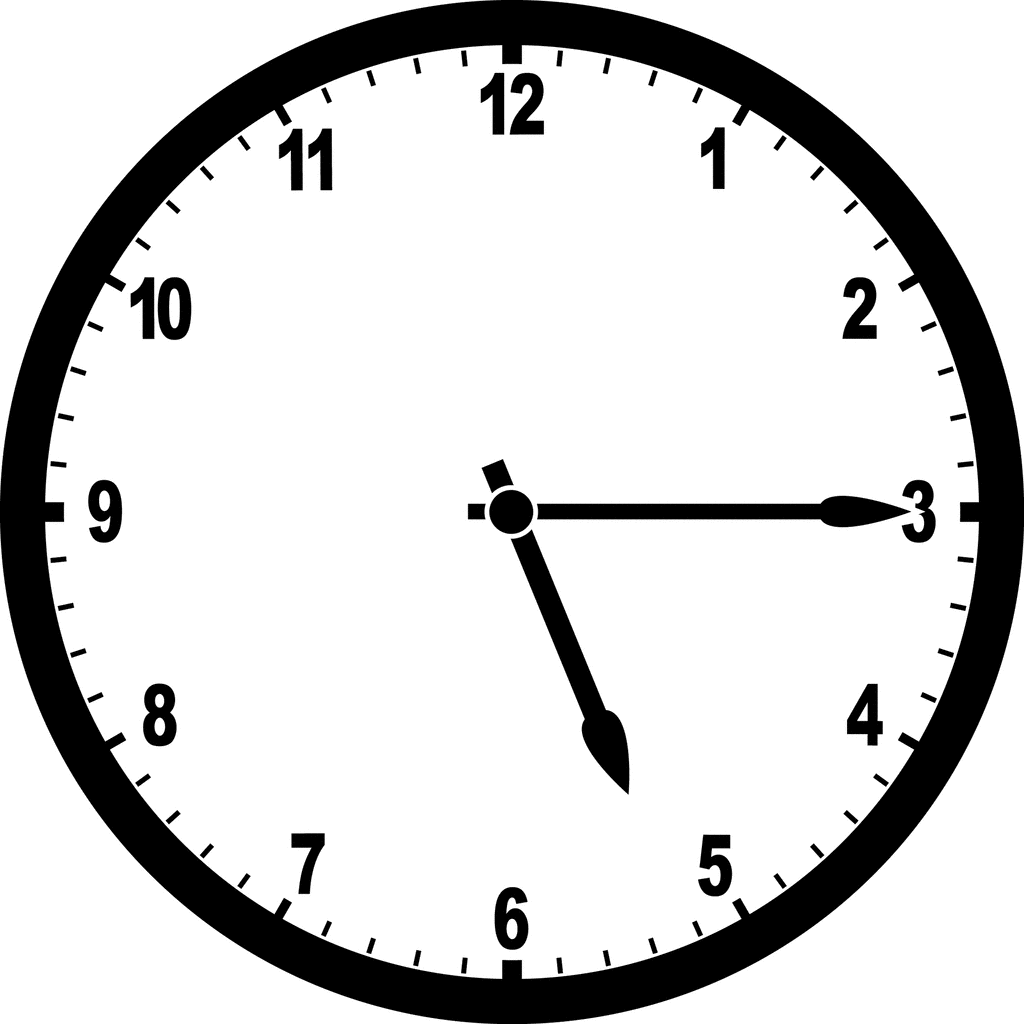
A clock has two hands. The small hand shows the hour of day and the large hand shows the number of minutes that have gone by in an hour.
The hour hand points to the large numbers on a clock. Each number is the hour of the day. If the hour hand is point to the 2 on a clock, the hour is 2.
The minute hand tells you the number of minutes which have gone by in an hour. As the minute hand moves past each of the large numbers on a clock it means another five minutes have gone by. If the minute hand is pointing to the 1, five minutes have gone by. If the minute hand points to the 2, ten minutes have gone by. Look at the illustration below to see how to count five minutes between each number on a clock. You count by fives!

Task
You will complete the following:
- Research telling time by visiting several websites.
- Each website should be visited in the order it is listed on the resources page.
- After completing your research you will go to Paint and open the picture titled Time Picture. You label the blank clock with numbers and draw in hands to show 11:45.
- Go to ThatQuiz and enter the following test code: TILN5582. Complete the twenty-question quiz to show that you know how to tell time. This quiz will be recorded.
Process
Step 1:
Visit each of the Websites below.
Show that you know the numbers that are displayed on a clock by visiting the Website below.
Learning Planet - numbers on the clock
Visit the Website below to see how the hands on a clock move around the clock.
Time for Time - moving hands on a clock, watching the hands move
Step 2:
Visit the two websites below to get practice telling time and moving the hands on a clock to show time.
Set Clock - setting hour hand and minute hand with feedback
Tell Time - telling time to 30 minutes
Smarty Games - telling time to five minutes
ABCya- setting the time independently
Step 3:
After completing your research you will go to Paint and open the picture titled Time Picture in your student file. You will label the blank clock with numbers and draw in hands to show 11:45.
The last part of this WebQuest is to go ThatQuiz and enter the following test code: TILN5582. Complete the twenty-question quiz to show that you know how to tell time. This quiz will be recorded.
Evaluation
Rubric ID: 2123639
|
| CATEGORY | 4 | 3 | 2 | 1 |
| Mathematical Concepts | Explanation shows complete understanding of the mathematical concepts used to solve the problem(s). | Explanation shows substantial understanding of the mathematical concepts used to solve the problem(s). | Explanation shows some understanding of the mathematical concepts needed to solve the problem(s). | Explanation shows very limited understanding of the underlying concepts needed to solve the problem(s) OR is not written. |
| Completion | All problems are completed. | All but one of the problems are completed. | All but two of the problems are completed. | Several of the problems are not completed. |
| Use of Manipulatives | Student always listens and follows directions and only uses manipulatives as instructed. | Student typically listens and follows directions and uses manipulatives as instructed most of the time. | Student sometimes listens and follows directions and uses manipulatives appropriately when reminded. | Student rarely listens and often "plays" with the manipulatives instead of using them as instructed. |
| Diagrams and Sketches | Diagrams and/or sketches are clear and greatly add to the reader's understanding of the procedure(s). | Diagrams and/or sketches are clear and easy to understand. | Diagrams and/or sketches are somewhat difficult to understand. | Diagrams and/or sketches are difficult to understand or are not used. |
| Strategy/Procedures | Typically, uses an efficient and effective strategy to solve the problem(s). | Typically, uses an effective strategy to solve the problem(s). | Sometimes uses an effective strategy to solve problems, but does not do it consistently. | Rarely uses an effective strategy to solve problems. |
| Mathematical Reasoning | Uses complex and refined mathematical reasoning. | Uses effective mathematical reasoning | Some evidence of mathematical reasoning. | Little evidence of mathematical reasoning. |
| Mathematical Terminology and Notation | Correct terminology and notation are always used, making it easy to understand what was done. | Correct terminology and notation are usually used, making it fairly easy to understand what was done. | Correct terminology and notation are used, but it is sometimes not easy to understand what was done. | There is little use, or a lot of inappropriate use, of terminology and notation. |
Conclusion
Congratulations!
You made it through the Telling Time WebQuest assignment. I know that you are now much more comfortable telling time and showing the time. I encourage you to visit the resources part of the WebQuest at home and keep practicing your time telling skills. Thank you for all your hard work!
Credits
ABCya.com, L.L.C. (2011). Learn to tell time. http://www.abcya.com/telling_time.htm
Dinesh, A. (1998). Set Clock. Retrieved fromhttp://www.ezschool.com/Games/SetClock.html
Dinesh, A. (1998). Tell Time. Retrieved fromhttp://www.ezschool.com/Games/TellTime.html
Florida Center for Instructional Technology. (Producer). (2010). 75 cents [Clip art] Retrieved fromhttp://etc.usf.edu/clipart/33900/33909/nclock-05-15_33909_lg.gif
Lyczak, A. (2004). That quiz. Retrieved from http://www.thatquiz.org/
Oswego City School District (Copyright). (2001). Study zone. [Clip art] Retrieved from http://www.studyzone.org/testprep/math4/j/timehr5.gif
Oswego City School District (Copyright). (2001) Study zone. [Clip art] Retrieved from http://www.studyzone.org/testprep/math4/j/halfhourclock.jpg

Planet Interactive Inc. (2011). Learning planet. Retrieved from http://www.learningplanet.com/act/tw/index.asp
Smarty Games. (2011). Tell Time. http://www.smartygames.com/igre/time/clockTest.html
Time for Time. (2004). Time for time. Retrieved from http://www.time-for-time.com/swf/myclox.swf
Teacher Page
Third grade students must learn to tell time. This Webquest reviews the parts of a clock and leads students in building telling time skills.
Teacher Introduction
The WebQuest provides third grade students with practice telling time to five minute increments. It starts with a review of the parts of a clock and moves on to telling time and showing the time with hands. Prior lessons should be taught introducing the parts of a clock and how to tell time. Students without this prior learning will have difficulty completing the tasks part of this WebQuest.
Please note that teachers will need to create their own “blank” clock in Paint and time quiz in www.thatquiz.org. ThatQuiz is a free site for teachers. Once you have registered, you can create quizzes and they will provide you with a code for that particular quiz. Students can then enter that code to complete the quiz. If you set up a class in ThatQuiz you can keep a record of student achievement on any tests you create in the site. I have found it to be a very useful website.