
Introduction

On Earth, elements and compounds are usually found as solids, liquids, or gases. These are called states of matter. Each substance can exist in each of the three states, and each substance has a characteristic temperature and pressure at which it will undergo a change of state.
On the basis of physical state, matter can be classified as solid, liquid, gas and plasma.
Matter has four states that we experience. In order of increasing energy they are: solid, liquid, gas, and plasma. Since temperature is a measure of energy, matter changes from one phase to another as its temperature is increased.
Task
At the end of this lesson, the students' should be able to identify the four states of matter, classify the difference amng them, and give examples of each said states.
Process
Matter:
It is something that occupies space possessing certain mass. Hence all the substances present in this universe are matters.
The Four States of Matter
Solid:
Matter which possesses definite mass , volume and shape are called solids.In this state particles are held very close to each other.These particles have no freedom of movement. Ex: Wood, stone, copper etc.

Liquid:
Matter which possesses definite mass and volume but indefinite shape are called liquid. In this state particles are close to each other and they can move within their volume. Ex: water,Benzene,carbon tetrachloride, kerosene.

Gas:
Matter which possess definite mass but indefinite volume and shape are called gases. In gases particles are far apart as compared to solid and liquid. The particles can move freely from one point to another.Ex: Nitrogen, Oxygen, Carbon dioxide etc.

Plasma:
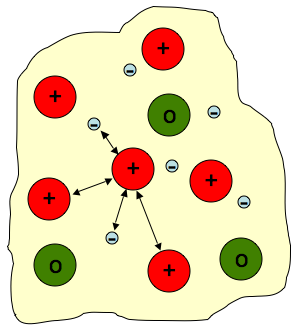
It is a highly ionized gas, made up of almost equal number of positive ions and negative electrons. It is formed only at a extremely high temperature of the order of 50000 C. It is described as the fourth state of a matter.Plasma is believed tobe the main constituent of stars including sun.
Note:
The fifth state of matter is called Bose‐Einstein condensate (BEC). This state occur at the end of the temperature scale at a step above absolute zero Kelvin.
Classification of matter on the basis of composition:
On the basis of the chemical composition matter can be classified as follows.
1. Heterogeneous matter
2. Homogeneous matter
1) Heterogeneous matter:
A substance is heterogeneous if it exhibits different properties at its different position. Different types of heterogeneous matter are
a) suspension
b) colloid
c) heteromixture
2) Homogeneous matter:
A substance is a homogeneous matter if the smallest part of it exhibits the same chemical and physical properties. Ex: Air , Solution of sugar with water, an intimate mixture of two or more than two metals (alloys). Homogeneous matter can be classified into two types.
a) Homogeneous mixtures
b) Pure substances

Evaluation
1. What are the four states of matter?
2. What can you say about their particles?
3. How do they differ from each other?
4. Create a poster about the interaction of the four states.
Conclusion
Matter is a very important part of our life. Evrything you see is a matter, and matter has four states which are the solid, liquid, gas and plasma. As the temperature increases, the state changes.
Solid particles are very close to each other, Liquids have particles that are slightly loose to each other and liquids shape depends on the shape of its container. Gas' particles are far away from each other that's why they can move freely, and Plasma known as an ionized gas, has also particles far away from each other and have a positive and negative ions.
Credits

Teacher Page
This web quest explains the different states of matter so that the students' will understand its concepts.