
Introduction
You have been selected to partake in a tropical exploration of the Everglades! Zoologists and Wildlife Biologist, life scientists who study animals and their natural interactions, want you to explore the Florida Everglades' animals and unique United States habitat. These scientists are looking for your information to use in the next National Geographic Magazine!
Get ready for an exciting adventure into the Everglades.
Task
Here is your task overview:
Students will form in groups of three. Each student will pick one animal to research and investigate the type of natural habitat it survives best in.
Students will then use the given websites and articles to learn more about the Florida Everglades and the struggles that surrounds the animals.
It is crucial to provide detailed descriptions of the animals, their habitat, and ways we can improve their surroundings. National Geographic is looking for their next issue on the Everglades and want Ms. Roberts's Fifth grade class to do it!! Do your best!!
Process
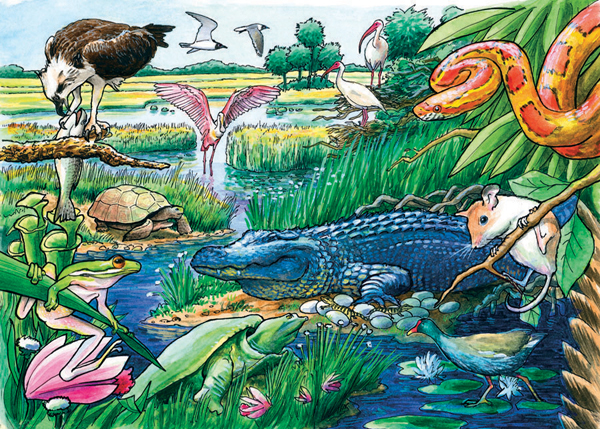
Begin at The Everglades National Park at http://www.nps.gov/ever/welcome2.htm. On the home page, click on "Everglades Ecosystem". Select three animals in the Animal Profiles and answer the following questions:
- What is the name of the animal?
- What kind of animal is it?
- Is this animal endangered?
- Write an additional interesting fact that you have learned about each of them.
Remember, each student must select their own animal to research. National Geographic wants a magazine on a collection or variety of wildlife in the Everglades!!
Provided below are mulitple websites you can use for additional information:
wildswi.org
a-z-animals.com
animalfactguide.com
Now that you have picked your three animals, it's time to do some extensive research. The Biologist want you to gather information on the habitats that your animals survive best in and the threats that may harm them.
Return to The Everglades Ecosystem and click on "Everglades Habitat". Read about the Everglades habitat and write a descriptive paragraph about the area and how it supports widlife. Feel free to use the following websites that may give you additional information:
http://www.nationalparks.org/explore-parks/everglades-national-park
http://whc.unesco.org/en/list/76
Next go to the site Lost Wetlands at seawifs.gsfc.nasa.gov/OCEAN_PLANET/HTML/peril_wetlands.html
Click on "Everglades" on this home page and identify two developments that are disturbing or destroying the Everglades. In your opinion, are they solvable? Provide facts to support your answer.
Evaluation
Wildlife in the Everglades Project Rubric
|
||||||||||||||||||||||||||||
|
Additional Comments:
Conclusion

Congratulations!!!
You have completed the Everglades exploration. Your project will now be reviewed by your teacher and if any students are interested, they can present them to their peers.
Enjoy your new knowledge of The Everglades!!
Credits
WebQuest Resources
http://www.nextgenscience.org/search-standards-dci?tid_1%5B%5D=10&field_idea_tid%5B%5D=111&=Search
seawifs.gsfc.nasa.gov/OCEAN_PLANET/HTML/peril_wetlands.htm
http://www.nps.gov/ever/welcome2.htm.
http://www.nationalparks.org/explore-parks/everglades-national-park
Teacher Page
Teacher's Notes
The Everglades Teacher's Notes Grade Levels: 5–8 Learning Objectives:
- Learn about the wildlife in the Everglades
- Find relevant information on a Web site
- Write a descriptive paragraph based on research
- Analyze information
- Present an argument based on information
Time Required: 2–3 class sessions
NGSS
3. LS4-3 Construct an argument with evidence that in a particular habitat some organisms can survive well, some survive less well, and some cannot survive at all.
5-ESS3-1 Obtain and combine information about ways individual communities use science ideas to protect the Earth’s resources and environment.
ESS3.C Human Impacts on Earth System- Human activitities in agriculture, industry, and every day life have major effects on the land, vegetation, streams, ocean, air, and even outer space.
W.3.2 Write informative/ explanatory texts to examine a topic and convey ideas and information clearly.