
Introduction
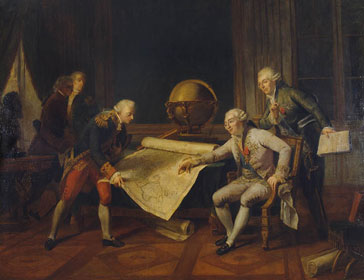
Nicolas-André Monsiau
1754–1837
Louis XVI giving his instructions to the Comte de La Pérouse
(Louis XVI donne ses instructions au
Capitaine de vaisseau La Pérouse)
1817 (detail) oil on canvas
172.0 x 227.0 cm
Versailles, musée national du château (Inv. MV 220)
Early French explorers and Australia
The British occupation and colonisation of Australia have obscured the significant role
of the French in the Europeon discovery, charting and documentation of the mysterious
land mass known in the eighteenth century as New Holland, as well as its flora,
fauna and human inhabitants. France was a leading centre of the Enlightenment which exalted
empirically gathered knowledge of nature in all its manifestations and the use of reason to
better understand and improve the universe. As the hallmarks of civilised society, these ideals
shaped exploration, replacing at least in part both commercial and political motivations.
The publication by the Philosophe Charles de Brosses of a two-volume book, Histoire des
navigations aux Terres Australes, in 1756 – summarising all thus far discovered about the
southern seas, including the explorations by Abel Tasman and William Dampier – fuelled
scientific and expansionist endeavour and was probably decisive in Louis XV’s decision to
support an exploratory expedition.1 Rivalry between England and France cannot be dismissed
as a contributing motivation, spurred on by news of Captain James Cook’s ‘discovery’ of the
east coast of Australia in 1770. Beginning with Louis XV, French rulers pursued a policy of
exploration of ‘Terre Australe’ that focused as much on scientific study of the land and its
inhabitants as on charting its coastline.
Louis XVI (1754–1793), who ascended to the throne at his grandfather’s death in 1775, was a
keen geographer, an avid reader of the accounts of Captain Cook’s voyages and a determined
rival of Britain’s maritime supremacy. In 1785, he commissioned Jean-François de Galaup,
Comte de La Pérouse (1741–1788), to circumnavigate the Pacific – an undertaking for which
public enthusiasm ran high. While Australia had always been intended as the final stop of La
Pérouse’s itinerary, Louis XVI was made anxious by news of the departure from England of
Arthur Phillip with the first prisoners destined to colonise Botany Bay. La Pérouse was then
asked by dispatch to proceed there in all haste. He sailed into Botany Bay on 26 January 1788,
only days after Phillip and the First Fleet had arrived there to establish the first European colony
in Australia. After spending six weeks in Botany Bay, La Pérouse set sail to New Caledonia, and
he and his ships were never seen again.2 Fortunately, his journal, charts and other papers were
dispatched to France before his disappearance.
A party led by Joseph-Antoine Bruny d’Entrecasteaux was sent in search of La Pérouse in 1791;
while unsuccessful in that venture, it nevertheless added substantially to the scientific knowledge
and charting of south-western Australia and Tasmania. As a student at the prestigious École
Militaire, the fifteen-year-old Napoleon apparently sought to join La Pérouse’s expedition to
the South Seas, demonstrating an early passion for exploration and science. It is not surprising,
then, that as First Consul Napoleon supported Nicolas Baudin’s now famous expedition to
Australia in 1800 (p. 139).3 The scientific and cartographic achievements of this expedition
added immeasurably to the sum of knowledge of the Terres Australes. Although the British first
claimed and colonised Australia, it was the French who fully embraced and made known the
richness and diversity of life in this land.
Elizabeth Cross
Task
- You are to create a timeline of the French exploration of the pacific
- You are to map the race between Boudin and Flinders using Prezi (https://prezi.com/signup/public/) NB use your College email and login
- Choose a French Explorer of the Pacific, and write a biography suitable for Year 6 students, including
- basic background (date of birth, where he grew up, etc)
- what inspired his voyage
- where did the voyage take him
- interesting facts
- map his journey
- how did he die
Process
This section of work will involved different quest to find the relevant information.
1. Watch the French Explorers https://www.youtube.com/watch?v=5g2rlpnW65E
2. Watch on 'Clickview': 'The Race. The Navigators - Boudin Vs Flinders: Part 1' - during double lesson
3. Explore the following websites to gather information on French Explorers for the Biography task.
- http://www.sl.nsw.gov.au/discover_collections/society_art/french/
- http://www.abc.net.au/navigators/ships/default.htm
- http://www.woodsidevalleyestate.com.au/about01.php
- http://www.australiaonthemap.org.au/landings-list/
- http://www.australiassouthwest.com/experiences/History/Explorers_and_Settlement/European_Explorers
- http://adb.anu.edu.au/biography/freycinet-louis-claude-desaulses-de-2226
Evaluation
CRITERIA |
A |
B |
C |
D |
E |
|
Meaning and relevance, organisation |
Totally clear |
Readily comprehensible |
Essential meaning conveyed |
Meaning disjointed |
Some meaning only |
|
Research skills of Explorer |
Commands a wide and detailed range of research skills |
Ready use of a wide range of research skills |
Appropriate display of familiar research skills |
Can display some research skills |
Produces few isolates and narrow range of research skills |
|
Presentation of Prezi PowerPoint, mapping and meeting points |
Completely accurate with some errors
|
Accurate with some errors
|
Fairly accurate with some errors that do not impede meaning
|
Some accuracy with many errors
|
Very little accuracy
|
|
Accuracy of timeline |
Completely accurate with some errors |
Accurate with some errors |
Fairly accurate with some errors that do not impede meaning |
Some accuracy with many errors |
Very little accuracy |