
Introduction
As advanced insects, butterflies and moths have a "complete" life cycle. This means that there are four separate stages, each of which looks completely different and serves a different purpose in the life of the insect.
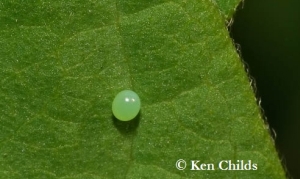
The egg is a tiny, round, oval, or cylindrical object, usually with fine ribs and other microscopic structures. The female attaches the egg to leaves, stems, or other objects, usually on or near the intended caterpillar food.
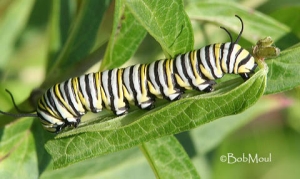
The caterpillar (or larva) is the long, worm-like stage of the butterfly or moth. It often has an interesting pattern of stripes or patches, and it may have spine-like hairs. It is the feeding and growth stage. As it grows, it sheds its skin four or more times so as to enclose its rapidly growing body.
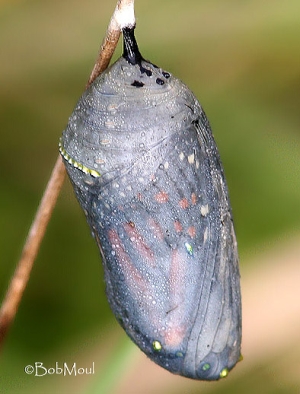
The chrysalis (or pupa) is the transformation stage within which the caterpillar tissues are broken down and the adult insect's structures are formed. The chrysalis of most species is brown or green and blends into the background. Many species overwinter in this stage.
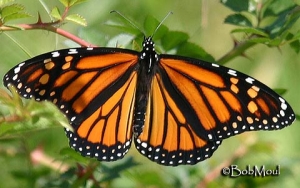
The adult (or imago) is colorful butterfly or moth usually seen. It is the reproductive and mobile stage for the species. The adults undergo courtship, mating, and egg-laying. The adult butterfly or moth is also the stage that migrates or colonizes new habitats. The butterfly pictured here is a Monarch, which is fairly large in size. The Monarch's wingspan is 3 3/8 - 4 7/8 inches (8.6 - 12.4 cm).
Task
You will be working collaboratively during this unit as you learn all four stages of the butterfly life cycle by viewing video clips, and reading stories.
At the end of the unit, you will be creating a butterfly life cycle diagram showing the different stages of the butterfly (egg, caterpillar, pupa, and butterfly) and explaining true facts about each stage.
Before moving on, can you tell your group the first stage of the life cycle? What is the second stage? How about the third stage? And, finally, what is the fourth stage? What is the scientific name for a caterpillar?
Remember to take notes in your science journal as you complete the Web Quest. Let's start our journey...
Click on the "Process" tab on the left to move forward.
Process
Are you ready? It is time to explore the butterfly life cycle.
Step 1: With your group, click on the National Geographic video clip below (#1). You will be introduced to the four stages of the butterfly life cycle as well as how the butterfly lives in its habitat. After watching the video, write one fact that you have learned and one questionor wonderingthat you want to know more about in your science journal. You may replay the video if needed.
Step 2: With your group, click on the Life Stages Information link below (#2). Sketch a picture of and label the four stages of the life cycle in your science journal. Write 1-2 facts about each stage. You will use these "notes" to help you create your diagram at the end of the unit.
Step 3: On your own or with your group, click on "The Very Hungry Caterpillar" story by Eric Carle and enjoy the story as it is read aloud. Can you add any more facts in your science journal? Do you have any questions?
Step 4: Test your skills by placing the stages of the butterfly life cycle in the correct order.
You will be using the information you have learned to create a Butterfly Life Cycle Diagram using different shapes of pasta. You will need to label and explain each stage, so you may revisit any of the previous steps if needed.
You have now completed the Web Quest. Your teacher can tell you where to find the supplies and directions you will need to make your Butterfly Life Cycle Diagram. You will use the notes you have writtento help you complete this project.
Evaluation
Butterfly Life Cycle Pasta Diagram
Directions: Using rice (or orzo), macaroni twists, large shell macaroni, and bow tie pasta to represent the four stages of the life cycle, students will create a diagram/poster. All stages should be in the correct order and labeled correctly. Students will use construction paper and other craft supplies to create their “pasta pictures”. Students will use their notes taken to help them create their project. Students should be creative and do their best work!
Rubrics
| QUALITY | |||||
Criteria |
4 excellent |
3 very good |
2 Good |
1 needs imp |
|
Attractiveness |
The diagram is exceptionally attractive in term of design lay out &neatness |
The diagram is attractive in term of design lay out &neatness |
The diagram is acceptable attractive thought it may be a bit messy |
The diagram is distractingly messy or very poorly design it is not attractive |
|
Originality |
Several of the graphics used on the diagram reflect a exceptional degree of student creativity in their creation and display |
One or two of the graphics used on the diagramreflect student creativity in their creation or display |
The graphic are made by the student but are based on the design or ideas of others. |
The graphic are made by the student but based on the design or ideas of others. |
|
Clarity |
Graphics are all in focus and the content easily viewed &identified from 6ft away |
Most graphics are in focus and the content easily viewed &identified from 6ft away |
Most graphics are in focus &the content is easily viewed & identified from 4ft away |
Many graphics not clear or too small |
|
Total |
A, excellent 10-12 ____
B, above average 7-9___
C, below average 6-5___
D, needs improvement 4-0___
Conclusion
Let's make it clearer...
1. When you see butterflies now, will you think of all the different stages they go through to become such beautiful creatures? Would you like to extend your learning about butterflies? There are many websites that give information on how to make butterfly gardens. Or maybe you want to locate a museum that you could visit. Or maybe you want to order some caterpillars and watch them change into butterflies. The possibilities are endless!
2. Could you tell your family and friends the stages of the butterfly's life cycle in order along with at least one important fact about each stage?
3. Do you remember the word that describes the changes that butterflies go through?
4. Do you remember the scientific name for caterpillar?
5. Do you remember the scientific name for chrysalis?
Thank you for going on this journey as we learned about the life stages of the butterfly.
Answers:
2. egg, caterpillar (larva), chrysalis (pupa), butterfly
3. metamorphosis
4. larva
5. pupa
Credits
Teacher Page

Audience: Grade Four
Topic: Butterfly Life Cycle
Pupils will learn the life cycle of the butterfly. A healthy habitat is needed in order for the butterfly to develop and go through its full process of metamorphosis
Authors:
Acoba, Jhonely
Agliam, Jessa MAe
Baguio, MArgie
Balantac, Anneli Jane
Idnay, Leizel Joy
Irorita, Excel
Padron, Maria Luisa