
Introduction
YEAR 9H CARTESIAN PLANE WEBQUEST
Graph, grid, or coordinate plane are all terms for the cartesian plane. Over the next two lessons you will be investigating the cartesian plane and discovering how it can be used to plot linear relationships. You have the option to work in pairs or independently whilst completing this investigation.
 An Interesting Fact:
The cartesian plane was discovered by the French philosopher Rene Descartes. Rumour has it that the idea came to him while he was lying in bed watching a fly crawl on the roof.
Today the Cartesian Plane is used all over the world as a very useful way to plot data.
Task
The Purpose of This Webquest?
At the end of this Webquest you will have learnt the skills necessary to solve the following problem and many others like it:
It's the school holidays and all of little Johnnys friends are going to the beach. Little Johnny has permission off his parents to go, but they are both at work, so he needs to catch a taxi to get there. Little Johnny researches on the internet and finds two taxi companys in the area. One company charges an initial 'flagfall' rate of $4.70 and an added rate of $1.90 per kilometre travelled. The other company charges an initial 'flagfall' rate of $3.50 and an added rate of $2.14 per kilometre travelled. If Johnny knows it is 7 kilometres to the beach, which taxi company will be cheaper and how much money would you recommend for him to take?
Note:
At the end of the Webquest you will be given a worksheet that guides you through solving the above problem. You be formally assessed on your answers.
You have the option to work in pairs or independently to complete the webquest. But you must work independently when completing the final assessment.
Process
Steps to Complete Your Quest!
1. Watch the following video that I have created for you. Pay attention because you will need this knowledge for future steps!
[video:https://vimeo.com/106704122 align:center]
2. Click on the following link and play through the game twice, or once each if you are completing the webquest in pairs!
http://www.math-play.com/Coordinate%20Plane%20Game/Graphing-points-in-the-coordinate-plane.html
3. Click on the link below and play through the game twice, or once each if you are completing the quest in pairs. You need to click on 'All Four Quadrants' to start the game.
http://www.mathsisfun.com/data/click-coordinate.html
4. For the next 10 minutes I would like you to research your own coordinate plotting game.
Did you know: There are many educational games out there for mathematics that you are able to take advantage of for every topic! Do you think these games could be useful for for topics you may struggle with?
5.Now it is time to collect your worksheet from me. I would like you to attempt question 1 and 2 before returning it to me. Remember, this worksheet must be completed independently!
6. If you have run out of time I would like you to complete this for homework otherwise if you have time remaining I would like you to now complete the 'absent kid' task now and post it on your class wiki. Remember that I monitor this Wiki regularly. As a reminder: You must write down in your own words an explanation of the key concepts covered so far in this WebQuest. I will put together the very best explanations as a handout for next lesson. This will serve as a reminder to you of what you have learnt so far in this WebQuest and will help any of your peers who may be absent today.
Note:
You will be marked on your contribution to the wiki!
We will complete the complete the remainder of this WebQuest next lesson! Thank you and have a good afternoon!
LESSON 2
7. After joining your points together on the worksheet last lesson you should have gotten two straight lines, one for each of the taxi companies. I would like you to watch the following video to learn how you can create a general equation for your line!
[video:https://www.youtube.com/watch?v=gvwKv6F69F0 align:center]
8. I hope you were paying attention! Now I would like you to click on the link below and play the game until you collect four coins! Some of the concepts covered in the video were difficult, so if you need help now is the time to ask me!
http://www.quia.com/cz/43443.html?AP_rand=1024611676
9. I would now like you to collect your worksheets from me and answer the remaining questions. I will stop you when there are 10 minutes left in the lesson so you can complete the final WebQuest activity. If you have not finished the worksheet you will be allowed to take it home, but it is to be handed in fully completed next lesson.
10. For your final task, I would like you to spend the last 10 minutes researching on YouTube. I would like you to find an instructional video, like the two you have seen above, that talks about the most difficult aspects of todays activities. I would like you post your link in the class wiki so that everyone can benefit from your research skills.
https://www.wikispaces.com/
11. If you finish early, please enjoy this video.
[video:https://www.youtube.com/watch?v=_dqQb8iZtS4 align:center]
Evaluation

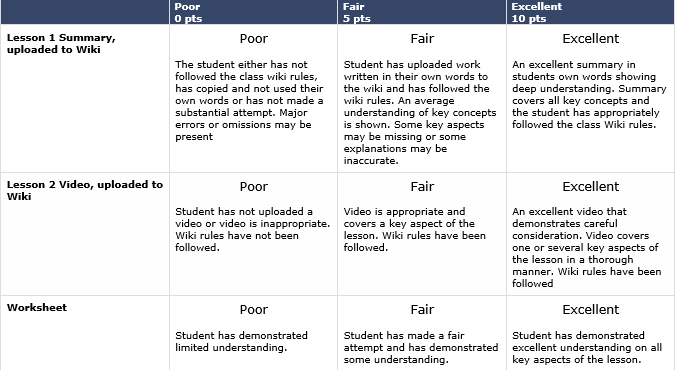
The following rubric will be used to evaluate your WebQuest! Please take a careful look at it, notice that your efforts towards the class wiki are each worth the same as the worksheet!
Conclusion
Congratulations on finishing your WebQuest and discovering how to help Johnny get to the beach!
Next lesson we will continue our work on cartesian planes and learn more about how we can use linear equations! We will also refine the knowledge you have discovered in this WebQuest.
If you have time I would like you to complete this quick survey so I can create more interesting lessons for you in the future!
https://www.surveymonkey.com/s/MXCCQRZ
Credits
References
ACARA. (2012, March 25). The Australian Curriculum: Mathematics. Retrieved from http://www.australiancurriculum.edu.au/SeniorSecondary/mathematics/essential-mathematics/RationaleAims
Anthony, G., & Walshaw, M. (2009). Characteristics of effective teaching mathematics: A view from the west. Journal of Mathematics Education, 2(2), 147-164.
Kahn Academy. (2006). Retrieved October 1, 2014, from https://www.youtube.com/watch?v=gvwKv6F69F0
Keeler, A. (2000). Quia. Retrieved October 1, 2014, from http://www.quia.com/cz/43443.html?AP_rand=1024611676
Mishra, P., & Koehler, M. (2006). Technological pedagogical content knowledge: A framework for teacher knowledge. The Teachers College Record, 108(6), 1017-1054.
Passy. (2014, October 5). Retrieved from http://passyworldofmathematics.com/the-cartesian-plane/
Pierce, Rod. (20 Jan 2014). "Hit the Coordinate". Math Is Fun. Retrieved 14 Oct 2014 from http://www.mathsisfun.com/data/click-coordinate.html
Popovici, D. (2010). Math-Play. Retrieved October 1, 2014, from http://www.math-play.com/Coordinate%20Plane%20Game/Graphing-points-in-t…
Prensky, M. (2001). Digital natives, digital immigrants part 1. On the horizon, 9(5), 1-6.
Teacher Page
Outcomes - Australian Curriculum (Year 9)
- Graph simple non-linear relations with and without the use of digital technologies and solve simple related equations (ACMNA296)
- Sketch linear graphs using the coordinates of two points and solve linear equations (ACMNA215)
- Find the gradient of a line segment (interval) on the Cartesian plane using a range of strategies, including graphing software (ACMNA294)
Lesson Overview
Lesson 1 - Approximately 40 minutes
The students briefly cover the cartesian plane in year 8. This lesson is designed to remind students of what they should already know and to extend on concepts. The video is an original creation that is designed to teach students the most important concepts of the lesson in an interesting an engaging manner. The video caters for visual and audio learners and should take the students no more than 5 minutes to complete.
The students then spend approximately 10 minutes playing the two games provided for them, these games were chosen especially to engage the kinesthetic learners and to reinforce the key skill of plotting coordinates. Students will need to know how to plot points for all future lessons.
The students are then given 10 minutes to research their own co-ordinate plotting game. This activity was chosen to give students the opportunity to learn what educational resources are out there for them to take advantage of if they are struggling. Games based mathematics learning is popular and there are free games tha cover almost every topic.
The worksheet should take about 5-10 minutes. It was designed to scaffold and consolid. Tate the students learning. It's purpose is to help the students become aware of anything they may be struggling with from the lesson. It also helps me to direct future lessons.
The final activity should take about 5 minutes, but the buffer is given for the students to complete the activity for homework if anything runs over time. In this activity the students are given the opportunity to demonstrate their understandig of the lesson. The aim is for students to create original explanations and in doing so to engage with the higher levels of thinking. It is an activity which I use frequently within the classroom, it is generally an excellent formative assessment for both myself and the students.
Lesson 2 - Approximately 40 minutes
The lesson similarly begins with students watching a video to learn the key concepts of the lesson, then follows with one game. This should take about 15 minutes. Afterwards the students spend about 15 minutes completing their worksheets. These initial tasks are designed to cater for all learning styles and to help scaffold student learning, similarly to lesson 1.
10 minutes is left at the end for students to complete the video task. This task was designed to encourage students to critically analyse media and to also become aware of what tools are out there to help them with their learning. Students are required to critically evaluate the video of their choice and deem it to be acceptable before posting it onto their class wiki.
Rationale
Prensky (2001) states that the younger generations are digital natives that have an inherent set of digital skills. These skils need to be encouraged in the classroom to enable proactive student engagement.Throughout the two lessons digital and games based skills have been used, taking into account technological, pedagogical and content knowledge, to create a thouroughly engaging lesson (Mishra & Kohler, 2006).
Digital natives have grown up in a fast paced over stimulating world and tend to prefer graphics over text (Prensky, 2001). The videos, interactive games, opportunity to use a class wiki and task of searching for their own video all provide real opportunities for student engagement in an increasingly fast paced world. The original video and worksheet creation provide highly engaging support and structure to the students work. Appropriate scaffolding is provided with the activities slowly building up in difficulty and the option for students to consolidste their knowoedge through the worksheet and rewatch videos as required.
Multiple literacies has been explored throughout the lessons to engage students and encourage critical thinking. The second lesson, where students are asked to find their own video and post it on the class wiki, particularly addresses this. Students must appreciate and critique the videos they are watching and deem them suitable. All students in the class will have previously signed the Acceptable Usage Policy as outlined by the NSW DET (2006) to ensure safe and appropriate ICT usage.
The lessons were created using multiple different technologies; videos, games, YouTube, wiki, and such promote high levels of engagement in a multiliteracy world (Prensky, 2001). As well as containing high levels of engagement the lessons also display many other elements of the Quality Teaching Model. Higher order thinking is promoted in the tasks that require critical analysis and creating; YouTube search and 'absent kid' tasks. High amounts of student self-direction are also demonstrated, with students working through tasks without direct teacher instruction, high expectations are attained through the rubric. Significance is also attained with students working through a taxi problem that relates to their life outside the classroom.
Overall the lessons blend well together, taking into account quality teaching and mulitliteracy awareness, to form a fantastic computer based set of mathematics lessons!