
Introduction
Welcome to this new topic, "Hardenability Testing of Steels for Product Qualification Purposes". You are on your way to becoming the materials engineering technician that you have always desired to be. Previous topics have introduced you to the concept of hardness testing for various engineering materials, and you have carried out hands-on hardness measurement. However, this current topic deals with another parameter that is related to hardness measurement, which is called "hardenability". The background information in this introduction will help you to understand the meaning of hardenability and the purpose of determining the hardenability of steels. The task that is assigned to you and the details of the testing procedure are presented in subsequent sections.
Background Information
The influence of alloy composition on the ability of a steel alloy to transform to martensite for a particular quenching treatment is related to a parameter called hardenability. For every different steel alloy there is a specific relationship between the mechanical properties and the cooling rate. Hardenability is used to describe the ability of an alloy to be hardened by the formation of martensite as a result of a given heat treatment and a specified cooling rate. The purpose of this testing is to know the mechanical strength obtainable in a particular steel and to the determine the type(s) of application for the steel.
The heating and cooling treatment of a steel specimen have great effects on the phases formed in the steel specimen, and consequently the hardenability. Other factors that influence hardenability include the addition of alloying elements and the coarsening of the grain structure, which increase the hardenability of steel. Any steel that has low critical cooling rate will harden deeper than one that has a high cooling rate of quenching. The size of the part that is being quenched also has a direct effect upon the hardenability of the material.
One standard procedure that is widely utilized to determine hardenability is the Jominy end quench test. In this test, hardness is measured along the flat surface of a Jominy specimen (to be described later) and the hardness readings are plotted versus distance from the quenched end.
Your Role
Now that you are familiar with hardenability, your role as you progress through this lesson is to work as part of a team of professionals carrying out various mechanical and chemical analysis on a newly developed steel. Specifically, your task is to carry out hardenability testing for the new alloy. The scenario is described in more details in the "task" section of this lession.
At the end of this lesson, you should be able to
a. explain the meaning of hardenability.
b. describe the purpose of hardenability testing.
c. identify the steps required in carrying out hardenability testing.
d. perform the task of hardenability testing using the standard procedures described in this lesson.
e. collate, plot and analyze hardenability test data.
f. document hardenability test results.
You are required to review the online reference manual provided in the link below before proceeding into the next section. The link contains the information that you need to work safely in a laboratory environment. Conformance to the safety guidelines is mandatory.
http://www.hc-sc.gc.ca/ewh-semt/pubs/occup-travail/ref_man/ref_manual_index-eng.php
Task
Let us begin by assigning a task to you. Your task is presented as a case scenario. Using a case scenario would help you to put yourself in situation similar to what you would experience in your daily work life. It is expected to assist you to view the task as a practicable and relevant adventure.
Your Task
You are a testing technician with Company XYZ. Company XYZ performs materials testing and product qualification in Manitoba. Your company just landed a new contract with a Manitoba-based alloy developer to carry out detailed mechanical analysis on their new alloy in order to determine the properties, and subsequently the expected performance. Also, newly developed alloys cannot be commercialized without a fact sheet containing various properties of the alloy. The properties contained in the fact sheet will enable design engineers to deternine the types of application that the new alloy would be useful for. Working as part of a larger team, you are required to evaluate the hardenability of this new steel product. The new product must be tested based on American Society for Testing and Materials (ASTM) standards. The developer has specified that they want your company to use the Jominy End Quench Test which is part of ASTM A255 - 10 for evaluating the hardenability of the alloy. You are the test technician in charge of hardenability testing for Company XYZ and you have the task of provinding the hardenability data for the new alloy as part of your company's collective effort. Your work will be a major input to the final report that Company XYZ will present to their client.
In order to assist you in completing this task, a step-by-step procedure is provided for you in the next section (Process). Additionally, you will find many links to useful resources that can help you during the complettion of your task, including a link to the ASTM A255 - 10 (Standard Test Methods for Determining Hardenability of Steel)
Process
PROCESS
A complete description of the procedure for the Jominy End Quench Test is provided as follows.
Equipment:
Electric furnace
Jominy End Quench Test Fixture
Jominy Specimens (Made as per ASTM standard)
Rockwell Hardness Testing Machine
Procedure:
1. Preheat the furnace to 1700 oF.
2. Place the Jominy specimen in the furnace and soak for one hour.
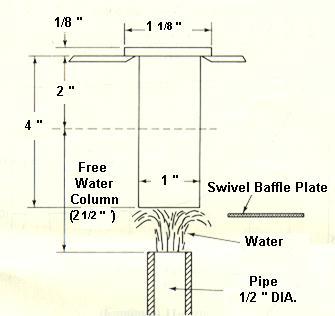
3. Turn the water on at the Jominy sink. Adjust the free water column to about 2.5 in. Swivel the baffle plate to block the water column so that there is no contact between water and the test specimen when the test specimen is initially placed on the fixture.
4. Remove the Jominy specimen from the furnace and place it in the fixture as shown in Figure 1. Swivel the baffle out of position so that the water impinges on the bottom of the specimen without wetting the sides of the specimen. Leave water running for about 15 minutes.
5. Remove the Jominy specimen from the fixture and grind a .015” deep flat on the side of the specimen (approximately ¼” wide flat).
6. Mark points on the ground surface at an interval of 1/16 in. up to 2 in. distance from the quenched end as shown in Figure 2
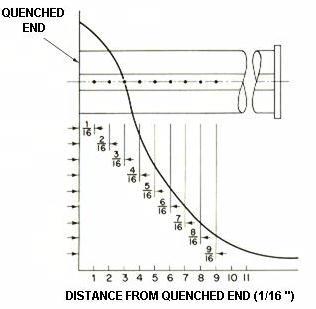
7. Take readings at an interval of 1/16 in. by measuring the Rockwell C hardness at each point marked in the previous step.
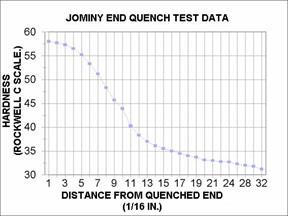
8. Plot the data for Rockwell Hardness versus Distance from quenched end as shown in Figure 3.
Determining the Hardenability of a Material:
In the Jominy test the quenching medium is eliminated from consideration by standardizing the effect of the quenching medium on a steel sample regardless of the medium. This is designated by the ratio of the heat transfer factor F to the thermal conductivity K of the material. This ratio is called H-factor which indicates the severity of a cooling rate.
Table 1 shows the H-values for various quench conditions and type of agitation. For H=0.20 the least severe cooling rate is observed. As H -factor increases the severity of the cooling rate also increases.
Table 1. H-Factors
|
H = F/K |
F= Heat transfer factor H= Thermal conductivity |
|
|
H-Factor |
Quench Conditions |
Agitation |
|
0.20 |
Poor oil quench |
None |
|
0.70 |
Strong oil quench |
Violent |
|
1.00 |
Poor water quench |
None |
|
1.50 |
Very good water quench |
Strong |
|
2.00 |
Brine quench |
None |
|
5.00 |
Brine quench |
Violent |
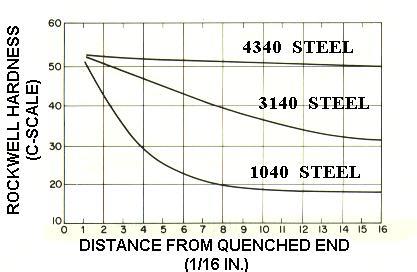
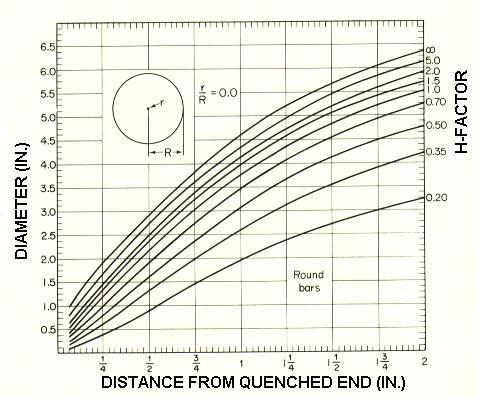
Figure 4 indicates the hardenability property of a certain type of steel regardless of the quenching medium. In order to find the effect of a certain type of quenching on the hardenability of a steel, additional graphs (Figure 5) that relate the size and the quenching medium must accompany the Jominy hardenability curves (Figure 4). Figure 5 represents the case where the hardness at the center of a bar with a specific size is to be calculated.
If a specific hardness is required for the center of a round part, first define the type of quench and the diameter of the part. Using Figure 5 draw a horizontal line from the diameter axis and intersect it with the H-Factor curve. Then, draw a vertical line from the intersection point and read the distance from the quenched end. Use the distance in Figure 4 to determine the hardness at the center of the part.
Application Example
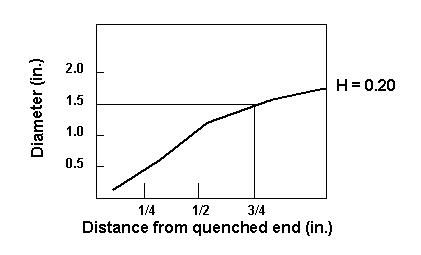
Example: A 1.5 in diameter steel part is quenched in oil with no agitation. (H=0.20). If we use a 3140 steel, what would be the hardness number at the center of the part? First go to Figure 5 and draw a horizontal line from 1.5 in. diameter and intersect it with H=0.20 as in Figure 6 below. Draw a vertical line from the intersection point and read distance from quenched end, which is 3/4 in. 3/4 in is the same as 12/16 in. Go to Figure 4 and locate 12/16 in. Draw a vertical line from 12/16 in distance from quenched end until it intersects the hardenability curve for 3140 Steel. Read the hardness.
The Jominy Number
The location of a certain hardness can be described by a Jominy number by Jx = y, where x = hardness number (Rockwell C scale) and y = distance from quenched end (expressed as y/16 in ).
A Rockwell hardness of 35 RC 5/16 in. from the quenched end is written as a Jominy number,
J35 = 5
where x = 35 and y = 5:
A Rockwell hardness of 30 RC 1/2 in. from the quenched end is written as a Jominy number where x = 30 and y = 8:
J30= 8
RESOURCES
You are encouraged to refer to the following resources and information to assist you in completing your task.
Standards
- ASTM A255-10: Standard Test Methods for Determining Hardenability of Steel - http://www.astm.org/Standards/A255.htm
Videos
- http://www.youtube.com/watch?v=qW0aUbTWtVM
- http://www.youtube.com/watch?v=qjsZVivfzcg
- http://www.youtube.com/watch?v=3NPyUmyt2IY
Academic Papers and Online Manuals
- http://www.ijaet.org/media/0001/8I3A-REVIEW-ON-JOMINY-TEST-AND-DETERMINATION-OF-EFFECT-OF-ALLOYING-ELEMENTS-ON-HARDENABILITY-OF-STEEL-USING-JOMINY-END-QUENCH-TEST-Copyright-IJAET.pdf
- http://www.smccd.edu/accounts/enriquez/engr270files/exp8_jominy.pdf
Laboratory Safety
You are required to review the online reference manual provided in the link below before
http://www.hc-sc.gc.ca/ewh-semt/pubs/occup-travail/ref_man/ref_manual_index-eng.php
LaboL