
Introduction

Welcome to the world of survival!!!
As you have entered into this world known as the ecosystem. You first passed a diagram of a food web. Did you notice how the energy was flowing throughout the web? In this webquest, you will be given a task to complete and demonstrate an understanding of what takes place in an ecosystem from beginning to end.
Even, You will explore the possibility of "what if" there were more or less of one organism in the food web, would it make a difference?
Are you ready for a journey, to track the flow of energy, and answer the "what if" question?
Get Set, Ready, Go..............................
Task
Each student will work on creating a presentation in the form of a media production to reveal the relationship between organisms for survival and in the ecosystem. They will work in a group of 3 or 4 students being given one type of environment to concentrate on: Possible food chains / food webs: Desert, coniferous forest, deciduous forest, temperate rainforest, fresh water, ocean
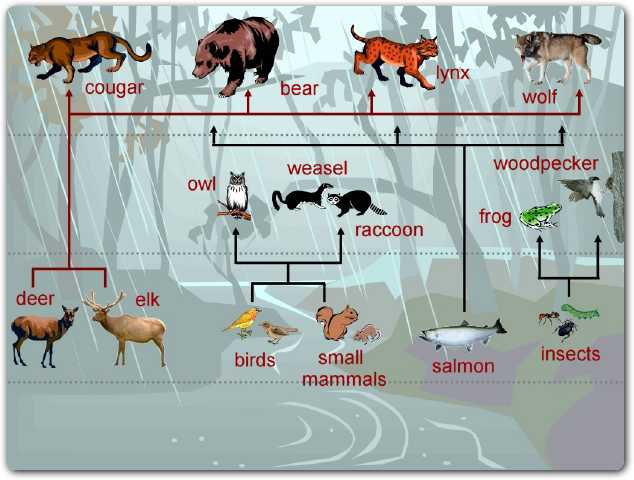
From the research information provided, the presentation should explain:
1. The different types of organism per the environment
2. The position on the food web/food chain
3. The difference between predator/prey, parasite/host, and producer/consumers per the environment
4. The effect on the ecosystem if there were an increase or decrease of an organism
Happy discoveries per your team and environment!!!
Process
Now, the purpose and the task has been provided, lets get started.
1. Select a team of 3 people of your choice to work with, making a wise selection, to produce a finish project of a presentation of a media production to teach the others in your class.
2. Talk it over with your team to select which environment you want to explore. (Remember the class wants to hear about all 3 enviornment.)
3. Once your team has informed the teacher which one you have selected, decide on what role each will be responsible for doing on the project and a timeline when you need them to be done. (Deadline is Thursday)
4. Resources have being provided on this page to address elaborating on your task.
5. Make sure to provide 2 questions and answers to the teacher per your presentation to be asked to your class.
Here are some web sites that can help you to gather information and visuals:
http://www.vtaide.com/png/foodchains.htm
http://www.sheppardsoftware.com/content/animals/kidscorner/foodchain/foodchain.htm
http://www.bbc.co.uk/bitesize/ks2/science/living_things/food_chains/play/
http://www.brainpop.com/science/ecologyandbehavior/foodchains/
You can use the template that is given by your teacher or create your own design!!!
Enjoy preparing to share what you have learned!!
Evaluation
|
|
3—Excellent |
2—Good |
1—Fair |
0—Needs Improvement |
|
Delivery |
• Holds attention of entire audience with the use of direct eye contact, seldom looking at notes • Speaks with fluctuation in volume and inflection to maintain audience interest and emphasize key points |
• Consistent use of direct eye contact with audience, but still returns to notes • Speaks with satisfactory variation of volume and inflection |
• Displays minimal eye contact with audience, while reading mostly from the notes • Speaks in uneven volume with little or no inflection |
• Holds no eye contact with audience, as entire report is read from notes • Speaks in low volume and/ or monotonous tone, which causes audience to disengage |
|
Content |
• Demonstrates full knowledge by answering all class questions with explanations and elaboration |
• Is at ease with expected answers to all questions |
• Is uncomfortable with information and is able to answer only rudimentary questions includes very thin data or evidence |
• Does not have grasp of information and cannot answer questions about subject ideas or conclusions |
|
Organization |
• Provides clear purpose and subject; pertinent examples, facts, and/or statistics; supports conclusions/ideas with evidence |
• Has somewhat clear purpose and subject; some examples, facts, and/or statistics that support the subject; includes some data or evidence |
• Attempts to define purpose and subject; provides weak examples, facts, and/ or statistics, which do not adequately support the subject |
• Does not clearly define subject and purpose; provides weak or no support of subject |
|
Enthusiasm |
• Demonstrates strong enthusiasm about topic |
• Shows some enthusiastic feelings about topic
|
• Shows little or mixed feelings about the topic being presented
|
• Shows no interest in topic presented
|
|
Language skills |
• Always uses appropriate vocabulary and speaks in complete sentences with correction. |
•Mostly uses appropriate vocabulary and speaks in complete sentences. Language mistakes do not interfere with meaning. |
• Sometimes uses appropriate vocabulary and speaks in complete sentences with minor mistakes. |
•Rarely uses appropriate vocabulary and speaks in complete sentences. Have many mistakes. |
|
Comments |
|
Conclusion
Congratulation!!
You have survived the journey into the ecosystem. Are you able to identify a predator from a prey, parasite from a host, and a producer from a consumer? Does it make a difference of the types of environments- marine, terrestial, or freshwater? What about the level of energy in a food web versus a food chain? Would it make a difference if there is more nor less of an organism within the ecosystem.
If you can answser all to the above questions, then you are ready to embark upon a new adventure of new discoveries.
If you feel like you are not ready, then take another journey into the ecosystem to gather more insight.
Happy exploring!!!
Credits
WELL DONE!!
You can always improve your presentation skills... Keep practicing.. Practice makes perfect.