
Introduction
Mongol leader Genghis Khan (1162-1227) rose from humble beginnings to establish the largest land empire in history. After uniting the nomadic tribes of the Mongolian plateau, he conquered huge chunks of central Asia and China. His descendents expanded the empire even further, advancing to such far-off places as Poland, Vietnam, Syria and Korea. At their peak, the Mongols controlled between 11 and 12 million contiguous square miles, an area about the size of Africa. Many people were slaughtered in the course of Genghis Khan’s invasions, but he also granted religious freedom to his subjects, abolished torture, encouraged trade and created the first international postal system. Genghis Khan died in 1227 during a military campaign against the Chinese kingdom of Xi Xia. His final resting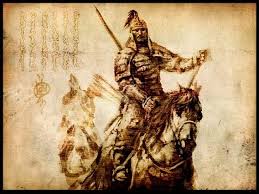 place
place
Task
My task for my English Studies assessment was to pick a time period throughout history and then pick somethinmg interesting from that time to research.
I choose to pick a person and I wante to do Genghis Khan.
I has a choice of a few ways of presenting my information. I chose to do a website because my teacher suggested it.
Process
For my English assessment I need to reseach a historical person from a time period throughout history. I have chosen to complete my assessment on Genghis Khan.
Once I have complied all of my research I had a choice of either making a website, documentary, docu -drama, podcast, website or animation.
I thought that t would be easier to do my research and create a website.
The process that I took when completing this task was to talk to my teacher aboutwhat I should research and which medium I should complete my assessment task in. I then used the internet for amajority of my research.
Evaluation
Information on Genghis Khan:
Uniting the Mongols:
Going against custom, Temujin put competent allies rather than relatives in key positions and executed the leaders of enemy tribes while incorporating the remaining members into his clan. He ordered that all looting wait until after a complete victory had been won, and he organized his warriors into units of 10 without regard to kin. Though Temujin was an animist, his followers included Christians, Muslims and Buddhists. By 1205 he had vanquished all rivals, including his former best friend Jamuka. The following year, he called a meeting of representatives from every part of the territory and established a nation similar in size to modern Mongolia. He was also proclaimed Chinggis Khan, which roughly translates to “Universal Ruler,” a name that became known in the West as Genghis Khan.
Establishing an Empire:
Having united the steppe tribes, Genghis Khan ruled over some 1 million people. In order to suppress the traditional causes of tribal warfare, he abolished inherited aristocratic titles. He also forbade the selling and kidnapping of women, banned the enslavement of any Mongol and made livestock theft punishable by death. Moreover, Genghis Khan ordered the adoption of a writing system, conducted a regular census, granted diplomatic immunity to foreign ambassadors and allowed freedom of religion well before that idea caught on elsewhere.
Genghis Khan’s first campaign outside of Mongolia took place against the Xi Xia kingdom of northwestern China. After a series of raids, the Mongols launched a major initiative in 1209 that brought them to the doorstep of Yinchuan, the Xi Xia capital. Unlike other armies, the Mongols traveled with no supply train other than a large reserve of horses. The army consisted almost entirely of cavalrymen, who were expert riders and deadly with a bow and arrows. At Yinchuan, the Mongols deployed a false withdrawal—one of their signature tactics—and then initiated a siege. Though their attempt to flood the city failed, the Xi Xia ruler submitted and presented tribute.
The Mongols next attacked the Jin Dynasty of northern China, whose ruler had made the mistake of demanding Genghis Khan’s submission. From 1211 to 1214, the outnumbered Mongols ravaged the countryside and sent refugees pouring into the cities. Food shortages became a problem, and the Jin army ended up killing tens of thousands of its own peasants. In 1214 the Mongols besieged the capital of Zhongdu (now Beijing), and the Jin ruler agreed to hand over large amounts of silk, silver, gold and horses. When the Jin ruler subsequently moved his court south to the city of Kaifeng, Genghis Khan took this as a breach of their agreement and, with the help of Jin deserters, sacked Zhongdu to the ground.
In 1219 Genghis Khan went to war against the Khwarezm Empire in present-day Turkmenistan, Uzbekistan, Afghanistan and Iran. The sultan there had agreed to a trade treaty, but when the first caravan arrived its goods were stolen and its merchants were killed. The sultan then murdered some of Genghis Khan’s ambassadors. Despite once again being outnumbered, the Mongol horde swept through one Khwarezm city after another, including Bukhara, Samarkand and Urgench. Skilled workers such as carpenters and jewelers were usually saved, while aristocrats and resisting soldiers were killed. Unskilled workers, meanwhile, were often used as human shields during the next assault. No one knows with any certainty how many people died during Genghis Khan’s wars, in part because the Mongols propagated their vicious image as a way of spreading terror.
Credits
Most of my information was sourced from: http://www.history.com/topics/genghis-khan
Link to vidoes
http://www.history.com/topics/genghis-khan/videos/ascending-the-chinese-throne