
Introduction
Today we will begin working on writing narratives.
You will learn that narratives are different from other forms of writing. Narratives tell stories and the stories can either be true or made up. Narratives can be a lot of fun to write.
Standards:
Write narratives to develop real or imagined experiences or events using effective technique, relevant descriptive details, and well-structured event sequences.
Engage and orient the reader by establishing a context and point of view and introducing a narrator and/or characters; organize an event sequence that unfolds naturally and logically.
Use narrative techniques, such as dialogue, pacing, and description, to develop experiences, events, and/or characters.
Use a variety of transition words, phrases, and clauses to convey sequence and signal shifts from one time frame or setting to another.
Use precise words and phrases, relevant descriptive details, and sensory language to capture the action and convey experiences and events.
Provide a conclusion that follows from and reflects on the narrated experiences or events.
ISTE Standards
1. Creativity and Innovation
Students demonstrate creative thinking, construct knowledge, and develop innovative products and processes using technology.
- Apply existing knowledge to generate new ideas, products, or processes.
Create original works as a means of personal or group expression.
Task
There are several key elements to a narrative story.

To begin with is setting.
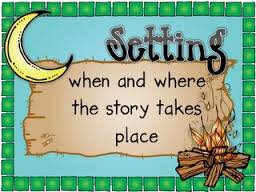
The setting is the time and place of the story. It could be a futuristic story that
occurs in Australia, or it could be a historic story about the Arctic in the early
eighteen hundreds. Your story will be contemporary, you will be telling a true
story from your life. Your setting will be the actual year and place it occurred.
You will be the protagonist or main character in your story. The other
characters or people that are important to your story will also need to be listed
and developed. Identify your protagonist, or the character that is involved with
the conflict. Remember that characters need to be developed, do not feel the
need to include people that were not important to the plot.
The conflict is one of the most important elements to any story. If
there is no conflict, it is not a narrative.
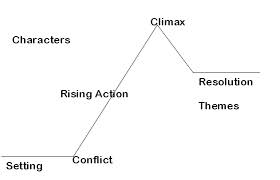
After identifying the conflict list the steps or events that occur while
working towards the resolution. Just like you see in any sitcom, a problem is
identified and the characters work towards the resolution of the conflict. These
are the events in your story.
The final outcome or resolution ends the story. Not all conflicts can be
solved, sometimes the resolution involves acceptance of change. However your
story ends is the resolution.
End the story by stating the theme or lesson learned from the story.
You may also wish to include information about the characters following the
story.
So remember the Key Elements to a Narrative are
Setting
Time and Place
Characters
Protagonist
Antagonist
Supporting Characters
Plot
Conflict
Rising Action
Events
Climax
Falling Action
Resolution
Process
1st You will Choose a story from your life to tell. It can be a funny story, sad, or a story you feel is important. Be sure to choose a story you like well enough to elaborate on and share.
2nd After selecting your narrative topic complete the Narrative Storyboard template. The more detail you include the easier it will be to draft your story.
3rd After completing the storyboard template have it checked for approval. Once approved you can write your story draft.
4th Now that you have approval you can begin writing out your draft. These are the words you will be reading in your digital story.
5th You will now need to go to vimeo and create a free account to finish your digital story. Simply go to the free registration tab. Register as a student for free access. Then you can begin creating your digital story.
Use the Story Template to get started
Key Elements to a Narrative
|
Setting |
|
Time: Place: |
|
Characters |
|
Protagonist |
|
Antagonist |
|
Supporting Characters
|
|
Plot |
|
Conflict: |
|
Rising Action |
|
Events
|
|
Climax |
|
Falling Action |
|
Resolution |
To help give you an idea of what Digital Stories are like click the link and watch a few: http://vimeo.com/originals/ownyourtomorrow/93491795
if the link does not work copy and paste in the address bar.
Evaluation
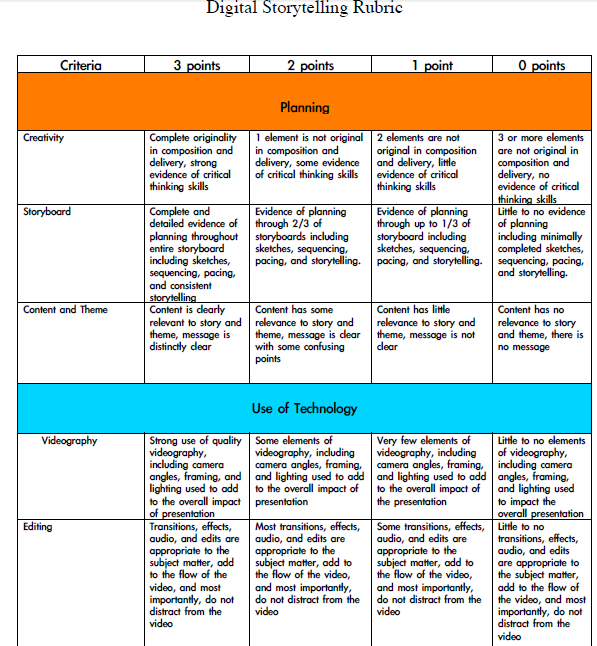
(2012)
Credits
References
Digital Storytelling Evaluation Rubrics for Teachers ~ Educational Technology and Mobile Learning. (2012.). Retrieved August 7, 2014.: http://www.educatorstechnology.com/2013/04/digital-storytelling-evaluation- rubrics.html
English Language Arts Standards » Writing » Grade 7. (n.d.). Home. Retrieved July 11, 2014, from http://www.corestandards.org/ELA-Literacy/W/7/
. (n.d.). . Retrieved July 11, 2014, from http://www.iste.org/docs/pdfs/20- 14_ISTE_Standards-S_PDF.pdf
Teacher Page
Remember
[img_assist|nid=14731|title=ss|desc=|link=none|align=left|width=640|height=499]
Have fun and be as creative as possible.........