
Introduction
Every second the population increases. Every second we consume natures to live and survive. Earth is the main source of life forms. What if one day the water dries, the volcanoes erupts, a huge earthquake occur, a strong typhoon form, a big meteor strikes and the Earth's life comes to end? What will we do? Is there any habitable planet like ours? These are the questions we have been asking and yet it is still a mystery.
Evaluation
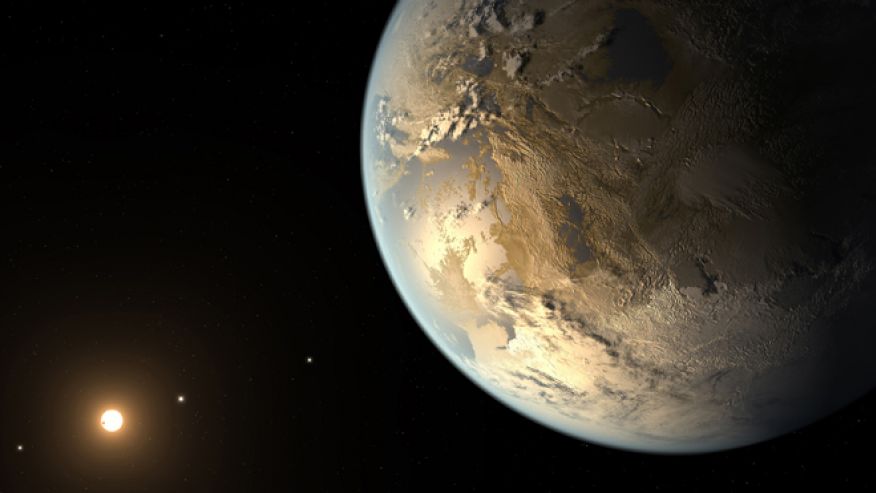
Until NASA has made it a mission to discover the truth. In March 2009, the space agency launched the Kepler Mission, a NASA discovery program designed to look for possible life-supporting planets. Astronomers discovered the newfound object detected by NASA’s orbiting Kepler telescope (which examines the heavens for the subtle changes in brightness that indicate an orbiting planet is crossing in front of a star and from these changes, scientists can calculate a planet’s size and make certain interferences about its makeup), dubbed Kepler-186f, which circles a red dwarf star 500 light-years from Earth in the constellation Cygnus, and part of a system of five planets, all of which are roughly Earth’s size. However, the other planets are too close to their star to support life. A light-year is almost 6 trillion miles.
"M dwarfs are the most numerous stars," said Quintana. "The first signs of other life in the galaxy may well come from planets orbiting an M dwarf."
"This is the smallest planet we've found so far in the habitable zone," said Prof Stephen Kane, an astrophysicist from San Francisco State University, US.
The discovery of Kepler-186f confirms that planets the size of Earth exist in the “habitable zone” (the range of distance from a star where liquid water might pool on the surface of an orbiting planet) of stars other than our sun. The planet is about 10 percent larger than Earth and may very well have liquid water because it resides at the outer edge of the habitable temperature zone around its star which is a good chance spot where water and water forms like lake, ocean, etc. can exist without freezing solid and boiling away. Although the size of Kepler-186f is known, its mass and composition are not. Because of its size, the team believes it is a rocky planet.
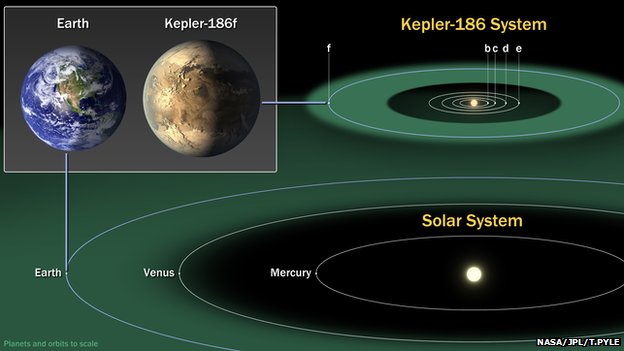
"Being in the habitable zone does not mean we know this planet is habitable. The temperature on the planet is strongly dependent on what kind of atmosphere the planet has," said Thomas Barclay, research scientist at the Bay Area Environmental Research Institute at Ames, and co-author of the paper. "Kepler-186f can be thought of as an Earth-cousin rather than an Earth-twin. It has many properties that resemble Earth."
The planet probably basks in an orange-red glow from its star and is most likely cooler than Earth, with an average temperature slightly above freezing, “similar to dawn or dusk on a spring day”, Marcy said.
Prof Kane explained: "Then it starts to develop a very substantial atmosphere very similar to what we see in the gas giant planets in our own Solar System.”
Scientist cannot say for certain whether it has atmosphere, but if it does, it probably contains a lot of carbon dioxide, outside expert said:
“Don’t take off your breathing mask if you ever land there,” said Lisa Kaltenegger, a Harvard and Max Planck Institute astronomer who had no connection to the research.
Kepler-186f travels around a small and cool star. Elisa Quintana, a lead researcher at NASA’s Ames Research Center said she considers the planet to be more of an “Earth cousin” than a twin because it circles a star that is smaller and dimmer than our sun. While Earth revolves around the sun in 365 days, this planet completes an orbit of its star every 130 days.
Despite the difference, “now we can point to a star and know that there really is a planet very similar to the Earth at least in size and temperature,” Harvard scientist David Charbonneau, who was not part of the team, said in email.
"The discovery of Kepler-186f is a significant step toward finding worlds like our planet Earth," said Paul Hertz, NASA's Astrophysics Division director at the agency's headquarters in Washington. "Future NASA missions, like the Transiting Exoplanet Survey Satellite and the James Webb Space Telescope, will discover the nearest rocky exoplanets and determine their composition and atmospheric conditions, continuing humankind's quest to find truly Earth-like worlds."
"We know of just one planet where life exists -- Earth. When we search for life outside our solar system we focus on finding planets with characteristics that mimic that of Earth," said Elisa Quintana, research scientist at the SETI Institute at NASA's Ames Research Center in Moffett Field, Calif., and lead author of the paper published today in the journal Science. "Finding a habitable zone planet comparable to Earth in size is a major step forward."
Conclusion
Astronomers may never know for certain whether Kepler-186f can sustain life. The planet is too far away even for next-generation space telescopes like NASA's overbudget James Webb, set for launch in 2018, to study in detail.
Kepler completed its prime mission and was in overtime when one of the wheels that keep its gaze steady failed last year. NASA has not yet decided whether to keep using the telescope to hunt for planets on a scaled-back basis.