
Introduction
The history of Charles Darwin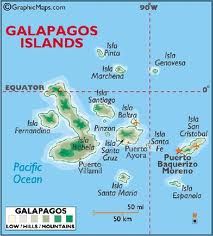
The Galapagos Islands are a group of rugged and isolated volcanic islands found about 1000km west of the South American mainland. Today they are a tourist destination for people who are fascinated by the variety of unusual wildlife found there. They have become famous because of 19th century naturalist Charles Darwin. After a visit in 1835, he felt challenged to explain why the wildlife was so different from that found anywhere else in the world.
By 1838, after studying the wildlife and then heading back to England Darwin came up with an idea that all living things experience a ‘struggle for existence’ and that nature ‘selects’ out individuals with favourable characteristics for survival, but he was not prepared to publish his ideas at the time. His ideas were controversial and he was aware of this so he wanted to present as much evidence as possible to support his theory. He began writing a book in 1856 entitled On the Origin of Species by Means of Natural Selection, but was surprised to find that a young naturalist, Alfred Wallace had began thinking along the same lines. In 1858, Wallace sent Darwin a copy of an essay he had written. The essay talked about a struggle for existence in natural populations and the survival of those organisms that were better adapted to the environment.
Darwin realised now that he realised that he waited too long to publish his ideas. He hurried to complete his book, which was published in 1859. It contained 500 pages of detailed evidence and argument for his history.
The great evolution debate
Only 1250 copi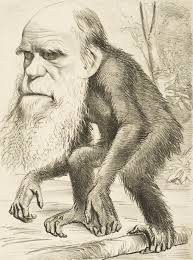 es of Darwin’s book were printed initially and every copy was sold on the first day of publication. A storm was sold of controversy followed. One way that Darwin’s theory was misrepresented was to say that he claimed that people were descended from apes. See image. Eventually Darwin’s ideas began to be accepted by the scientific community but debate about is theory continued into the 20th century. Darwin’s theory was called the theory of NATURAL SELECTION.
Task
Understanding Darwin's history
Background questions
Before you proceed, use the internet as a resource to answer the following questions:
- What unusual life did Darwin find on the Galapagos Islands?
- Provide a brief description of the tortoises Darwin found on the Galapagos Islands.
- Darwin had developed his theory of evolution by natural selection by 1838, yet he did not publish his ideas until 1859. Why did he take so long?
Varieties of finches
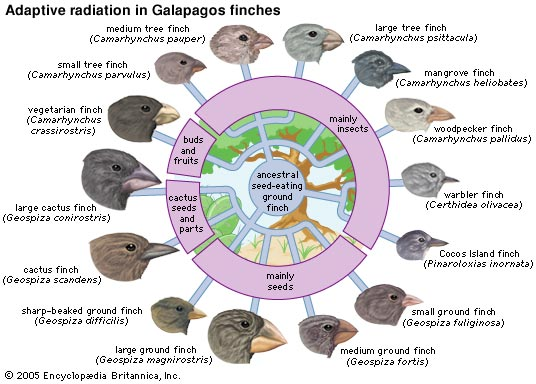
While visiting the Galapagos Islands in 1835, Charles Darwin was puzzled to find different species of finch on each island. He struggled to explain why these differences might exist. He observed finches with beaks like small parrots. They had a mixed diet of insects, flowers and fruit. The warbler finch had a thin pointed beak and ate only insects.
The woodpecker finch used twigs or cactus spines to prise insects out of bark. Other finches ate only seeds. All these finches were different from the finches he had observed on the South American mainland.
Why do you think the finches found on different islands had different beaks?
Discuss with your partner, then write your response into your workbook
Process
The theory of evolution by natural selection
Write the following closed passage into your workbooks.
Darwin's theory of natural selection is summarised by the following.
1. Each organism must face a constant "struggle to ___________” and those best adapted to their environment will survive best.
2. A species produces more ___________ than can possibly survive.
3. There is __________ within a species population and some individuals have types of variations that favour their survival.
4. Organisms that survive will pass their favourable ________ on to future generations.
5. The environment selects those individuals best suited for survival by the mechanism of natural ___________________
Use these words to complete the passage:
characteristics, offspring, survive, variation, selection
Survival of the fittest
The theory of Natural Selection was proposed by Charles Darwin.
The survival and successful reproduction of the organisms that are best suited to their environment.
Darwin's grand idea of evolution by natural selection is relatively simple but often misunderstood.
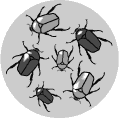
To find out how it works, imagine a population of beetles:
|
1. There is variation in traits. For example, some beetles are green and some are brown.
|
2. There is differential reproduction 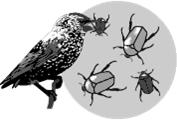
Since the environment can't support unlimited population growth, not all individuals get to reproduce to their full potential. In this example, green beetles tend to get eaten by birds and survive to reproduce less often than brown beetles do.
|
3. There is heredity.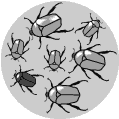
The surviving brown beetles have brown baby beetles because this trait has a genetic basis. |
|
4. End Result The more advantageous trait, brown coloration, which allows the beetle to have more offspring, becomes more common in the population. If this process continues, eventually, all individuals in the population will be brown. |
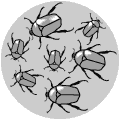
If you have variation, differential reproduction, and heredity, you will have evolution by natural selection as an outcome. It is as simple as that.
Evaluation
Evaluate your understanding of natural selection

Peppered moth simulation
Introduction:
Charles Darwin accumulated a tremendous collection of facts to support the theory of evolution by natural selection. One of his difficulties in demonstrating the theory, however, was the lack of an example of evolution over a short period of time, which could be observed as it was taking place in nature. Although Darwin was unaware of it, remarkable examples of evolution, which might have helped to persuade people of his theory, were in the countryside of his native England. One such example is the evolution of the peppered moth Biston betularia.
The economic changes known as the industrial revolution began in the middle of the eighteenth century. Since then, tons of soot have been deposited on the country side around industrial areas. The soot discoloured and generally darkened the surfaces of trees and rocks. In 1848, a dark-coloured moth was first recorded. Today, in some areas, 90% or more of the-peppered moths are dark in colour. More than 70 species of moth in England have undergone a change from light to dark. Similar observations have been made in other industrial nations, including the United States.
Instruction:
Click the link below to read more information on Kettlewell's study of moths. At the end, you will run two simulations for 5 minutes each, during this time you will play the part of a bluejay that eats moths.
After 5 minutes record the % of dark moths and light moths - you will need this information later.
Peppered Moth Simulation at peppermoths.weebly.com
Whilst working through this task, answer the following questions:
Data and Analysis
Read the background information and answer the questions as you go.
Life Cycle of the Peppered Moth
1. Why are these moths called "peppered moths?"
2. What animals eat the peppered moth?
3. What is a lichen?
4. Moths that have more dark spots than the average moth are called what?
Impact of Pollution
5. Where was the first black form of the moth found?
6. What was the Industrial Revolution?
7. What was causing the different colors in the moths?
8. What is natural selection?
Kettlewell's Experiments
9. What is an entomologist?
10. How do scientists test theories?
11. Write down ONE of Kettlewell's predictions.
12. Why did dark moths have a survival advantage?
13. When Kettlewell recaptured the marked moths, what did he find?
Birdseye View
14. Open the simulation and play the role of the bird in both the dark and the light forest. Try to behave as a bird would behave, choosing the moths that are the most obvious. At the end of each simulation, record the percent of moths captured in the table below.

Final Analysis
15. Explain how the color of the moths increases or decreases their chances of survival.
16. Explain the concept of "natural selection" using your moths as an example.
17. What would happen if there were no predators in the forest? Would the colors of the moths change over time? Defend your answer?