
Introduction
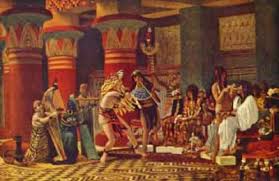
Growing up in Ancient Egypt was nothing like growing up in today's society. Family was the most important value of life in Ancient Egypt. Wealthy families had help raising their children but did most of the work themselves. Boys from wealthy families were able to start school at age 7 to study religion. Children were married as early as age 10. Women listened to the men of the families but were able to make their own money and decisions on business matters. All Egyptian clothing was made from linen and houses were made from sun dried bricks. All food was prepared in a clay oven. Ancient Egypt had a very structured society, so your social standing and role in society decided how you spent your day. In their free time, the men would hunt and fish to provide food for the family and the women would create music, do household chores, and wash clothes in the Nile River. The biggest parts of Ancient Egyption life were festivals praising their Almighty. Many young people would gather and meet to praise, eat, and rejoice together. As you can see, growing up in Ancient Egypt was very different than growing up in 21st century America. If you were living in Ancient Egypt, what would your life be like? Take a moment to imagine...You are about to enter Ancient Egypt through the eyes of a young adult.
_1.jpg) [video:https://www.youtube.com/watch?v=XzTBNfQ7_GA autoplay:1]
[video:https://www.youtube.com/watch?v=XzTBNfQ7_GA autoplay:1]
Task
To help you understand what life would have been like for someone your own age in Ancient Egypt, you are going to research what life was like then for adolescents, ages 13 though 15. Once you have conducted your research you will write a note card sized bio of your Egyptian adolescent. Then you will work in groups of three to create a skit, incorporating each of your Egyptian characters. Your group will perform your skit before the class and add your note card bios to a class collection. You will also have a wrap-up essay after all skits have been performed. Creativity, innovation, and humor are encouraged throughout this project!
Process
Let's Get Started!!!
Steps 1-4: At Home
1) Perform a little preliminary research on adolescents in Ancient Egypt to help you decide which role in Egyptian society you want to investigate further.
2) Choose a role from one of the following social positions:
Roles:Member of the Pharoah’s family, Priest, Noble, Scribe/Government Official, Craftsperson, Merchant, Soldier,Farmer,Laborer/Slave
Example: I choose to research what life would have been like for a teenage girl in a merchant family.
3) Research your particular role, taking notes as you go along.
Answer the following questions:
- What would my character’s social position have been?
- What would his/her daily life consisted of?
- What would have been his or her education, religion, entertainment, work, and possible dreams or expectations for the future?
- What would he or she have eaten? Worn?
4) Name your character and write an “About Me” bio on a 5x7 notecard. See the Evaluation section for details on what your notecard must include.
Steps 5-7: In Class
5). You will be divided into groups of three in class. Within your groups, introduce your character, share your Bio notecards, and answer each other’s questions about your characters.
5) As a group, write a short skit (one scene) in which all three of your Egyptian characters interact. See the evaluation section for skit requirements. Remember, we just went over scenic elements, so I will be looking for evidence of last weeks focus on drama in your skits. Be as creative as possible! Music, humor, artistry and enthusiasm are encouraged!
6) Perform your skits on assigned days before the class.
7) Each student will have a copy of each student’s bio notecard. You will put them on a ring.
8) Homework:
Choose which character of all the ones presented in the skits that you would most like to be if you were an Ancient Egyptian. Write a one-paragraph essay explaining your choice. See evaluation section for essay requirements.
Here are some resources that you can use to conduct your research. Don't limit yourself to these resources. The school library and internet have many more resources!
Children in Egypt
http://www.reshafim.org.il/ad/egypt/people/childhood.htm
http://fathom.lib.uchicago.edu/2/21701778/
http://fathom.lib.uchicago.edu/2/21701778/
http://members.tripod.com/~ancient_egypt/chiae.html
Women in Egypt:
http://www.virtual-egypt.com/newhtml/special/women/
http://www.kidsgen.com/ancient_egypt/daily_life.htm
http://www2.sptimes.com/Egypt/EgyptCredit.4.2.html
Social Roles in Egypt:
http://www.historyonthenet.com/Egyptians/society.htm
Evaluation
Notecard
include the following on the bio of your person
- the station of life- high/middle/low class why
- the job- pharoah, merchant, farmer, dancer
- the family life- married, single
- the entertainment- the hobbies, the toys
- the food
Skit
| Category | 4 | 3 | 2 | 1 |
| Drama | The skit included an element of drama, music, humor, artisory, and so on with a short explanation at the end of the skit of why this element was chosen | The skit included some element of drama, music, humor, artistry however their explanation was not well developed. | The skit included the drama lement however there was no explanation at the end. | There was not drama element included. |
| Role | Students are consistent through out the skit in both their characters and the material that is used to support it. | Studens are consistent with their character however ther are minor flaws in the supporting material. | Students are not consistent in the skit with the character they have minor flaws in their supporting material. | Students are not consistent in the skit with their character and their are major flaws in the supporting material. |
| Historical Accuracy | All historical information was accurate and included four historical facts about the daily life of each role. | Almost all historical information was accurate and only included 3 areas of daily life. | Most of the historical information was accurate and included 2 areas of daily life. | Very little of the historical information was accuate and there was only 1 area of daily life mentioned. |
Paragraph
| Category | 4 | 3 | 2 | 1 |
| Organization | Information is very organized with well-constructed in the paragraph | Information is organized with well-constructed paragraphs | Information is organized, but paragraphs are not well-constructed. | The information appears to be disorganized. |
| Paragraph Construction | All paragraphs include introductory sentence, explanations or details, and concluding sentence. | Most paragraphs include introductory sentence, explanations or details, and concluding sentence. | Paragraphs included related information but were typically not constructed well. | Paragraphing structure was not clear and sentences were not typically related within the paragraphs. |
| Quantity of information | Information clearly relates to the main topic. It includes several supporting details and/or examples. | Information clearly relates to the main topic. It provides 1-2 supporting details and/or examples. | Information clearly relates to the main topic. No details and/or examples are given. | Information has little or nothing to do with the main topic. |
| Why it is your choice | Using sources you are able to cleary state why you choose this role in ancient egyptian life. | Your use of sources is shary in your paragraph but your choice is clear and you have a clear understanding of what that role incorporated . | You included sources but you were not clear on your understanding of the role you choose. | You did not include sources and you did not have a clear understanding of the role that you choose. |
Conclusion
 Your mission has been to put yourself in the mind frame of an adolescent from Ancient Egypt. Think about all the ways the world has changed since this time period. Can you imagine what your life would be like if you had to get married at 10? Or if you never knew what a teleivison as? It is always a good thing to look and reflect on how the world has changed from century to century so you know what to be thankful for. Reflect about the role you took in your group and other ways your life could be effected by the situational outcomes of the project.
Teacher Page
This webquest was designed for a 6th grade unit on Ancient Civilizations.
Standards: ODE Standards for 6th grade: Regions and People of the Eastern Hemisphere, History, Early Civilizations.
OBJECTIVES:
- Students will be able to research and summarize an historical topic.
- Students will be able to colloboratively create a skit, using their shared research knowledge.
- Students will be able to perform their skits, practicing oral language and elements of drama.
- Students will be able to write an essay, choosing and defending their choice of a particular role in Egyptian society.
This webquest will allow students to:
1) Learn about Ancient Egyptian society and culture through the viewpoint of people their own age, making the material more relevant.
2) Practice researching, using internet sources.
3) Practice summarizing research and communicating their summaries to their peers.
4) Practice collaborative learning and creativity through working on and performing their skits in small groups.
5) Review and put into practice previously learned/cross-curricular material (scenic elements) by writing and performing skits.
6) Gain confidence performing in front of a class.
7)Think and write reflectively on which Egyptian role they would have like to have. This part of the assignment requires them to think critically about the different Egyptian roles, choose one, and defend their choice. Each of these elements requires students to think critically and communicate their thought effectively.
[img_assist|nid=10587|title=pic|desc=|link=none|align=left|width=640|height=377]