
Introduction
Welcome!
You are currently reading the novel, The Red Badge of Courage by Stephen Crane. The main character of this novel is about your age and had a romantic view of war ... until he experienced it. The realistic descriptions of the harsh realities of war are portrayed in vivid detail. What was it like for a teenager thrust into the Civil War?
Let's explore and find out ...
Task
Your task is to create a piece of work which will enhance your understanding of the main character and the major themes of the novel. You and a partner will have a choice of:
*writing a Civil War letter
*creating an illustration to accompany a scene in the book
*writing a song from the perspective of a character from the book
You and your partner will present your project to the class along with other students who have selected the same activity.
Process
Letters of the Civil War
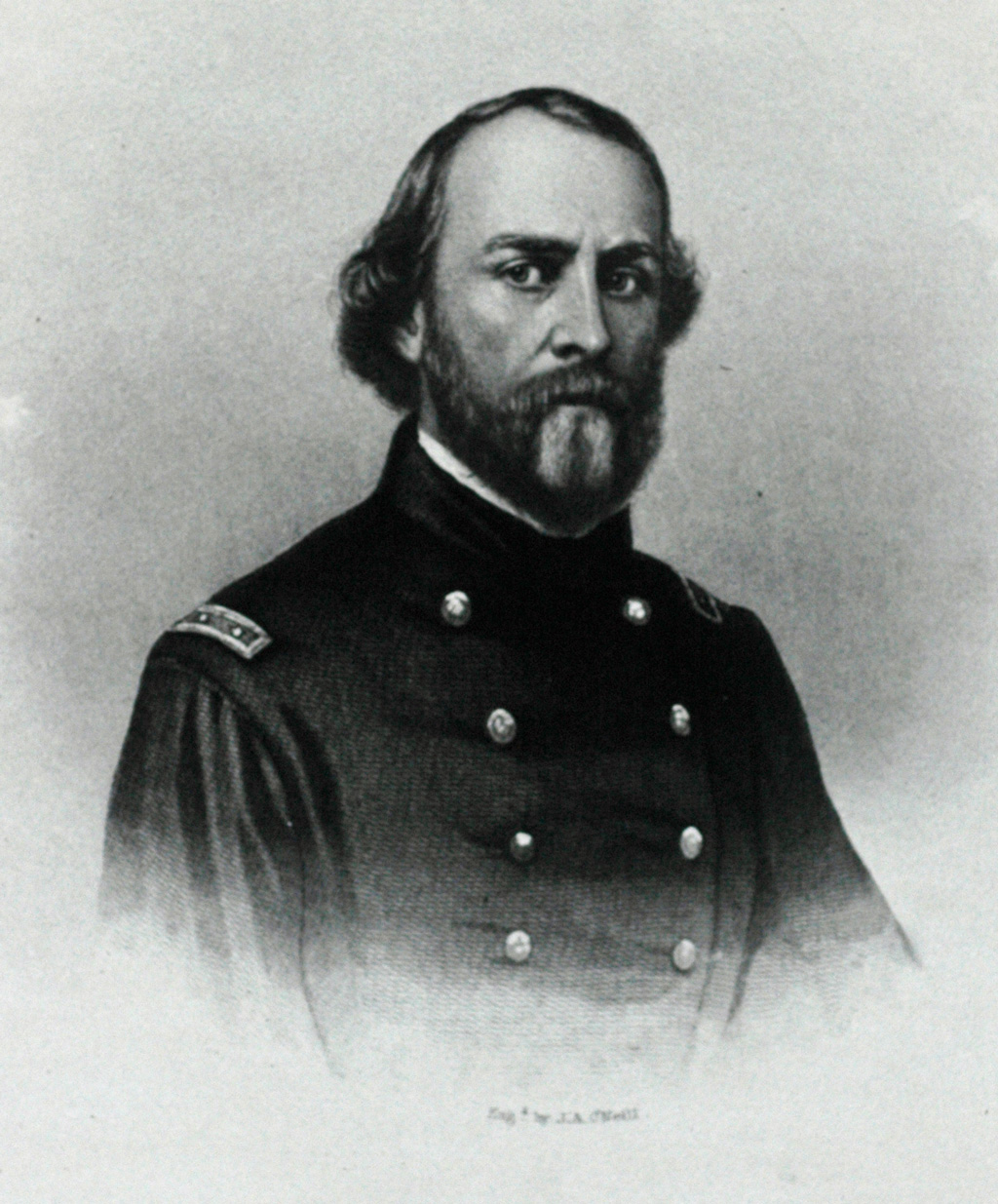
Sullivan Ballou
Listen to the reading of the famous “Sullivan Ballou letter” written by the Union officer a few days before his mortal wounding at the Battle of Bull Run, on July 21, 1861.
Before his regiment left Washington for Bull Run, Ballou sat down and wrote to his wife and two children back home in Rhode Island. He wrote of his faith in the Union cause, and his willingness to die for it. He confessed guilt that his death might harm his family but said his love of country “comes over me like a strong wind and bears me irresistibly . . . to the battlefield.”
He professed his love for his wife, and hoped to be with her even in death, “amidst your happiest scenes and gloomiest hours — always, always.” “If there be a soft breeze upon your cheek, it shall be my breath; or the cool air fans your throbbing temple, it shall be my spirit passing by.”
The letter was never mailed but was returned to his wife with her husband’s effects.
Ballou was struck in the leg by a cannonball during the battle and died a week later. The battle was a Union defeat."
Ballou’s anguished words are read by actor Paul Roebling, listen to his rendition here:
http://www.npr.org/2011/07/21/138582888/on-bull-run-anniversary-maj-ballous-letter
July 14, 1861
Camp Clark, Washington
My very dear Sarah:
The indications are very strong that we shall move in a few days—perhaps tomorrow. Lest I should not be able to write again, I feel impelled to write a few lines that may fall under your eye when I shall be no more . . .
I have no misgivings about, or lack of confidence in the cause in which I am engaged, and my courage does not halt or falter. I know how strongly American Civilization now leans on the triumph of the Government and how great a debt we owe to those who went before us through the blood and sufferings of the Revolution. And I am willing—perfectly willing—to lay down all my joys in this life, to help maintain this Government, and to pay that debt . . .
Sarah my love for you is deathless, it seems to bind me with mighty cables that nothing but Omnipotence could break; and yet my love of Country comes over me like a strong wind and bears me unresistibly on with all these chains to the battle field.
The memories of the blissful moments I have spent with you come creeping over me, and I feel most gratified to God and to you that I have enjoyed them for so long. And hard it is for me to give them up and burn to ashes the hopes of future years, when, God willing, we might still have lived and loved together, and seen our sons grown up to honorable manhood, around us. I have, I know, but few and small claims upon Divine Providence, but something whispers to me—perhaps it is the wafted prayer of my little Edgar, that I shall return to my loved ones unharmed. If I do not my dear Sarah, never forget how much I love you, and when my last breath escapes me on the battle field, it will whisper your name. Forgive my many faults and the many pains I have caused you. How thoughtless and foolish I have often times been! How gladly would I wash out with my tears every little spot upon your happiness . . .
But, O Sarah! If the dead can come back to this earth and flit unseen around those they loved, I shall always be near you; in the gladdest days and in the darkest nights . . . always, always, and if there be a soft breeze upon your cheek, it shall be my breath, as the cool air fans your throbbing temple, it shall be my spirit passing by. Sarah do not mourn me dead; think I am gone and wait for thee, for we shall meet again . . .
The letter, a copy of which resides in the Rhode Island Historical Society, is from the “if I do not return” genre, often written by soldiers on the eve of battle.
OPTION 1 - Letter
Explore the Civil War letter links here:
http://www.civilwararchive.com/LETTERS/letters.htm
http://spec.lib.vt.edu/cwlove/
http://www.civil-war.net/searchlinks.asp?searchlinks=Letters%20and%20Diaries
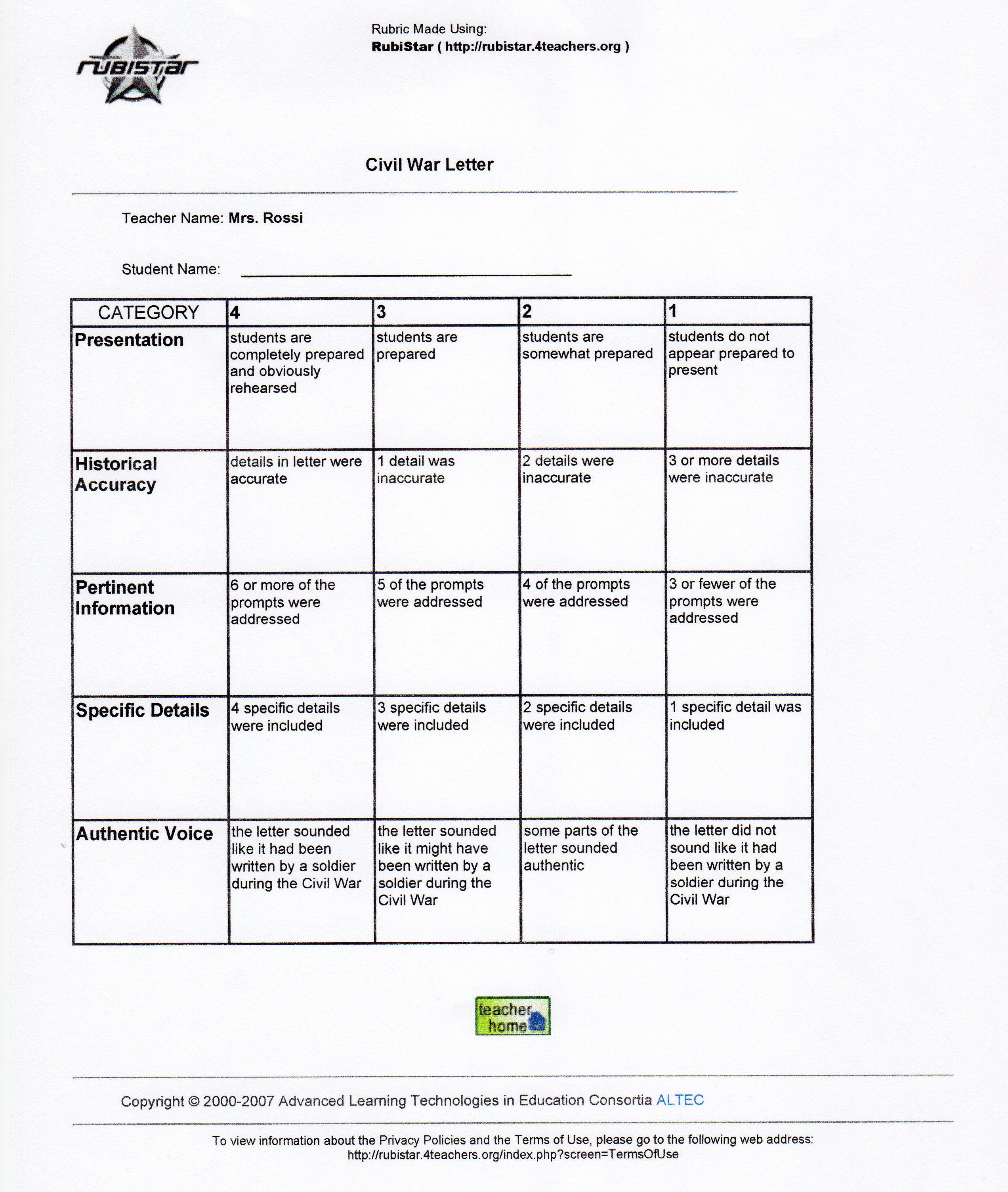
Write a 300 to 500 word letter to your mom/dad/wife/sweetheart.
Be sure to include the following information:
- What is the date?
- How old are you?
- What is your hometown? State?.
- Why did you sign up to fight?
- What is your opinion about the Civil War?
- What are your hopes and/or fears?
- What do you miss?
*add specific details: clothing, food, hobbies, occupation
You and your partner will read your letter aloud to the class along with the other students who have selected this task on “Civil War Letter Day.”
********************************************************************************************************************************************************************************************
Illustrate a Passage
The Red Badge of Courage is filled with sensory imagery and symbolism, – the sights, sounds, and even the smells of war. Viewed through the eyes of a young and idealistic boy, these images virtually assault him. It can be very gritty and graphic at times.
Sensory Imagery:
Sift through the chapters in the book in search of a clearly defined graphic scene. Look for specific examples of imagery: visual, auditory, olfactory. Find a scene where you can “hear” the noise, “see” the action, “smell” the … well, you get the idea.
Animal Imagery:
There are plenty of references to animals and animalistic behavior: “Rows of dragons advancing, red and green monsters, regiments moving like snakes, men being killed like pigs, a soldier fighting like a wild cat.”
The Color Red:
The color red is mentioned repeatedly in this novel. Red is symbolically the color of danger, passion, and aggression. Here are several examples:
“From across the river the red eyes were still peering.” (Chapter 2 Paragraph 11)
“They were going to look at war, the red animal – war, the blood-swollen god.” (Chapter 3 Paragraph 30)
"At times he regarded the wounded soldiers in an envious way. He conceived persons with torn bodies to be peculiarly happy. He wished that he, too, had a wound, a red badge of courage" (Chapter 9 Paragraph 3).
OPTION 2 -Illustration
Read the article about imaging the Civil War here:
http://xroads.virginia.edu/~hyper/crane/images/section3.html
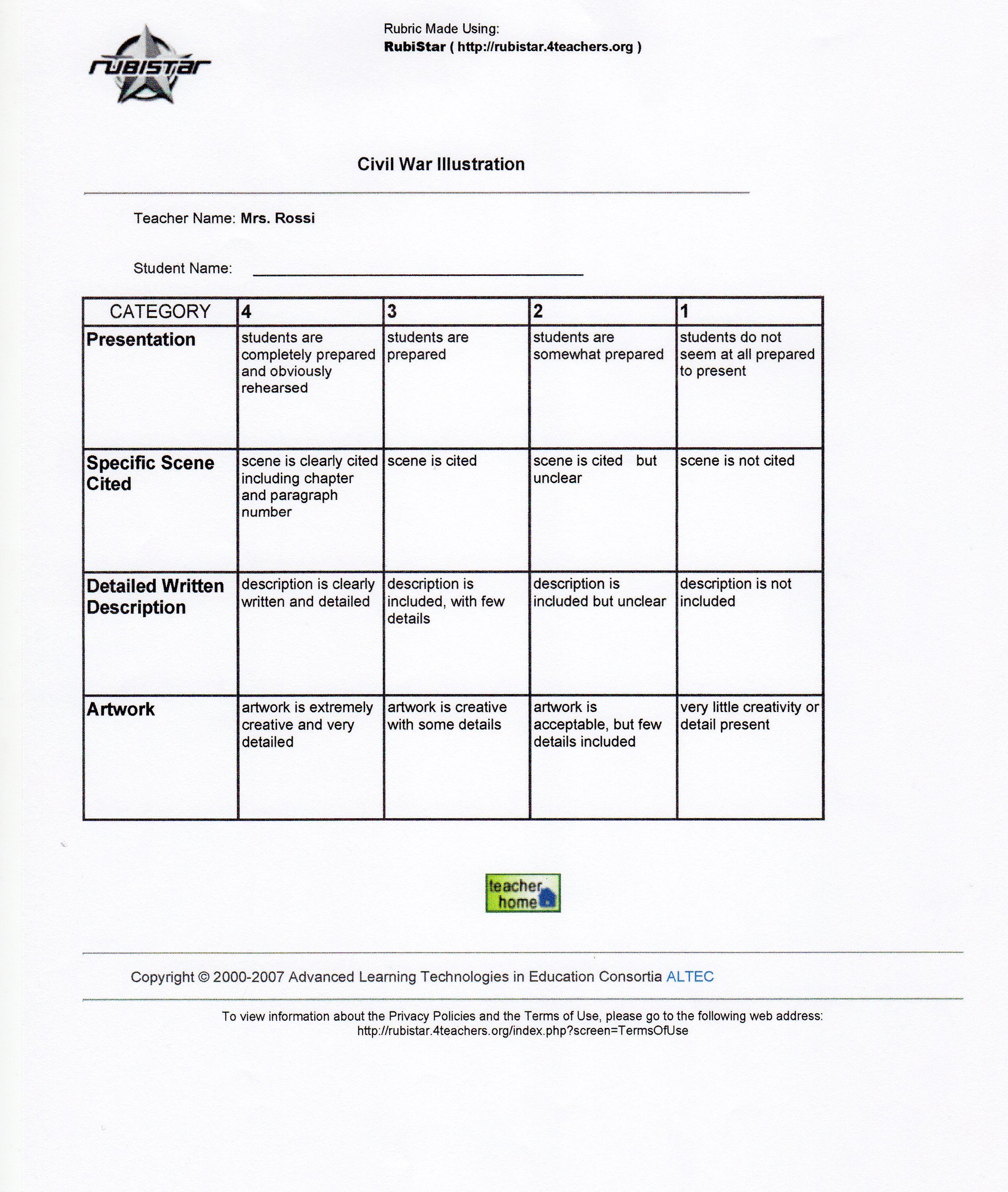
Pick one scene and using an art medium of your choice, create an illustration for a specific scene. (Yes! It can be abstract.) In your own words, write a detailed description of the scene you have chosen to illustrate. Be sure to include the actual passage cited with chapter and paragraph. (Minimum 100 words.) You and your partner will present this illustration to the class along with the other students who have selected this task on “Illustration Day”.
***************************************************************************************************************************************************************************************************
Songs of the Civil War
Many songs were written about the Civil War. This music was used in a variety of ways – from political to personal. The Red Badge of Courage was acknowledged to be one of the first novels about war that did not glorify battle … and portrayed the true terror and devastation felt be the soldiers. Three selections below are poignant examples of this perspective and the very personal cost of war.
Read the lyrics of “The Faded Coat of Blue” as you listen to a recorded version of the song:
http://www.youtube.com/watch?v=SZPIZ0g9wC4
“This weeper memorializes the death of a "brave lad" who now lies in an unmarked grave in his "faded coat of blue." The lyrics suggest he may have starved to death.”
THE FADED COAT OF BLUE
by J.H. McNaughton
In a lonely grave unknown lies the heart that beat so true.
He sank faint and hungry among the Spanish brave
And they laid him sad and lonely in a nameless grave.
CHORUS: No more the bugle calls the weary one.
Rest, noble spirit in their graves unknown
For we'll find you and know you among the good and true
Where a robe of white is given for a faded coat of blue.
He cried "Give me water and just a little crumb
And my mother she will bless you through all the years to come
And tell my sweet sister, so gentle, good and true.
That I'll meet her up in heaven in my faded coat of blue".
No dear one was nigh him to close his mild blue eyes
No gentle voice was by him to give him sweet replies
No stone marks the lonely sod of my lad so brave and true
In a lowly grave he's sleeping in his faded coat of blue
Read the lyrics of “Last Letter Home” while you listen to a recorded version of the song here:
http://www.youtube.com/watch?v=TNlXOQX6JkI
“"I joined the Southern cavalry for fun," says this dying soldier whose wounds are so grievous that "the morphine seems to do no good at all." It is a chilling statement about the heartbreaking bravado of youth and the impulse that ensures nations an endless supply of cannon fodder.”
“Last Letter Home”
I have heard the cannons thundering all night,
And I cannot help but wonder, why's the Rebel Cause so right?
And the morphine seems to do no good at all.
I would run away, if I would not fall.
Well I joined the Southern cavalry for fun.
Must have rode a thousand horses; Always had a way with a gun.
Now I'm among the horseless riders lying still.
Swallowed up by the Cause on the Widow's Hill.
And I dreamed of a rose in a Spanish garden,
And I kissed you and placed it in your hair.
And, if I'm ever on my feet again, I will,
I will run all the way just to meet you there.
Through the day I watched those Southern boys go down.
And they lay like Georgia peaches, bruised and broken on the ground.
Through the night I wondered if it was worth the pain,
And I cried not in revenge, but I called your name.
And I dreamed of a rose in a Spanish garden,
And I kissed you and placed it in your hair.
And, if I'm ever on my feet again, I will,
I will run all the way just to meet you there.
Read the lyrics of “The Vacant Chair” as you listen to a recorded version of the song:
http://www.youtube.com/watch?v=FT25niTg2IM
“The death in battle of a soldier from Massachusetts inspired a poem that was soon set to music. It visualizes what family gatherings will be like with one chair at the table forever vacant.”
“The Vacant Chair”
by Henry S. Washburn
[Chorus:]
We shall meet, but we shall miss him
There will be one vacant chair
We shall linger to caress him
While we breathe our evening prayer
When a year ago we gathered
Joy was in his mild blue eye,
But a golden chord is severed
And our hopes in ruin lie.
[Chorus]
At our fireside, sad and lonely,
Often will the bosom swell,
At remembrance of the story
How our noble Willie fell;
How he strove to bear our banner
Through the thickest of the fight,
And uphold our country's honor
In the strength of manhood's night.
[Chorus]
True, they tell us wreaths of glory
Ever more will deck his brow,
But this soothes the anguish only
Sweeping o'er our heartstrings now.
Sleep today, Oh early fallen,
In thy green and narrow bed,
Dirges from the pine and cypress,
Mingle with the tears we shed.
[Chorus]
OPTION 3-Song
Write song lyrics from the perspective of one of the following characters from The Red Badge of Courage:
Henry Fleming
Henry’s mother
Jim Conklin
Wilson
The tattered soldier
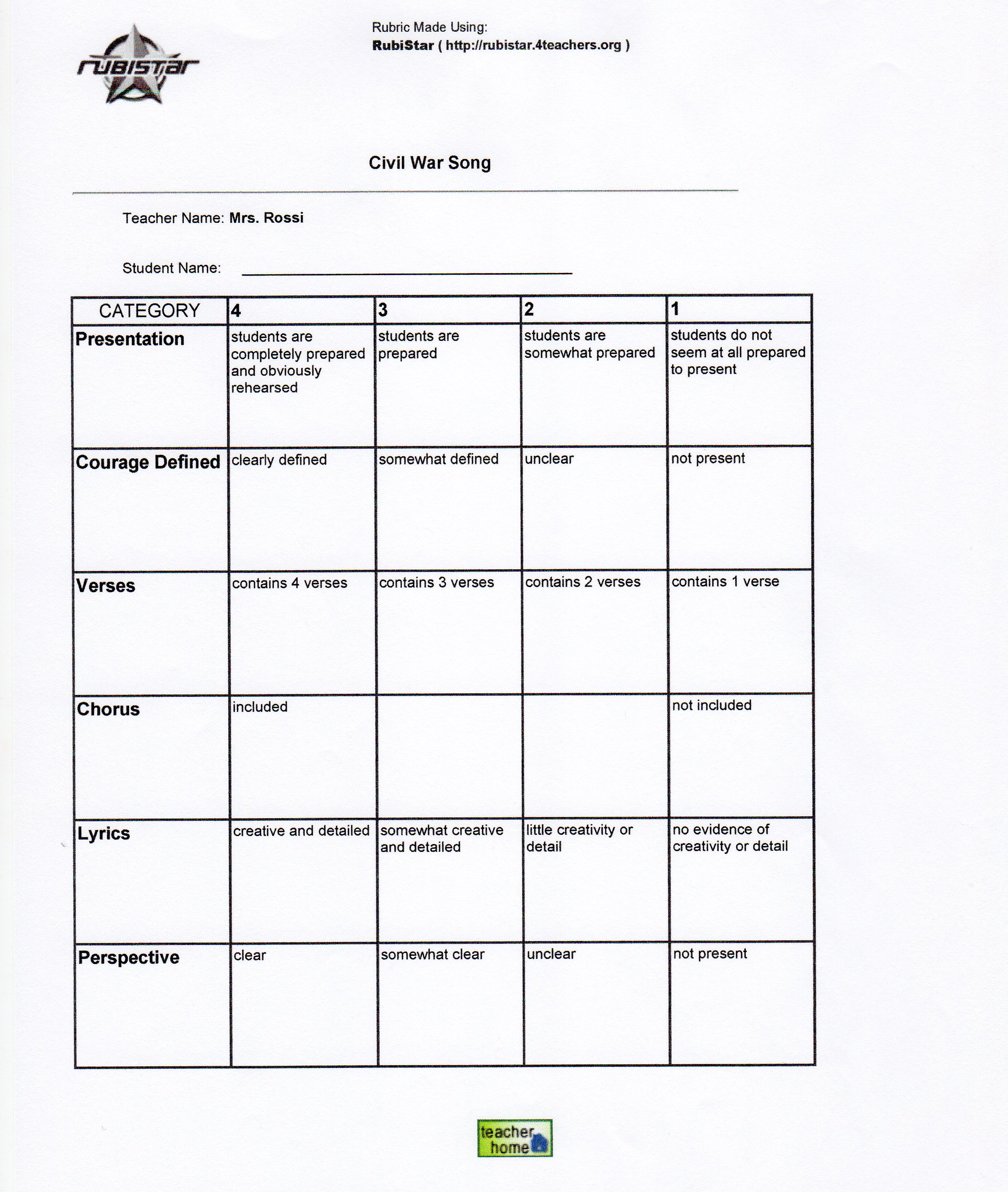
You must include the character's definition of courage in your lyrics. What does it mean to them? Does it change over time? Be sure to include a title, chorus and at least four verses. (Yes! It can be a rap song.) If you are musically inclined, add sheet music to you song. You and your partner will read your lyrics/perform your song for the class along with other students who have selected this task on “Song Day.”
Evaluation
Conclusion
Congratulations!
You and your partner have collaborated to create a project which will enhance your understanding of the novel as well as the Civil War. There will be one designated day for presentations of letters, one day for illustrations, and one day for songs.
Credits
"12 Civil War Songs to Check Out After You've Seen Lincoln | Cmtedge.com." Cmtedgecom. N.p., n.d. Web. 05 Apr. 2014.
Burns, Ken. "Civil War Letters In the Classroom." PBS. PBS, 23 July 1990. Web. 05 Apr. 2014.
""Faded Coat of Blue" Annie & Mac Old Time Music Moment." YouTube. YouTube, 25 Aug. 2011. Web. 05 Apr. 2014.
"Imaging the Civil War: Authenticity in Painting, Photography, and The Red Badge OfCourage." Imaging the Civil War: Authenticity in Painting, Photography, and The Red Badge OfCourage. N.p., n.d. Web. 05 Apr. 2014.
"The Last Letter Home Performed by Hickory Vaught and Bernie Lubbers." YouTube. YouTube, 02 Apr. 2013. Web. 05 Apr. 2014.
""My Very Dear Wife" - The Last Letter of Major Sullivan Ballou." National Parks Service. Ed. United States. National Park Service. U.S. Department of the Interior, 01 Apr. 2014. Web. 05 Apr. 2014.
PBS. PBS, n.d. Web. 05 Apr. 2014.
Shmoop Editorial Team. "The Red Badge of Courage Quotes." Shmoop.com. Shmoop University, Inc., 11 Nov. 2008. Web. 05 Apr. 2014.
"The Vacant Chair." YouTube. YouTube, 20 Apr. 2009. Web. 05 Apr. 2014.
Teacher Page
This WebQuest was created for students in grade 8 to accompany the reading of the novel, The Red Badge of Courage. The activities in this WebQuest were designed to meet the following standards:
RI8.1: Cite the textual evidence that most strongly supports an analysis of what the text says explicitly as well as inferences drawn from the text.
RI8.2: Determine a central idea of a text and analyze its development over the course of the text, including its relationship to supporting ideas; provide an objective summary of the text.
RI8.3: Analyze how a text makes connections among and distinctions between individuals, ideas, or events (e.g., through comparisons, analogies, or categories).
W8.6: Use technology, including the Internet, to produce and publish writing and present the relationships between information and ideas efficiently as well as to interact and collaborate with others.
W8.9: Draw evidence from literary or informational texts to support analysis, reflection, and research.
SL8.4: Present claims and findings (e.g., argument, narrative, response to literature presentations), emphasizing salient points in a focused, coherent manner with relevant evidence, sound valid reasoning, and well-chosen details; use appropriate eye contact, adequate volume, and clear pronunciation.