
Introduction
Have you ever had a baked potato without  salt? Not too tasty, right? Well, writing without figurative language is about the same. Figurative language adds spice to your writing. It makes it fun to read, and helps the reader visualize what the author is trying to express. This webquest will help you to become a more expressive writer. Work independently as you begin your Figurative Language Journey. During this journey, you will explore 5 different types of figurative language:Simile, Metaphor, Onomatopoeia, Personification and Imagery.
Task
You will engage in research and tasks that will allow you to investigate and discover methods that will improve your own writing skills.
- Study Similes, Metaphors, Onomataopeia, Personification and Imagery.
- Be able to recognize and infer the meaning of figurative language in short stories and poetry
- Create and Print a multimedia Flip Chart that contains all of the following types of figurative language being studied.
Process
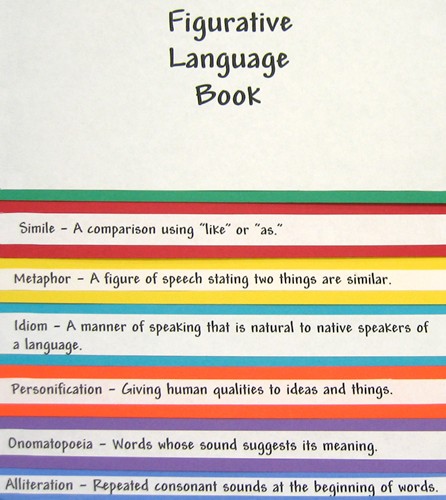
FLIP CHART NOTES
- Continue to scroll down and read all the materials in the hyperlinks first before creating your Flip Chart. There is no "save" function on the Flip Chart. The Flip Chart must be done in one sitting
- Write notes about information that you will include in your Flip Chart. These notes will be turned in.
- There are 5 kinds of figurative language that should be included in the Flip Chart.
- Create a multimedia Flip Chart that contains all of the following types of figurative language: Similes, Personification, Metaphors, Onomataopeia, Imagery.
- Research, discover, and write the answers to each question that follows on each page of your chart
- Print the flip chart when you have finished
- Turn in both your chart and notes at the end of the period.
Tab 1 - Similes
Include the answers to all the questions. Some of your responses will require inferences, others will require examples only.
- What are similes?
- How are similes used in writings?
- Write three original sentences to include similes.
- Read Predictable by Bruce Lansky
- Use the graphic organizer to write similes from the poem.
- Re-create the poem Predictable and title it Clever.
Tab 2 - Metaphor
Analyze the list of metaphors.
- What is a metaphor?
- Choose 5 of the words given to create your own metaphor: red, girl, bed, school, bus, desk, shoe, television, friend, heart, shark, car, blue, yellow.
- Tab 3 - Personification
Watch the Personification clip. Answer the questions. Some of your responses will require inferences, others will require examples only.
- What is personification?
- How is personification used in writing?
- Why is personification use? What is its purpose?
- Write three original sentences that employ personification
- Tab 4 - Onomatopoeia
Click on this link Onomatopoeia to create a definition. After you have defined the word, choose a poem and write it down. Underline lines that used Onomatopoeia.
- Tab 5 - Imagery
Read Fly Away Home by Eve Bunting. While listening to the story take note of the following: Setting; physical appearance; location; problem and solution
Open the picture book questions - Write the questions and answer each. *** Drawings will be included after the Flip Book is Printed.
Flip Book Instructions
THERE IS NO SAVING. PLEASE WORK QUICKLY!
1. Open a new window or tab by clicking this link.
2. Click "Add a page label" until you have 8 tabs.
3. Fill in each tab with the figurative language term.
4. Click the "next" button on the top right corner of the page.
5. Choose "Black Ink Printer" when the printer menu opens.
6. Fill each tab with the notes you took. Make sure to get the information from all the questions on each flip book page. You may be creative and use different templates/designs.
7. When finished click the "print" button in the top right corner, and then print again. Make sure to pick up your flipbook and put your name on it before you turn it in.
Evaluation
Evaluation
You will be evaluated on how complete your notes are as well as your finished flip book product.