
Introduction
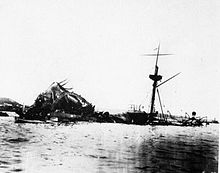
In 1898 a there was a war that was so short that many students even forget it happened.
While the Spanish-American War only lasted some short four months, it taught us somethings about a fledgling new country, our suspcions through peer pressure, and the enromity of the consequences of our actions.
Complete this Webquest to not only understand the Who? What? When? Where? Why? and How? of the Spanish-American War, but explore the controversies, the GOSSIP, and death tolls that still cause us to cringe.
The objectives:
- Based on SC SS Standard 5-3.5 yous hould be able to:
- Understand the concept of yellow journalism
- Apply the principle of yellow journalism through re-creating a piece of your own
- the results of the stance of America as a world power after the Spanish-American War
- Explore the controverisal topic of the Bombing/Explosion of the USS Maine (the event that is said to have began the Spanish-American War)
- Based on the CCRL5.1: Quote accurately from a text when explaining what the text says explicitly wand when drawing indferences from the text.
Task
You have two tasks to complete!
Process
Task 1Visit the following websites and answer the questions below: http://history.state.gov/milestones/1866-1898/yellow-journalism http://pbs.orgcrucible/frames/_journalism.htm What is yellow journalism and how did it contribute to the Spanish American War? On the PBS website, click on the link titled "Hearst Gallery." Examine the examples of headlines about the Spanish American War. How are these headlines examples of yellow journalism?Task 2Visit the following websites and answer the questions below:http://www.history.navy.mil/faqs/faq71-1.htmhttp://www.history.navy.mil/photos/events/spanam/events/maineskg.htmAnswer the following questions:
- What was the purpose of the USS Maine's location?
- What was the importance of the USS Maine's location?
Culminating Activity:
Create a piece of yellow journalism based on the controversy of the attack/explosion of the USS Maine.
Explore the controversy as to whether the "Bombing" of the USS Maine was in fact an explosion in the weapons armory of the ship or an attack from Spanish forces.
- Compile not only an argument, but reconstruct (per group) a to-scale model of the bombing of the ship to prove which side they've taken.
Your argument should be in the form of a thesis statement explaining the reasoing behind your belief.Create a reconstructed model of the ship that explains (supports) your theory of explosion/bombing.
Evaluation
Rubric for Spanish-American War Project
|
Criteria |
weight |
4 – Exemplary |
3 – Accomplished |
2 – Developing |
1 – Beginning |
|
Cooperation |
10% |
¨ Does a full share of work or more ¨ Assigns a clearly defined role; group members perform roles effectively ¨ Always considers all views and helps team to reach fair decision ¨ Never argues with teammates ¨ Group tries to solve its problems by itself without seeking outside help |
¨ Does an equal share of work ¨ Assigns roles, but roles are not clearly defined or consistently adhered to ¨ Usually considers all views and helps team to reach fair decision ¨ Rarely argues ¨ Group seldom solves its problems as a team and asks classmates or teacher for help |
¨ Does almost as much work as others ¨ Assigns roles, but roles are not adhered to ¨ Often sides with friends instead of considering all views ¨ Sometimes argues ¨ Group settles problems and gives up easily |
¨Does less work than other group members ¨No effort made to assign roles to group members ¨Acts as cliques or individuals rather than group ¨Arguments within group ¨Little attempt to solve problems; gives up easily |
|
Research |
15% |
¨ Collects and contributes accurate content ¨ Goes above and beyond to research information ¨ Communicates and shares all information with the group ¨ Always does the assigned work without having to be reminded |
¨ Collects and contributes mostly accurate content ¨ At times, takes initiative to find extra information ¨ Shares information with the group ¨ Usually does the assigned work; rarely needs reminding |
¨ Collects and contributes somewhat accurate content ¨ Uses only materials provided ¨ Shares some information with the group ¨ Rarely does the assigned work; often needs reminding |
¨Collects and contributes inaccurate content ¨Does not utilize resources effectively ¨Keeps information to self; does not share with group ¨Relies on others to do the work |
|
Scale Model |
25% |
¨ Historically Accurate Model exemplifying the students’ position of attack or explosion |
¨ Model effectively built, butsome details are not historically accurate or relevant to the students’ position |
¨ Model has several historical flaws, and lacks needed components to convince the audience of the students’ position of attack or explosion |
¨Model has major historical flaws, and lacks needed components to convince the audience of the students’ position of attack or explosion |
|
Newspaper Front Page |
25% |
¨ Headline is engaging and creative ¨ Article accurately uses traits of yellow journalism ¨ Article introduces topic clearly and concisely. ¨ Article develops topic fully with relevant supporting facts and details. ¨ Article provides a related concluding statement or section. ¨ Front page demonstrates above average understanding of the use of sensationalized headlines. ¨ Front page is neat and colorful. |
¨ Headline is thoughtful ¨ Article adequately uses traits of yellow journalism ¨ Article introduces topic clearly. ¨ Article develops topic adequately with general facts and details. ¨ Article provides a concluding statement or section. ¨ Front page demonstrates the understanding of the use of sensationalized headlines. ¨ Front page is adequately neat and colorful. |
¨ Headline is somewhat unclear ¨ Article uses few traits of yellow journalism ¨ Article introduces topic. ¨ Article develops topic with minimal facts or details. ¨ Article provides a limited conclusion. ¨ Front page demonstrates little understanding of the use of sensationalized headlines. ¨ Little color is used in the front page and it is somewhat neat in appearance. |
¨Headline is unclear and shows little resemblance to the topic ¨Article attempts to use traits of yellow journalism. ¨Article attempts to introduce topic. ¨Article attempts to develop topic using few facts and details. ¨Article attempts to provide a conclusion. ¨Front page demonstrates very little understanding of the use of sensationalized headlines. ¨No color is used and front page is not neat in appearance.
|
|
Presentation |
25% |
¨ Presentation is clever and original ¨ Engaging; captures interest of audience ¨ Appropriate variety of visual aids ¨ Visual aids add to or clarify presentation ¨ Each presenter speaks clearly and loudly; good eye contact; appropriate body language ¨ Members contribute equally to the presentation |
¨ Presentation is thoughtful ¨ Presentation is well done; interesting to audience ¨ Some use of visual aids ¨ Visual aids somewhat add to or clarify presentation ¨ Most of the time, presenter speaks clearly and loudly; some eye contact; some use of appropriate body language ¨ Most of the members contributed equally to the presentation |
¨ Presentation is at times clearly presented ¨ Presentation is at times interesting to audience ¨ Limited use of visual aids ¨ Visual aids do not clarify or add the presentation ¨ Presenter is hard to hear; little eye contact; poor body language ¨ Some members did not contribute equally to the presentation |
¨Little creativity used; bland ¨Presentation is hard to follow; poorly organized ¨No use of visual aids ¨Presenter cannot be heard; no eye contact; poor body language ¨Some members did not contribute to the presentation |
Extra Credit (2pts. Each for a maximum of 10 points): Include any of the following newspaper components for extra credit: political cartoon, advertisments, or editorials about the war. Please remember to keep all content true to the time period.
Score ______________
Conclusion
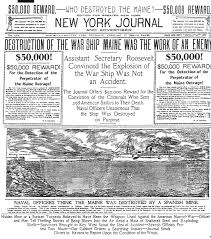
The Spanish-American War, while brief, was an important time in United States history. This solidified America's stance as a world power and brought to the forefront the sadness of war.
So what did you decide?
How did your study of the Spanish-American War help you to unveil the conspiracies and realities that plague America's history?
Your studies should affirm your need to:
1.) Recreate primary documents!
2.) Prove your argument!
3.) Investigate to find truths!
Credits
Images:
1898. USS Main (ACR-1). [Photograph]. Retrieved from http://en.wikipedia.org/wiki/File:USSMaine.jpg.

1898. The Maine entering Havana Harbor. [Photograph]. Retrieved from http://en.wikipedia.org/wiki/File:USS_Maine_entering_Havana_harbor_HD-S….

2014. http://www.buzzle.com/articles/ship-model-building.html
A Special Thanks Goes to:
Mrs. Jessica Overstreet
Ms. Kishni Neville
Mr. Sidney Reeves
...for all of their hardwork...