
Introduction
Poetry is a powerful form of language that allows us to express how we feel and see the world. Poetry should make you cry, laugh but most importantly feel!
Take some time to watch a Poetry Slam Champion
Wow! That's amazing...
This webquest will take you on a journey to explore some of the most famous poems. I hope it inspires you to create your own poems and explain to the others how you see and feel the world.
Task

Your task is to locate 3 poems using the websites or books in the library. You will present these poems giving information about the Poet, descibing the type of poem and the language techniques the poet used, explaining the message the poet is trying to convey and why you have choosen the poems. You will be presenting your work to the class in week 10.
Process
Step 1: Locate your 3 poems.
You might have already chosen suitable poems in class, you can still use them. Your poems need to be at least 10 lines long. Below are some useful websites to find poems:
When you have chosen 3 poems. Cut and paste or type the poems into a Word.doc. You can add a border and decorate them.
Remember to save your document to your name.
Step 2: Information about the Poet
Use the internet to research the Poets who wrote the poems you have selected.
The webpages from step 1 would be a good place to start.
Here are some questions to guide your thinking as you read about the poets.
- Where were they born?
- When were they born?
- What did they do for a living?
- How did they come to writing poetry?
- What was their most famous poem?
Now in you Word.doc under each poem write a paragraph about the poet.
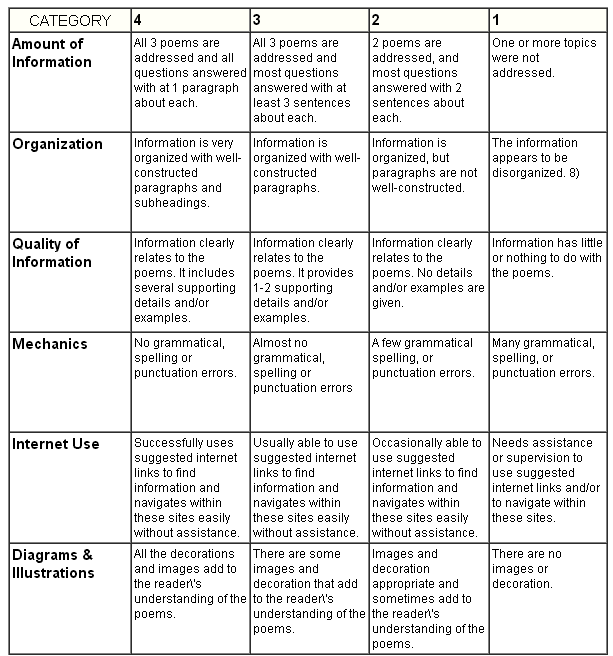
There is an example in the evaluation page.
Step 3: Type and Techniques
Use this website to discover what type of poem your poems are:
Now look at the techniques the poets may have used in your poems here:
In your Word.doc under each poem write two paragraphs. One explaining the type of poem and the other discussing the techniques the poet has used in the poem. Remember to quote examples from the poem.
An example is on the evaluation page.
Step 4: Messages
Now you need to really read your poems and decide what are the messages in the poems. Here are some questions to guide your thinking as you re-read your poems:
What is the poet trying to tell the reader?
How is this poem making you feel?
Often the type of poem gives us a clue or sometimes the last stanza or the most repeated phrase.
In your Word.doc under each poem write a paragraph telling me what message the poet is trying to tell you the reader.
An example is on the evaluation page.
Step 5: Why did you pick these poems?
You are nearly there! There must have been a reason for you to pick your poems. Here are some questions to guide your thoughts:
Did you have something happen in your life that you can connect with this poem?
Do you like the sound of the poem?
Is the topic of the poem interesting to you?
How does this poem make you feel?
Now write a short paragraph in your Word.doc under each poem telling why.
Their is an example in the evaluation.
Evaluation
Wynken, Blynken, and Nod (Dutch Lullaby)
by Eugene Field
Wynken, Blynken, and Nod one night
Sailed off in a wooden shoe---
Sailed on a river of crystal light,
Into a sea of dew.
"Where are you going, and what do you wish?"
The old moon asked the three.
"We have come to fish for the herring fish
That live in this beautiful sea;
Nets of silver and gold have we!"
Said Wynken,
Blynken,
And Nod.
The old moon laughed and sang a song,
As they rocked in the wooden shoe,
And the wind that sped them all night long
Ruffled the waves of dew.
The little stars were the herring fish
That lived in that beautiful sea---
"Now cast your nets wherever you wish---
Never afeard are we";
So cried the stars to the fishermen three:
Wynken,
Blynken,
And Nod.
All night long their nets they threw
To the stars in the twinkling foam---
Then down from the skies came the wooden shoe,
Bringing the fishermen home;
'T was all so pretty a sail it seemed
As if it could not be,
And some folks thought 't was a dream they 'd dreamed
Of sailing that beautiful sea---
But I shall name you the fishermen three:
Wynken,
Blynken,
And Nod.Wynken and Blynken are two little eyes,
And Nod is a little head,
And the wooden shoe that sailed the skies
Is a wee one's trundle-bed.
So shut your eyes while mother sings
Of wonderful sights that be,
And you shall see the beautiful things
As you rock in the misty sea,
Where the old shoe rocked the fishermen three:
Wynken,
Blynken,
And Nod
Eugene Field
Eugene Field was an American poet who wrote only children’s poems. His nickname was “The Children’s Poet”. He was born on September 2nd, 1850, in Saint Louis and had one brother who was very different from him. He loved to study and was afraid of the dark as a child. At age six his mother died. He wrote his first poem when he was nine about his cousin’s dog, fido. As an adult Eugene had many jobs. He worked for many newspapers until the Chicago Daily News offered him a job where he wrote a humorous column called "Sharps and Flats". He first started publishing his poetry in 1879, as a book called "Christmas Treasures”. Over a twelve books of poetry followed and he became well known for his light-hearted poems for children, perhaps the most famous of which is "Wynken, Blynken, and Nod." Field passed away in Chicago of a heart attack at the age of 45.
Type of Poem
Wynken Blynken and Nod is a lullaby. Lullabies were used to help send children to sleep and should rhyme making them sound musical when they are read; often they are put to music.
Poetic Techniques
Metaphors are the comparison of two unlike things without using ‘like’ or ‘as’.
This poem is all about Metaphors which create beautiful pictures in the readers mind. Some of the metaphors used in this poem are:
Wynken, Blynken, and Nod – eyes and head
Sailed off in a wooden shoe- drifting off to sleep in a trundle bed
Sailed on a river of crystal light,
Into a sea of dew. – into their dreams
We have come to fish for the herring fish
That live in this beautiful sea- to look for dreams in their mind
As they rocked in the wooden shoe- the rocking of a trundle bed
Repetition is using the same words or phrases in the same stanza or in a pattern in the poem.
In this poem the poet has used repetition with the words;
Said Wynken, Blynken, and Nod at the beginning and repeated at the end of each stanza.
Rhyme scheme is a repeated pattern of rhymed words at the end of the line.
In Wynken, Blynken and Nod the rhyme scheme is ABABCDCDD in each of the stanzas.
Wynken, Blynken, and Nod one night (A)
Sailed off in a wooden shoe--- (B)
Sailed on a river of crystal light, (A)
Into a sea of dew. (B)
"Where are you going, and what do you wish?" (C)
The old moon asked the three. (D)
"We have come to fish for the herring fish (C)
That live in this beautiful sea; ( D)
Nets of silver and gold have we!" (D)
Said Wynken,
Blynken,
And Nod.
Personification is giving human qualities or characteristics to animals or objects.
The poet has used personification in this poem when he make the moon talk and sing.
"Where are you going, and what do you wish?"
The old moon asked the three.
The old moon laughed and sang a song,
Message
The poem Wynken, Blynken and Nod is giving a message of calm and safety so that the child it is being read to can fall asleep. The poet does this by using rhyme that makes it sound musical and the beautiful images he makes with the metaphors. He wants the reader to feel safe when he says, “Never afeard are we”, and to have beautiful dreams. He makes the reader feel even safer when he describes what Wynken and Blynken and Nod are and tells the child that the mother is near.
So shut your eyes while mother sings
Of wonderful sights that be,
Why I chose this Poem…
I chose this poem because when my son was small it was his favourite poem to read before bed. I like the feeling of peace and happiness it gives as you read it and find it beautiful to read aloud. I think it is clever how the poet uses the eyes and head of the child to make it personal and that it is a dream I could imagine.
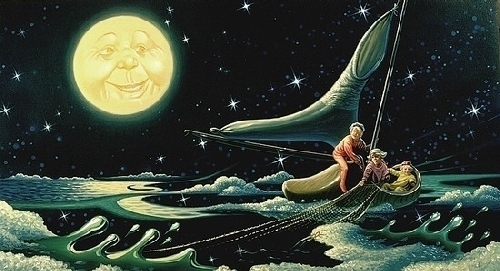
http://bobpetillo.com/workszoom/111305/wynken-blynken-and-nod
Conclusion
Lastly, check your work and make it look interesting with images and page borders if you wish and print it for Mrs Wyber. Remeber to include your name.You will be choosing one poem to present to the class in week 10.