
Introduction

Pretend you are an historian embarking on an adventure! You will be looking for clues about the culture, land, and lifestyle of the Mesopotamian people. You will find detailed information within this webquest. You will also explore artifacts uncovered by previous archaeologists. Artifacts can help tell the story of a people and their civilization. As a historian you will use these discoveries to put together the story of the ancient Mesopotamian civilization.
[video:https://www.youtube.com/watch?v=84y2q4giihY&feature=youtu.be]
Task
Follow the instructions within the webquest. At times you will be asked to read information on websites, view maps, watch videos, and even play games. There will be questions throughout; think about your answers.
The answers won't always be factual; you will often give your opinion, based on facts. You will need to rely on what you have learned in class and what you experience in the webquest.
Make sure you follow the directions and answer the questions in complete sentences. You may write your answers on loose-leaf or type them on a Word document.
Process
Check out Sumerian Cuneiform Writing. Read through the whole page.
1. Why did the Sumerians decide to use symbols instead of pictographs? (If you are unsure of what a word means look it up - use the dictionaries or Merriam-Webster online dictionary)
2. What material did they write their records on? What d
4. Look at the numbers in this form of writing. Write your age using this writing. (This is easy and fun - enjoy!)3. What other civilizations adopted cuneiform writing? How was this helpful to historians?id they keep a record of? (Be specific - there are many.)
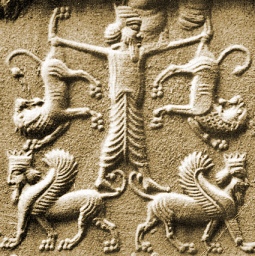
5. What is the Epic of Gilgamesh?
6. Why do you think it is historically important? Read the story of Gilgamesh and the Cedar Forest
7. Who was Gilgamesh?
8. Why did Gilgamesh want to go on an adventure with Enkidu?
9. What did they accomplish on their adventure? (Summarize in your own words - using complete sentences).
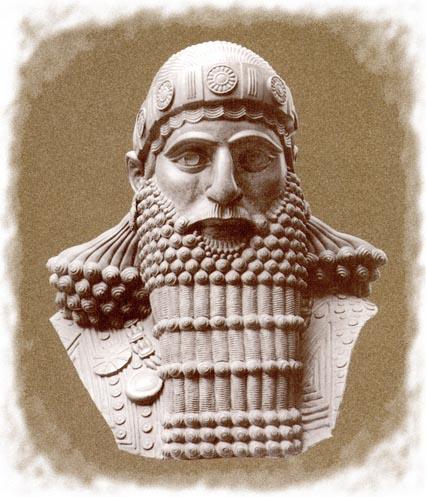
10. Who was Hammurabi? What did he create? What did he believe?
11. Where were the laws found, and by whom?
12. Read through the first ten laws of Hammurabi's Code. List three that you thought were most surprising.
13. What is a city-state? Click here and read: city-state definition (The answer is in the first paragraph - but this is a great website - read on a bit )
14. Who ruled the city-states?
15. What is the Standard of Ur?
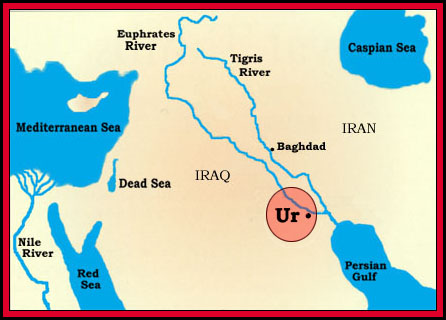
16. Examine Ur's location on the map; why do you think it became such an important city-state?
17. Take a look at this slide show of Lost Treasures from Iraq. Describe three of the artifacts (in your own words) that you found interesting.
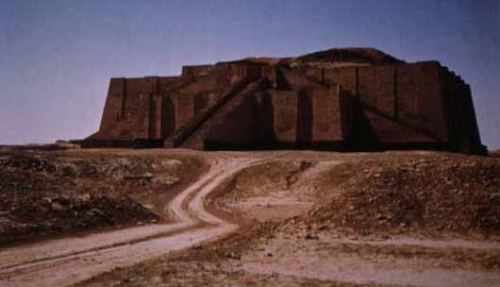
Read about Ziggurats.
18. Why were they built (explain the people's beliefs)?
19. Where were they built (in the community)? Explore how ziggurats were built over time: (You'll need to click on the arrow to continue with the story.)
20. Where was one of the oldest ziggurats built?
21. Why would kings leave their names carved on objects in the buildings? Explore the Ziggurat of Ur Ruins. Click on the pictures and read the captions.
22. Who was C. Leonard Wooley? What did he do?
23. This image allows you to click around on it. Choose two areas on the ziggurat to investigate and then explain them. (Use details and complete sentences please!)
FOR FUN!!! Attempt the challenge of building a ziggurat: Ziggurat Challenge!
Read the page and look at the video at the bottom.
24. How does the environment make it difficult for archeologists to uncover artifacts?
25. Weather greatly affects archeologists work. What kind of affect do you think it had on the Mesopotamians? (think about it!!!)
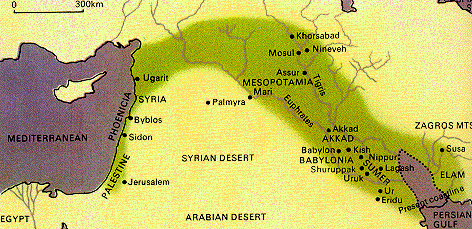
See how much you know about Mesopotamia. Take the quiz.
Good work - you have completed the webquest!!! Pick a partner and play The Royal Game of Ur. Have fun!
Pretend that you live in Ancient Sumeria and write about your daily life. Be sure to include geography, religion, literature, and government. Your response must be at least one page in length. Be creative!
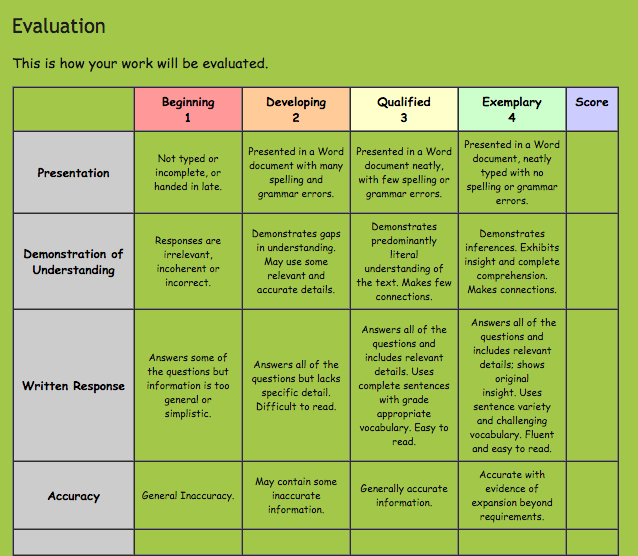
Evaluation
Teacher Page
Purpose
The purpose of this project is to get the students to take an active role in their learning
experience. In this activity we will ask the students to pretend that they are historians and explore
several facets of the culture, and lifestyle of the people of Mesopotamia as well as the geography
of Mesopotamia itself. By taking on the role of a historian the students will use the given sources
in order to examine stories, documents and artifacts. For some of the questions the students will
simple be asked to read and analyze documents and answer questions based on those documents.
In other instances the students will be asked to make inferences and formulate their own opinions
about the information being presented to them. In addition, by presenting this information through
a website and allowing the students to use technology in the classroom, we hope to appeal to the
students interests and get them excited to learn.
In completing these tasks the students will be implementing skills from several of the
Social Studies common Core standards. They will be citing textual evidence while answering
questions based on primary and secondary sources. They will be using technology as a learning
tool in which they produce and present information and ideas in a clear and concise manner. They
will be determining the central idea of the sources they are working with as well as formulate their
own opinions based on the information being presented to them. In closing, this activity is
designed not only to enhance skills that will be crucial to the present and future success as our
students but we also hope to catch their attention and interest by utilizing technology in our
classrooms.
For our webquest lesson, we used multiple websites to give the students the most vast and
diverse resources possible. The first set of links takes the students to information on cuneiform,
the Mesopotamian written language. This gives the students their first insight into the day-to-
day lives of the Mesopotamians by illustrating how they were the first civilization to master a
written language. The next section, The Epic of Gilgamesh, is essential to any understanding of
ancient Mesopotamia as it introduces the students to the first major legend and hero of recorded
history. Hopefully, this would intrigue the students as it offers more exciting information and
prose than a primary source of artwork or agriculture. This story could be useful to hold the
student’s attention and interest in the subject.
The next group of links takes the students to lessons on Hammurabi’s Code and City-
States. These topics are essential to any discussion of Mesopotamia and also have the benefit of
being both familiar to the students and easy to comprehend. Nearly all students are familiar with
the expression “an eye for an eye” and therefore are already aware of the basics of the Code of
Hammurabi. City-states are also relatively simple for students as they have already learned of
similar living situations with the ancient Greeks and Native Americans.
Following that, we used a series of links on artifacts and religion to show the students
what kind of items and tools were used during this time period and how people worshipped.
These are both key details to understanding the Mesopotamian people and would give the
students a great deal of insight on how these people lived which will help on their final written
assignment. Lastly, we used a video on the geography and climate of the Fertile Crescent to give
the students the last pieces of information needed to complete their final assignment by showing
what kind of weather and geographical issues affected the lives of the Mesopotamians.
Standards Addressed
Our lesson addresses the NCSS standard of culture. Specifically, students will learn about
how the ancient Sumerians created and adapted to culture. Through the webquest, students will
observe parts of ancient Sumerian culture and then in a writing activity imagine they were living
in that time and will describe their life.
Common Core Standards:
CCSS.ELA-LITERACY.RH.6-8.1
Cite specific textual evidence to support analysis of primary and secondary
sources.
CCSS.ELA-LITERACY.RH.6-8.2
Determine the central ideas or information of a primary or secondary source;
provide an accurate summary of the source distinct from prior knowledge or
opinions.
CCSS.ELA-LITERACY.RH.6-8.4
Determine the meaning of words and phrases as they are used in a text, including
vocabulary specific to domains related to history/social studies.
CCSS.ELA-LITERACY.RH.6-8.7
Integrate visual information (e.g., in charts, graphs, photographs, videos, or maps)
with other information in print and digital texts.
CCSS.ELA-LITERACY.RH.6-8.9
Analyze the relationship between a primary and secondary source on the same topic.
CCSS.ELA-LITERACY.WHST.6-8.6
Use technology, including the Internet, to produce and publish writing and present
the relationships between information and ideas clearly and efficiently.
CCSS.ELA-LITERACY.WHST.6-8.7
Conduct short research projects to answer a question (including a self-generated
question), drawing on several sources and generating additional related, focused
questions that allow for multiple avenues of exploration.
CCSS.ELA-LITERACY.WHST.6-8.8
Gather relevant information from multiple print and digital sources, using search
terms effectively; assess the credibility and accuracy of each source; and quote
or paraphrase the data and conclusions of others while avoiding plagiarism and
following a standard format for citation.