
Introduction
Step into the shadowy corners of Edward Gorey’s imagination—where gloomy children meet unfortunate fates, and rhyme is both charming and chilling. Gorey never wrote classic limericks, but his work is a perfect match for the form: short, funny, grim, and clever.
Your mission? Study limericks, channel your inner Gorey, and craft your own collection of Gorey-style limericks complete with haunting illustrations.
Task
By the end of this WebQuest, you and your group will:
-
Explore Edward Gorey’s tone, themes, and illustrations.
-
Learn the structure and rhythm of limericks.
-
Write a series of Gorey-style limericks, each featuring a doomed or eccentric character.
-
Create illustrations that match your poems.
-
Present your collection as a "Little Book of Lurid Limericks."
Process
🔎 Phase 1: Who Was Edward Gorey?
Start by discovering who Edward Gorey was and what made his work so weird and wonderful.
Explore:
-
Selected readings: The Gashlycrumb Tinies, The Doubtful Guest
-
Search “Edward Gorey animated” on YouTube to watch his intros for PBS Mystery!
Mini Task: Answer the following:
-
What themes and tone does Gorey use?
-
How would you describe his art in 3 words?
-
What kind of characters does he invent?
Phase 2: Limerick Lab
Limericks are 5-line poems with the rhythm: da-da-DUM da-da-DUM da-da-DUM and a rhyming pattern of AABBA.
Example (classic, not Gorey-style):
There once was a man from Peru
Who dreamed he was eating his shoe.
He awoke with a fright
In the middle of the night
To find that his dream had come true.
Now imagine a Gorey-style version:
A boy who was fond of the sea
Was swallowed alive by a flea.
His mother was vexed,
His sister perplexed,
And they brewed him for afternoon tea.
Mini Task: Write two test limericks. One should be silly, one should be dark (Gorey-style).
Phase 3: The Dark & Droll Collection
Main Task: Create your own "Little Book of Lurid Limericks". In your group or solo:
-
Write 5 original Gorey-style limericks, each about a different character (ex: Eloise who tripped on a spike, or Neville who swallowed his bike).
-
Include a matching illustration for each. ex:
-
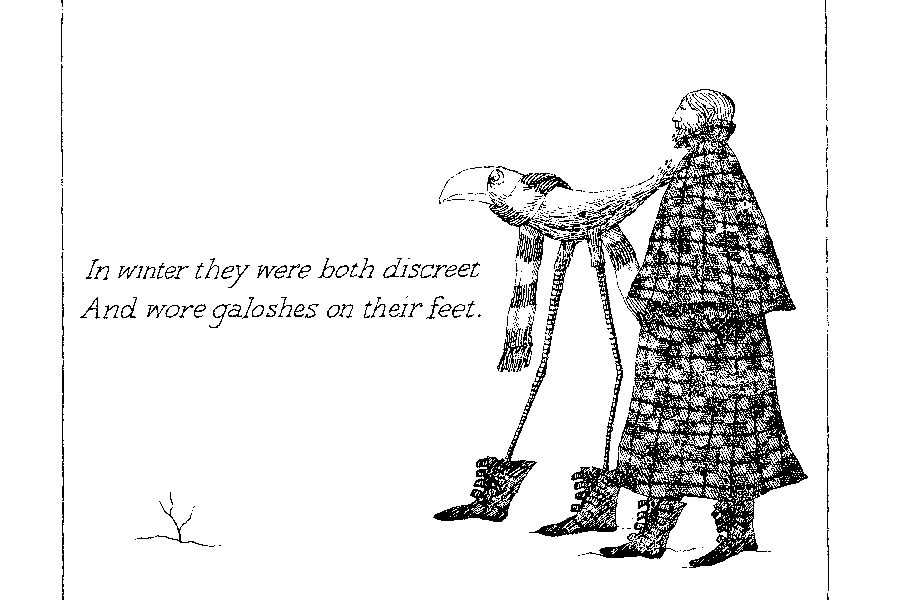
-
Design your book’s cover and title page.
Tools:
-
Hand-draw your book OR create it digitally using Google Slides, Canva, or Book Creator.
Phase 4: Share the Shadows
Present your book to the class:
-
Perform 1 of your limericks aloud in your best gloomy narrator voice.
-
Show your art and explain how you matched it to the poem’s mood.
Evaluation
| Category | 10 pts (Excellent) | 8 pts (Good) | 6 pts (Developing) | 4 pts (Needs Work) |
|---|---|---|---|---|
| Limerick Structure | All limericks follow rhythm/rhyme | Most follow structure well | Some mistakes in form | Lacks proper form |
| Gorey-style Tone | Clever, eerie, Gorey-perfect | Mostly dark and creative | Inconsistent tone | Lacks Gorey feel |
| Illustrations | Unique, detailed, matches poem | Good effort, fits story | Simple or unclear | Doesn’t relate |
| Creativity | Original characters/situations | Fun ideas with variety | Basic or repetitive | Needs imagination |
| Presentation | Clear, entertaining, expressive | Confident delivery | Rushed or unclear | Unprepared |
Conclusion
You’ve peered into the odd, unsettling world of Edward Gorey and added your own voice—through rhyme, rhythm, and illustration. Now you understand how just five lines can delight, disturb, and dazzle.