
Introduction
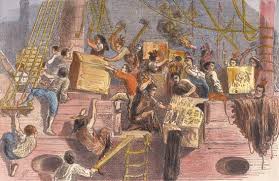
Taxation Without Representation!
Welcome! The Boston Tea party is one leading event that led up to the American Revolution and of which contains many key concepts to historical figures and geographical locations.Step back into time. You are a writer and your job is to record facts and opinions from the this historic event at the Boston Harbor in 1773. Ready? Let's go!
Task
The task for this project will be for you to use the facts you have read from the assigned webpages and class
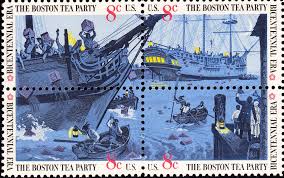 presentations and put yourself in
the Boston Tea Party. Choose a position: Positions include: a eyewitness, a patriot, indian, or a British citizen.
You will write a news journalarticle describing the Boston Tea Party through the perspective of the position you have choosen.
Process
1. First you will be assigned to a group of 4-6 members. Each group will use the provided a weblink and write a summary of important main ideas. You will share you information in class.
http://www.kidspast.com/world-history/0357-colonies-view-of-europe.php
http://memory.loc.gov/ammem/collections/continental/timeline1e.html
2. In the same groups, you will use information you discovered from your summary to describe events by making a timeline of events leading up to the Boston Tea Party. You will share your findings in a classroom discussion. Your group may use a interactive timeline found at: http://www.teachnology.com/web_tools/materials/timeline/
3. After the first two tasks are completed, Each group will now be given a specific role to research from provided websites. Responses can be recorded using the graphic organizer https://bubbl.us/ or on paper.
Group 1- What are taxes and how did colonists feel about taxes?
http://www.socialstudiesforkids.com/articles/ushistory/bostonteaparty.htm
http://www.historyforkids.org/learn/economy/taxes.htm
Group 2- Research the Indian roles in the Boston Tea Party.
http://www.pbs.org/ktca/liberty/popup_brant.html
http://www.eyewitnesstohistory.com/teaparty.htm
Group 3- Background information. Research the amount of tea dumped into the harbor. Find important participators/revolutionary members and describe their role in the Boston Tea Party.
http://www.ducksters.com/history/boston_tea_party.php
http://www.bostonteapartyship.com/participants-in-the-boston-tea-party
Group 4-Research on how the British felt about the Boston Tea Party.
http://www.kidport.com/reflib/usahistory/americanrevolution/teaparty.htm#Events
3. After research and collaboration is complete, each group will then present their findings and ideas to the class.
4. After each presentation independently you will write a news journal article describing the events based on the persepctive you choose based on what you learned from class presentations/discussions or information from your group.
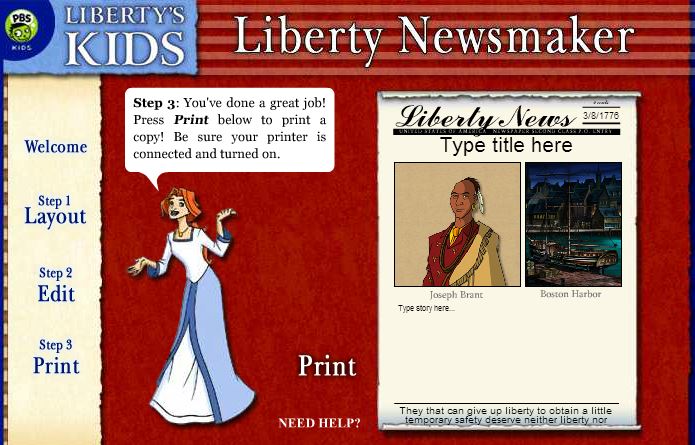
To do this, use the website to create your news story. (Format will look similar to the picture.)Make sure to print your story when done.
http://www.libertyskids.com/lnn_lnm.html
Evaluation
|
Beginning 1 |
Developing 2 |
Accomplished 3 |
Exemplary 4 |
Score |
|
|
Quality of Information |
Information has little or nothing to do with the main topic. |
Information clearly relates to the main topic. No details and/or examples are given. |
Information clearly relates to the main topic. It provides 1-2 supporting details and/or examples. |
Information clearly relates to the main topic. It includes several supporting details and/or examples. |
|
|
Mechanics
|
Many grammatical, spelling, or punctuation errors. |
A few grammatical spelling, or punctuation errors. |
Almost no grammatical, spelling or punctuation errors. |
No grammatical, spelling or punctuation errors. |
|
|
Internet Use
|
Needs assistance or supervision to use suggested internet links and/or to navigate within these sites. |
Occasionally able to use suggested internet links to find information and navigates within these sites easily without assistance. |
Usually able to use suggested internet links to find information and navigates within these sites easily without assistance. |
Successfully uses suggested internet links to find information and navigates within these sites easily without assistance. |
|
|
Working With Others
|
Rarely listens to, shares with, and supports the efforts of others. Often is not a good team player. |
Often listens to, shares with, and supports the efforts of others, but sometimes is not a good team member. |
Usually listens to, shares, with, and supports the efforts of others. Does not cause \"waves\" in the group. |
Almost always listens to, shares with, and supports the efforts of others. Tries to keep people working well together. |
|
|
Contributions |
Rarely provides useful ideas when participating in the group and in classroom discussion. |
Sometimes provides useful ideas when participating in the group and in classroom discussion. |
Usually provides useful ideas when participating in the group and in classroom discussion. |
Routinely provides useful ideas when participating in the group and in classroom discussion. |
Conclusion
You have learned the overall importance of the Boston Tea Party and how the American Revolution was started. You completed different projects to learn the importance of how history is told through different viewpoints. How did this change from your intial views and understanding based on reading a general summary? Knowing all the facts now would you have participated and took a stand that night?
Credits
Images used were found on google images from:
http://upload.wikimedia.org/wikipedia/commons/4/48/Boston_Tea_Party-1973_issue-3c.jpg

http://media-1.web.britannica.com/eb-media/75/96175-004-A4E3929F.jpg

Teacher Page
The purpose of the web-quest is for students to use inquiry of thinking. The process is taks to help students meet the overall goal which will over a two week period.
List of appropriate Common Core Standards:
CCSS.ELA-LITERACY.RH.6-8.6 CCSS.ELA-LITERACY.WHST.6-8.6 CCSS.ELA-LITERACY.RH.6-8.2 CCSS.ELA-LITERACY.WHST.6-8.4 Produce clear and coherent writing in which the development, organization, and style are appropriate to task, purpose, and audience. |
NET-S standards:
Design and Develop Digital-Age Learning Experiences and Assessments to provide students with multiple and varied formative and summative assessments aligned with content and technology standards and use resulting data to inform learning and teaching.
ISTE
Creativity and Innovation
Communication and Collaboration
Research and Information Fluency
Critical Thinking Problem solving decision making
Digital citizenship
Technology operations and concepts
Found at http://www.iste.org/docs/pdfs/20-14_ISTE_Standards-S_PDF.pdf