
Introduction
Earthquakes:
What are they? Why do they happen?
What happens when they end?
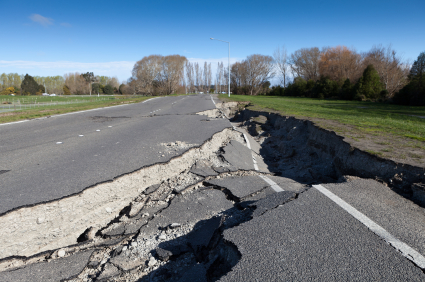
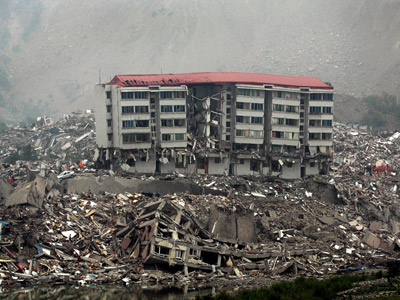
Task
The Task
Our class has been asked by President Obama to explore different websites on Earthquakes. The President want us to find information that could be helpful for the public to know about Earthquakes in case a large quake were to hit the United States.
The Objective
Your objective is to compare and contrast key details about earthquakes and their relationship to earth's surface between mutiple textual sources by presenting a comparative graphic organizer of your choice.
The Goal
Your goal is to finish this Webquest and help President Obama and our community. You will be doing this by completing a graphic organizer of your choice that compares and contrasts two different Earthquake websites/articles. You will work in small groups to find information about Earthquakes on both sites. You will determine what is similar (compare) and what is different (contrast) about the content or information provided. You will complete the graphic organizer listing these similarities and differences. Finally, you will present this graphic organizer in an oral presentation to the class.
Process
Breaking it Down
Day 1: We just finished learning about Earthquakes as a class. This is where we activated our background knowledge about this topic. This will make it easier to find the information and make comparisons between the websites. We also just finished completing an example of a graphic organzier in class where I show two websites I picked, and how I determined one similarity and one difference. Then as a class we found another similarity and difference to add to my graphic organizer. Not that this is completed, you will be placed into small groups (3-4) where you will decide on your articles. You must select two articles. One article will be one of the two I used during class, and the other must be from the other list on this Webquest. You must also select the type of graphic organizer you will use, and begin to plan how you will put it together.
Day 2: You will be working in your small groups to read the articles/websites you selected. All group members must be on task and participating. After writing down the Earthquake information in your Science journals, you will go back and determine the similarities and differences.
HINT: circle or underline the similarities/differences in your information preferably in different colors that way it is easier to assemble your graphic organizer.
Once you are done collecting the information and determing the key details, you will be using the graphic organizer your group chose to display the similiarities and differences. The graphic organizer can be done how your group chooses, but it must clear when addressing compare and contrast for the two websites information on earthquakes. We will be integrating the information from both websites on the topic of earthquakes when doing this graphic organizer and when presenting to the class. It is highly suggested you use illustrations (drawing, magazine cutouts, pictures off the Internet) to supplement your writing. Be prepared to present this graphic organizer to your class as an oral presentation. PREPARE, PREPARE, PREPARE!
Day 3: Present graphic organizer to the class in the form of an oral presentation. Complete self evaluation rubrics and answer final questions! You're done :)
All group members will need to participate equally in every step! Look at the evaluation page for more detailed information.
Websites
Pick one from this category (websites used in class):

http://earthquake.usgs.gov/learn/kids/eqscience.php

http://kids.nationalgeographic.com/explore/science/earthquake/
http://video.nationalgeographic.com/video/101-videos/earthquake-101
(Use the video to supplement the website)
Pick one from this category:

http://urbanext.illinois.edu/earth/ (Available in Spanish)

http://www.ga.gov.au/scientific-topics/hazards/earthquake/basics/what
http://www.history.com/videos/the-science-of-earthquakes#the-science-of…
(Use the video to supplement the website)
Organizers
Here are some types of graphic organizers you may want to use after you've found the information you need. These are just examples, you may use whatever graphic organizer you would like as long as it shows the comparisons and contrasts clearly organized. Pictures help to convey your information. Think about printing off pictures, drawing, or cutting out pictures from the magazines I have provided to supplement your writing.


Evaluation
Some Tips
- Briefly scan over the websites to get a general idea
- Limit your groups to 3-4 people
- Have some ideas in mind that you want to focus on
- Take clear notes in your journal and write down the URLs
- Clearly label the similarities and differences in your notes
- Spend time on your graphic organizer: make it neat and easy to read (include pictures). This will be beneficial when presenting, and help you and your audience.
- PRACTICE your oral presentation (what you will say, and who will say it)
- ASK THE TEACHER FOR HELP
- Stay calm and relaxed
- And the most important tip: Have fun!! :)
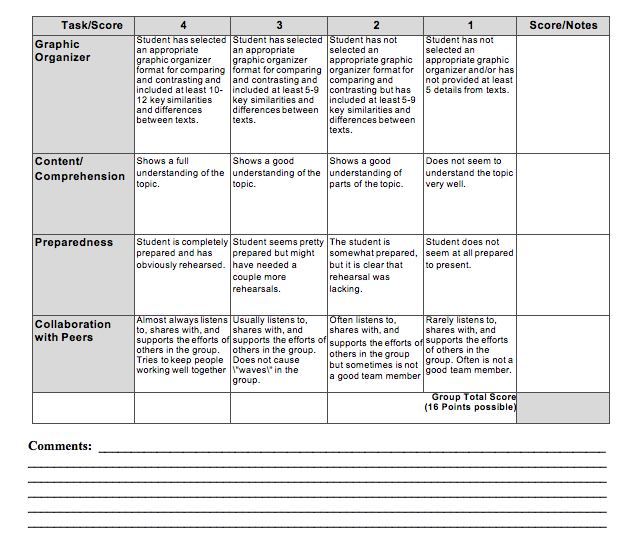
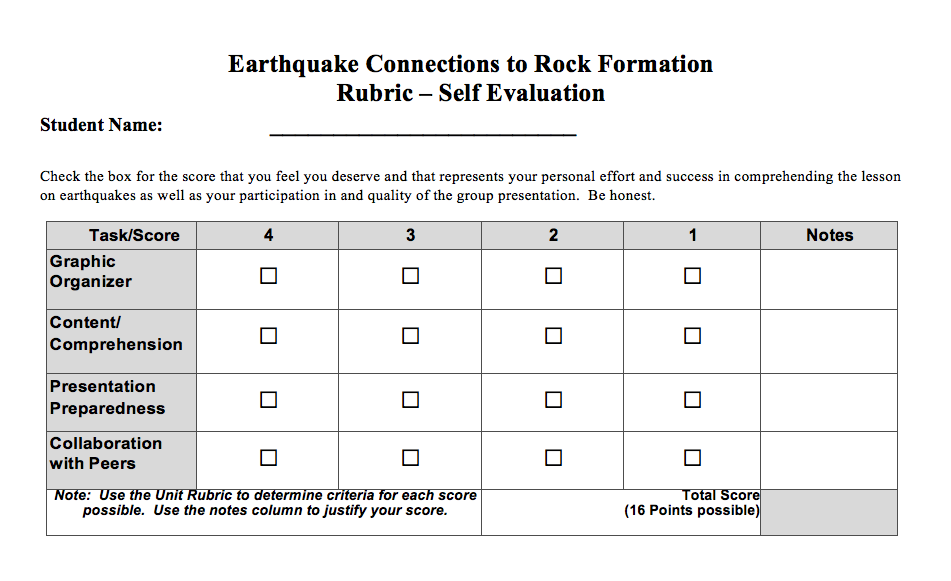
The Rubric
The first rubric is what I will be using to evaluate you on your participation, overall presentation, and T-chart. There is a second rubric that rates the same information, but you will be filling it out as a self evaluation form. I have attached both forms below.
Hint: Use the rubric to ensure you are on the right track. This helps to know that you have completed all the steps.
Conclusion
Congratulations Students!!

You have completed the webquest, and helped the President. Your graphic organizers and oral presentations helped teach the community a lot of great information about earthquakes.
Now that we have completed our lesson here are a few questions about earthquakes you should answer in your small groups.
What are the forces that cause earthquakes in the earth's surface, and why don't earthquakes split the earth open?
What are the places where the earthquakes occur between tectonic plates called?
What are the two types of fault line where the earth's crustal plate move together and move apart?
Credits
References
Pictures
http://easyscienceforkids.com/all-about-earthquakes/
http://science.howstuffworks.com/environmental/green-science/humans-sta…
http://www.imgion.com/images/01/Congrats-For-Great-Job-.jpg

Websites
http://kids.nationalgeographic.com/explore/science/earthquake/
http://video.nationalgeographic.com/video/101-videos/earthquake-101
http://earthquake.usgs.gov/learn/kids/eqscience.php
http://www.ga.gov.au/scientific-topics/hazards/earthquake/basics/what
http://urbanext.illinois.edu/earth/
http://www.history.com/videos/the-science-of-earthquakes#the-science-of…
http://www.vtaide.com/png/George/earthquake.htm
Organizers
http://www.do2learn.com/organizationtools/SocialSkillsToolbox/GraphicOr…
http://www.studenthandouts.com/01-Web-Pages/001-Pages/venn-diagram-comp…
http://timvandevall.com/free-printable-compare-and-contrast-graphic-org…
http://www.siue.edu/MLTE/LA%20Modules%20DONE/compare_and_contrast1.htm
Teacher Page
Earthquakes
Today we will begin our new Science unit on how the Earth's surface changes through a variety of processes and forces. We will be focusing on the relationship of earthquakes and the Earth's surface.
Here are a few questions to think about as we begin this unit.
From our background knowledge, we know that large earthquakes do not seem to happen in Denver, Colorado. If an earthquake were to happen in Denver, Colorado, what impact would it have on the local community? Its economy? and the local environment?
Why do you think earthquakes tend to reoccur in the same locations?
The Goal
For this lesson we will be completing a webquest. This webquest will help you integrate information from several texts (websites) on earthquakes in order to write (graphic organizers) and speak (oral presentation) on the subject knowledgeably. You will be comparing and contrasting details about earthquakes and their relationship to the earth's surface. Remember the Earth's surface changes constantly through a variety of processes and forces. At the end of this lesson you will be able to communicate different scientific explanations of factors that change the Earth's surface.
Basic Facts About Earthquakes
Key Vocabulary: similarity, difference, fault, tectonic plates, seismic waves, seismograph, epicenter, hypocenter, magnitude, earthquake (quake, tremor), and aftershock
An earthquake is a shaking of the ground caused by movement of large sections of the earth's crust. These sections are known as tectonic plates. The tectonic plates edges are marked by faults (fault plane). Most earthquakes occur along the fault lines when the plates move past each other or collide. The hypocenter is where the earthquake begins below the surface, and the epicenter is where it starts on the surface.
[img_assist|nid=22787|title=pic|desc=|link=none|align=left|width=615|height=484]
Graphic Organizer Example
I chose Nat Geo and USGS for my two websites to complete my T-chart graphic organizer. Now I will give you an example of one similarity and one difference (compare/contrast). We will then find one more similarity and difference together as a class before starting the Webquest. This should give you a clear idea of how to set up your graphic organizer.
