
Introduction
Hello everyone, welcome to my webquest about the climates around the world. You will come across some explanations about the topic. After this, you will use the newly learned information to answer some questions about earth plates.
Ultimately you know in which ways the earth plates can move on the earth.
Good luck!
In this webquest some words need some explanation before we start with the quest. The words are:
- plate tectonics = platentektoniek
-boundaries = grenzen
-mountains = bergen
-earthquakes = aardbevingen
If you don't know a word and it's not listed here, no problem! Look it up in a dictionary or on the internet?
Click on the link here to answer the quiz questions about the earth plates. Answer questions in between the explanations, so that you do not have to do this at the end.
https://forms.gle/CJMu4XoPAkpE2BmaA
Task
There are several loose plates on Earth. These records do not stand still. The plates move across the earth. Each plate has a different name, so we know what each plate is called.
Look at the following figure for what each earth plate is called.
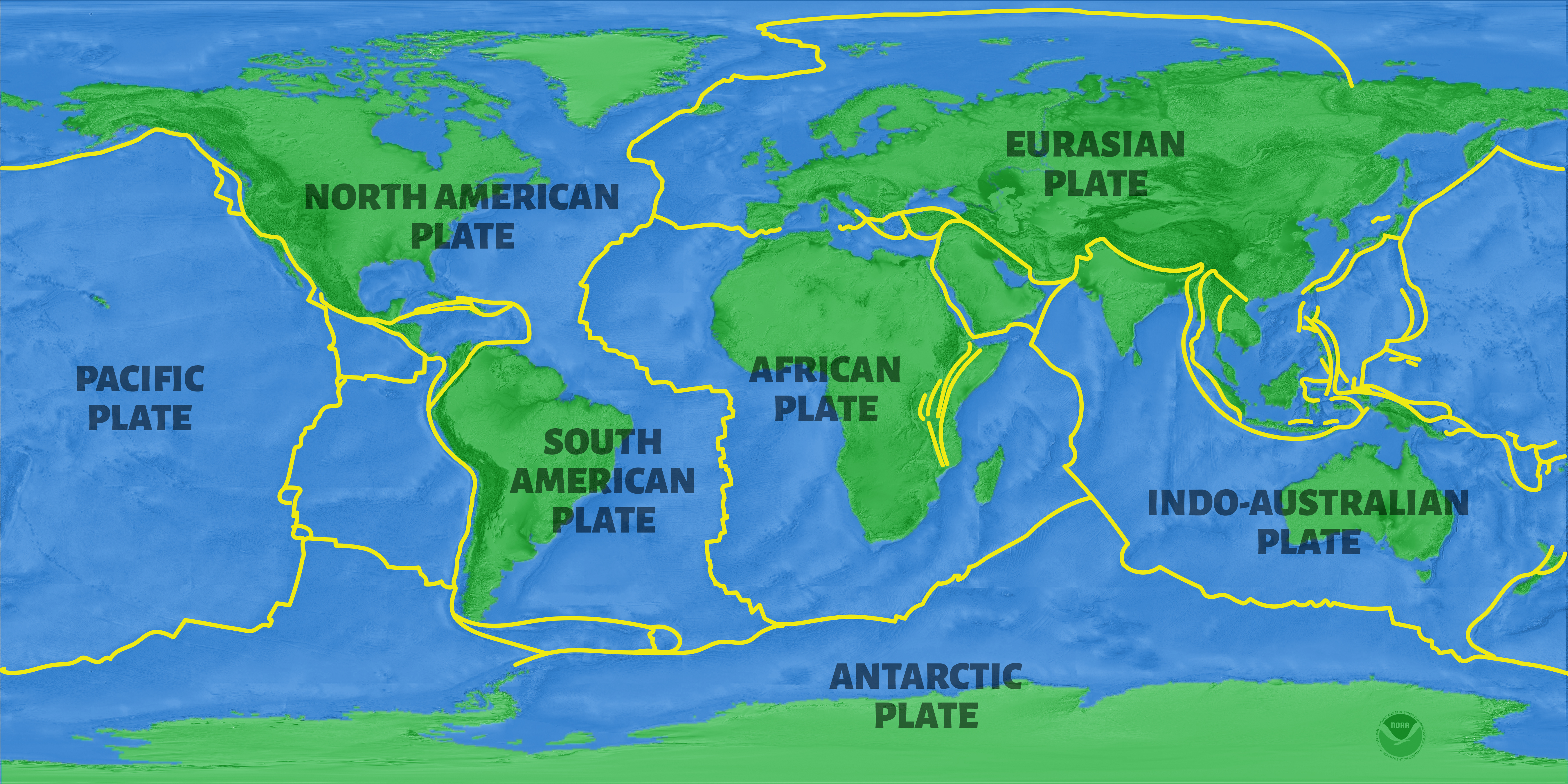
Look at the picture and see what all the earth plates are called.
Watch this video about the earth plates. Don't worry, you don't have to remember all the layers in the earth they explain! This is just additional information.
Watch this video until 3.30 minutes.
Read the artical about the diffrent plate tectonics. Reaed the articel from: ''the movement of the plates....'' until 'the end' of the artical.
https://www.nationalgeographic.com/science/article/plate-tectonics#:~:t…)%20per%20year.
Process
Watch the video from 3.39 minutes until the end of the video.
Evaluation
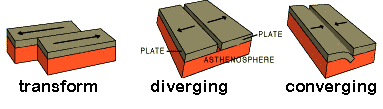
Take an A4 paper and draw the three ways earth plates can move. Do this so that it is clear to yourself!
Conclusion
The conclusion!
Earth plates can move relative to each other in three ways. In a convergent plate movement, the plates move towards each other. With a divergent plate movement they move away from each other and with a transformed plate movement they move past each other.
.
Credits
Thank you for doing this webquest. Hopefully, you learned something! Please fill in the next page of the forms (Summary) so we know how helpful you found this webquest.