
Introduction
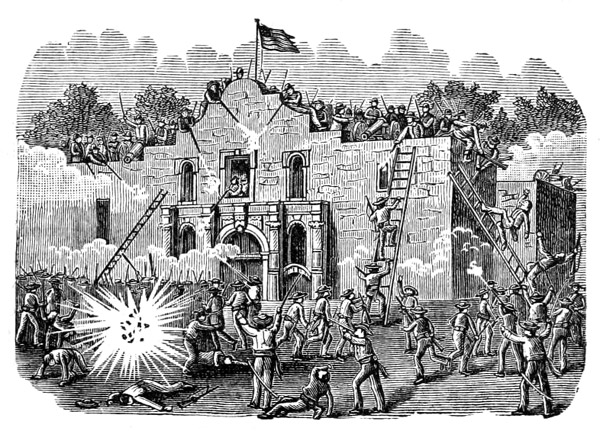
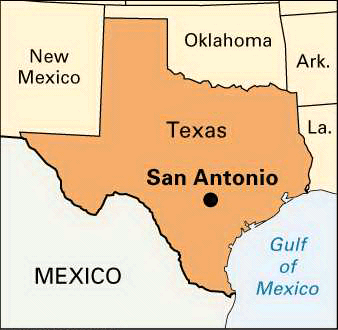
Good Morning historians!! Today we will be traveling all the way to San Antonio, Texas where we will visit the historically iconic Alamo! Throughout this virtual fieldtrip, you and a partner will navigate yourselves through the first Spanish Mission in Texas and dig deeper into the reality of what really occured at the Alamo in 1836!
Welcome: Remember the Alamo
Instructional Objectives: The students will navigate the Alamo website to acquire the history and facts of the Battle at the Alamo by following the checklist provided, discussing with peers when prompted, and completing the worksheet questions.
Rationale: This virtual field trip allows students to explore the Alamo without physically being in San Antonio, Texas. Students will learn important facts about the events leading up to the final battle at the Alamo by navigating themselves through a series of videos, pictures, discussions, and individual worksheet questions. Each student will complete a worksheet after actively participating in the virtual field trip of the Alamo with 100% accuracy in groups of two.
Task
Step by Step Instructions:
You are going to navigate yourself through the Alamo using the provided blueprint. You and your partner will be exploring the rooms at the Alamo, reading information, carrying on discussion, and answering your worksheet questions throughout this virtual field trip.
Discussion Ques will be in GREEN.
Worksheet Questions will be in RED.
Videos will be hyperlinked and in BLUE.
Process
THIS WILL BE THE ACTUAL FIELDTRIP ITSELF WITH VIDEOS, PICTURES, DISCUSSION QUES, AND WORKSHEET QUESTIONS!
Working on worksheet as they follow the webquest adventure!
Read the following letter from Willam B. Travis:
William Barret Travis' Letter from the Alamo
Commandancy of the Alamo
Bejar, Feby. 24, 1836
To the People of Texas & All Americans in the World
Fellow citizens & compatriots:
I am besieged, by a thousand or more of the Mexicans under Santa Anna I have sustained a continual Bombardment & cannonade for 24 hours & have not lost a man The enemy has demanded a surrender at discretion, otherwise, the garrison are to be put to the sword, if the fort is taken I have answered the demand with a cannon shot, & our flag still waves proudly from the walls I shall never surrender or retreat. Then, I call on you in the name of Liberty, of patriotism & everything dear to the American character, to come to our aid, with all dispatch The enemy is receiving reinforcements daily & will no doubt increase to three or four thousand in four or five days. If this call is neglected, I am determined to sustain myself as long as possible & die like a soldier who never forgets what is due to his own honor & that of his country
VICTORY OR DEATH.
William Barret Travis,
Lt. Col. comdt.
P.S. The Lord is on our side. When the enemy appeared in sight we had not three bushels of corn. We have since found in deserted houses 80 or 90 bushels and got into the walls 20 or 30 head of Beeves. - Travis
Evaluation
Worksheet done in a group 2
Make a rubric!
Conclusion
Sum up the events leading up the Battle at the Alamo and the battle itself.
Add timeline again here.
EXTRA CREDIT:
Students are to write 2 to 4 sentences explaining the significance in which each of the following people played in the Battle at the Alamo.
A maximum of 7 points will be added to the Texas Colonization Unit test if you meet the guidelines. This extra credit is ALL OR NOTHING.
Significant People: Santa Anna, William B. Travis, David Crockett, James Butler Bonham, José María (Gregorio) Esparza, Susannah Dickinson, and James Bowie
Vocabulary
artillery: Large caliber crew served mounted firearms (such as cannons, howitzers and rockets)
barrack: a building for lodging soldiers in garrison
bayonet: a steel blade attached at the muzzle end of a shoulder arm such as a musket and used in hand to hand combat
beeves: cattle
besieged: surrounded with armed forces
bombardment: an attack with artillery
cannonade: a heavy fire of artillery
cartridge: a tube of paper containing a complete charge for a firearm (paper tube, ball and powder)
cavalry: an army component mounted on horseback
Centralist: a political faction in Mexico whose goal was to limit the power of the states in favor of concentrating power in Mexico City
cholera: very contagious disease causing diarrhea and vomiting contracted by drinking untreated water and usually resulting in death due to dehydration. Cholera epidemics were widespread in the United States and Mexico in the 1830’s and 1840’s
colonist: one that settles in a new country at the request of that country
constitution: a system of fundamental laws and principles that prescribes the nature, functions and limits of a government
convert: a person that has been persuaded or induced to adopt a particular belief and lifestyle
convento: the living quarters of religious orders
courier: a messenger
custodian: one entrusted with guarding and protecting
daguerreotype: an early photograph produced on silver or a silver covered copper plate
dictator: one ruling absolutely and often oppressively
degüello: a bugle call used by the Mexican Army to appeal to the enemy to surrender or else die by the sword
Empresario: a land agent given permission by the Mexican Government to bring colonists to Texas
Federalist: a political faction in Mexico whose goal was to restructure Mexico socially and politically along the lines of a federal republic
friar: a member of a religious order (Franciscans) combining monastic life and outside religious activity
grenadier: a soldier who is a member of a special corps or regiment originally carrying grenades
garrison: military post; soldiers that are stationed at a military post
grapeshot: a cluster of small iron balls used as a cannon charge
infantry: soldiers trained, armed and equipped to fight on foot
immigrant: a person who comes to a country to take up permanent residence either legally or illegally
lunette: a crescent shaped fortification
musket: a heavy, large caliber smooth bore shoulder firearm usually equipped with a bayonet
no quarter: It is the opposite of the term quarter which means, the sparing of men’s lives in battle and giving them good treatment when they surrender. Thus no quarter means that no prisoners will be taken alive.
provisional government: temporary government
palisade: a fence of stakes usually for defense
parapet: an earthen or stone embankment protecting soldiers from enemy fire
parley: to discuss terms with the enemy
picket: a soldier whose job is to warn a garrison of a surprise attack
pistol: a hand gun
pyre: a combustible heap for burning a dead body
redoubt: a reinforcing earthwork within a fortification
republic: A government in which the supreme power lies in a body of citizens who are entitled to vote for officers and representatives responsible to them
rifle: a shoulder weapon with spiral grooves cut into the bore
saber: a heavy cavalry sword with a one-edged, slightly curved blade
sentry: a soldier standing guard at a point of passage such as a gate
skirmish: a minor battle in war
shako: a stiff military hat with a high crown
shrine: A shrine is a place hallowed by its associations. At a Shrine events have occurred that people believe should be remembered for their significance or for the character of those who participated in them. Shrines can be religious or patriotic.
soldado: Spanish term for soldier
smallpox: a contagious viral disease, causing fever, vomiting and rash often resulting in death.
surrender: to give up completely
sword: a weapon with a long blade for cutting or thrusting
Tejano: a native born Mexican from the state of Coahuila y Tejas
Texian: used in place of the word Texan through out the period of the Texas Revolution and the Texas Republic
Credits
Katie Hannas, Lindsey James, Bethany Oetting, and Cara Toon
Resources used/works cited
Teacher Page
TEK: § 113.19. Social Studies, Grade 7
(b) Knowledge and skills.
(3)The student understands how individuals, events, and issues related to the Texas Revolution shaped the history of Texas. The student is expected to:
(c) Explain the issues surrounding significant events of the Texas Revolution, including the Battle of Gonzales, William B. Travis’ letter “To the people of Texas and All Americans in the World,” the siege of the Alamo and the 189 heroes all the heroic defenders who gave their lives there, the Constitutional Convention of 1836, Fannin's surrender at Goliad, and the Battle of San Jacinto
Instructional Objectives: The students will navigate the Alamo website to acquire the history and facts of the Battle at the Alamo by following the checklist provided, discussing with peers when prompted, and completing the worksheet questions.
Rationale: This virtual field trip allows students to explore the Alamo without physically being in San Antonio, Texas. Students will learn important facts about the events leading up to the final battle at the Alamo by navigating themselves through a series of videos, pictures, discussions, and individual worksheet questions. Each student will complete a worksheet after actively participating in the virtual field trip of the Alamo with 100% accuracy in groups of two.
Grade Level: 6-8
Curriculum: Social Studies