
Introduction
Task
Proteins are essential for the functioning g of all living cells and therefore must be correctly manufactured inside the cell. Mistakes (mutations) may occur, however, during the process of protein synthesis
Write an essay in which you describe the process that results in the formation of fully functional proteins and explain how gene mutations affect this process.
use the information provided and if you want to use more resources first run the source pass me so i validate the authenticity of the information.
Process

Genes specify a proteins
Conclusions: A gene is a segment of DNA that specifies the sequence of amino acids in a polypeptide of a protein. (this is the definition of a gene)
Gene Expression
Three Important Points to Remember
1)Chromosomes are made of DNA
2) Segments of DNA code for a protein
3) Protein in turn, relates to a trait (eye color, enzymes, hormones..)
How Proteins are Synthesized from DNA
1. DNA is transcribed into mRNA (messenger RNA)
2. mRNA leaves the nucleus and travels to the cytoplasm
3. Ribosomes in the cytoplasm use the code on mRNA to translate it into amino acids
4. Amino acids form a chain - a protein
This is also sometimes referred to as “The Central Dogma”

Properties of the Genetic Code

1. Three bases in mRNA make a “codon” , also called a “triplet”
2. Each codon specifies a single amino acid (you will need a chart)
3. Most amino acids have more than one codon (helps prevent effects of DNA mutations)
4. It is unambiguous (each codon has only one meaning)
5. The code has start and stop signals. (one start, three stops)
6. The code is universal – all living things share it (common evolutionary ancestors)
7. We can move genes from one organism to another (use bacteria to make insulin) because it is universal.
Sounds simple, huh? Well, you're not getting off that easy, now we will break down each step of the process.
Transcription
RNA is very similar to DNA with the following exceptions:
it is single stranded | it has uracil instead of thymine | it has the sugar ribose, instead of deoxyribose
The base-pair rule is followed during transcription, except, instead of pairing thymine with adenine, when creating an RNA strand, uracil is used
DNA Strand: T G C A T C A G A
RNA Strand: A C G U A G U C U
View the following animation: Transcription
Transcription begins on the area of DNA that contains the gene. Each gene has three regions:
1. Promoter - turns the gene on or off, defines the start of a gene
2. Coding region - has the information on how to construct the protein
3. Termination sequence - signals the end of the gene
RNA Polymerase is responsible for reading the gene, and building the mRNA strand. It reads only the 3' to 5' strand.
Introns – areas of the RNA that will not be expressed (“junk DNA”) and are spliced out
Exons – areas of RNA that will be expressed

Still confused: Check on these animations:
Transcription 3- http://www.stolaf.edu/people/giannini/flashanimat/molgenetics/transcrip…
 Translation
View the animation of translation: Translation
1. The mRNA travels to the cytoplasm
2. Amino acids exist freely in the cytoplasm, many of them you acquire from your diet
3. Each 3 bases (codon) translates to a single amino acid. (See codon chart)
4. The ribosome looks for the "start" codon - AUG, this is where the chain begins
5. Transfer (tRNA), has an anticodon at one end and an amino acid at the other, it binds to a complementary codon.
6. Another tRNA reads the next codon, the amino acid attached to it binds with the amino acid on the previous tRNA using a peptide bond. The first tRNA falls off.
7. This process continues until the "stop" codon is reached.
8. The amino acid chain folds into a 3 dimensional structure, now a protein.
9. That protein can be an enzyme, a hormone, or any other structure in the body that gives it traits and functionality.
Still confused?
Check out other animations:
Translation 3 - http://www.stolaf.edu/people/giannini/flashanimat/molgenetics/translati…
Test for Understanding
A DNA sequence has the following bases: T A C - A G A - T T A - G G G - A T T
What amino acids does it code for? (You'll need to use the codon chart)
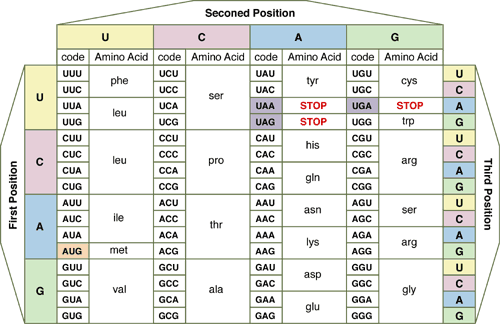

CHECK FOR UNDERSTANDING

Other Chapters: 13-1 (Genetic Material), 13-2 (DNA Structure), 13-3 (Replication), 14-1 (Function of Genes), 15 (Mutations), 16 (Biotechnology),
Watch the Following, and take notes:
Evaluation
| proficiency | ||
|---|---|---|
| Composition of DNA |
|
|
| Structure of DNA | Students will describe the arrangement of the components the DNA molecule. They will use and explain the following vocabulary: monomer polymer double helix complementary base pair rule chargaff's rule 1 pt per correct use and explanation term. |
|
| Transcription of mRNA | Students correctly predict the transcription of the mRNA from the sense strand of DNA 3 pt |
|
| Explanation of transcription | Students thoroughly describe the transcription process using and explaining the following vocabulary: nucleus RNA nucleotide base pair rule uracil nuclear envelope ribosome 1pt per correct use and explanantion of term |
|
| Explanantion of translation |
|
|
| Amino acid sequence |
students correctly predict the amino acid sequence using the central dogma. 5 pt |
Conclusion
protein synthesis is a very vital process for our survival
for a summary follow the link and watch other videos pertaining to DNA and protein synthesis
https://www.pbslearningmedia.org/resource/nvra.sci.prosynth/protein-synthesis/?student=true
Teacher Page
For more information do not hesitate to consult with me on 219007446kn@gmail.com