
Introduction
Have you ever wondered how the changes in growth and development occur? How does an organism grow? You will find out the answers to those questions as you explore The Life Cycle. Make sure you have your graphic organizer out as you complete each task.
Task
With your partner, you will read the parts of the life cycle. During your reading of the life cycle you will be completing a graphic organizer to show your knowledge. Keep track of everything you learn about the frog's life cycle. You will use it as a guide to answer your questions at the end.

Process
The life cycle of a frog consists of three stages: egg, larva, and adult.
Breeding:

The breeding season for frogs usually occurs during the spring in temperate climates and during the rainy season in tropical climates. When male frogs are ready to breed, they often use loud croaking calls to attract partners. Males produce these calls by filling a vocal sac with air and moving the air back and forth to create a chirp-like sound.
When mating, the male frog holds onto the female's back, clasping his front legs around her waist or neck. This embrace is referred to as amplexus; its purpose is to ensure that the male is in the optimal position to fertilize the female's eggs as she lays them.
Stage 1: Egg /iStock_000003278552XSmall-56a004fc5f9b58eba4ae83bd.jpg)
Many species lay their eggs in calm water among vegetation, where the eggs can develop in relative safety. The female frog lays numerous eggs in masses that tend to clump together in groupings known as spawn. As she deposits the eggs, the male releases sperm onto the eggs and fertilizes them.
In many species of frogs, the adults leave the eggs to develop without further care. But in a few species, parents remain with the eggs to look after them as they develop. As the fertilized egg mature, the yolk in each egg splits into more and more cells and begins to take the form of a tadpole, the larva of a frog. Within one to three weeks, the egg is ready to hatch, and a tiny tadpole breaks free.
Stage 2: Tadpole (Larva) 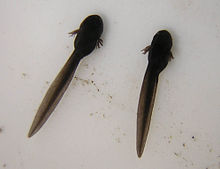
Tadpoles, frogs' larvae, have rudimentary gills, a mouth, and a long tail. For the first week or two after the tadpole hatches, it moves very little. During this time, the tadpole absorbs the remaining yolk left over from the egg, which provides much-needed nourishment. After absorbing the yolk, the tadpole is strong enough to swim on its own.
Most tadpoles feed on algae and other vegetation, so they are considered herbivores. They filter material from the water as they swim or tear away bits of plant material. As the tadpole continues to grow, it begins to develop hind limbs. Its body elongates and its diet grows more robust, shifting to larger plant matter and even insects. Later in development, front limbs grow and tails shrink. Skin forms over the gills.
Stage 3: Adult 
At approximately 12 weeks of age, the tadpole's gills and tail have been fully absorbed into the body, meaning that the frog has reached the adult stage of its life cycle. It is now ready to venture out onto dry land and, in time, repeat the life cycle.
Evaluation
1. When does the breeding season usually occur for frogs?
a. spring in temperate climates
b. summer in temperatesclimates
c. summer in warm climates
d. spring in warm climates
2. What do frogs do to attract partners?
3. How many weeks does it take an egg to be ready to hatch?
a. two to three weeks
b. one to three weeks
c. four to five weeks
d. three to four weeks
4. The ___________ frog lays numerous eggs in ________________ that tend to clump together in groupings known as spawn.
5. Describe the adult stage of the frog's life cycle.
6. How many days after a frog hatches can it swim and feed on algae?
7. What is the difference between the larva and adult stage? Provide 2-3 examples.
8. How many days after a tadpole hatches can it swim and feed on algae?
a. 5 to 8 days
b. 2 to 5 days
c. 7 to 10 days
d. 1 to 4 days
9. Some frogs that live in higher altitudes or in colder places might take a whole ___________ to go through the tadpole stage.
10. About how many weeks does it take for little tiny feet to sprout?
Conclusion
The changes in growth and development that occurs in frogs and other organisms is the life cycle. Specifically, the life cycle of a frog has 3 stages. Stage 1 is egg, stage 2 is tadpole (larva), and stage 3 is adult. You should have learned the vital aspects of a frog's life cycle during this WebQuest.
Credits
Klappenbach, Laura. “The Stages in a Frog's Life.” ThoughtCo, ThoughtCo, 11 Aug. 2019,
https://www.thoughtco.com/life-cycle-of-a-frog-130097.
Life Cycle of a Frog, http://allaboutfrogs.org/weird/general/cycle.html.
Teacher Page
Performance Expectation:
Develop models to describe that organisms have unique and diverse life cycles but all have in common birth, growth, reproduction, and death.
Modified:
8. Obtain, evaluate, and communicate that organisms have unique and diverse life cycles but all have in common birth, growth, reproduction, and death. Students will do this throughout the WebQuest with reading the information and expressing understanding through questions through multiple choice, short answer, extended response, and fill in the blank questions.
Disciplinary Core Ideas:
Reproduction is essential to the continued existence of every kind of organism. Plants and animals have unique and diverse life cycles. This is emphasized throughout the WebQuest because the egg starts the life, and comes from reproduction, the tadpole (larva) grows and becomes an adult who attract partners to begin the reproduction stage all over again.