
Introduction
Essential Question/Task Definition: How do I prevent groundwater contamination?
“Chinese workers clean a heavily-polluted canal running through central Beijing on May 16, 2010. China is experiencing a severe water scarcity as its population of 1.3 billion - one-fifth of the world's total - relies on only 7 percent of the global freshwater resources. Water pollution and scarcity is costing China 2.3 percent of its gross domestic product every year, according to a recent report.”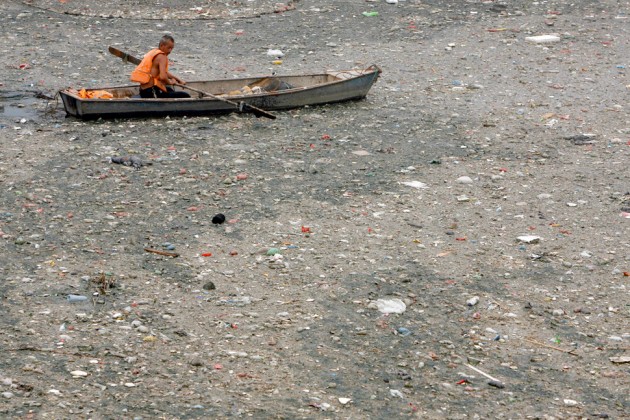
"Chinese Workers Clean A Polluted Canal In Beijing." UPI Photo Collection. 2010. Student Resources in Context. Web. 1 Nov. 2014.
Larson, Christina. "Government Study Finds 60 Percent of China's Groundwater Polluted." Bloomberg Business Week. Bloomberg, 25 Apr. 2014. Web. 29 Oct. 2014.
Task
Step #1: Task Definition:
How do we prevent groundwater contamination?
Follow six steps to create an edmodo (https://edmo.do/j/8cegfi, Group Code: yzprsv) presentation with three ways to prevent groundwater contamination. Cite & evaluate your work.
Step 2: Information Seeking Strategies
UDLib/Search houses numerous resources to help find information on the topic of water contamination in China.
We will examine UDLib/Search to find articles discussing China’s water pollution rate.
Step 3: Location & Access
Then go to the UDLibSearch databases. Utilize these two databases: Science Online and Science In Context.
Step 4: Use your Info
Find three resources from the Science Online and Science In Context. Use the three resources to answer the questions in your packet. Create a bibliography.
Step 5: Put it all Together
Put it all together to Create your project using edmodo, (https://edmo.do/j/8cegfi, Group Code: yzprsv), or something you like. At edmodo make a quick news commercial providing ways to stop or lessen the pollution of groundwater. Include a bibliography.
Step 6: Evaluate
Before handing in your work evaluate it! Use the handout provided and check the boxes you feel are complete.
Process
Graphic Organizers
Step #1: Task Definition
How do we prevent groundwater pollution? Find three resources providing three facts on how to prevent groundwater pollution. Create a presentation with the facts and their sources.
1) What am I supposed to do?? Determine a purpose and need for information.
2) Write what you already know about your research topic.
3) Decide what questions you have about your topic.
|
What do I want to find out? |
|
TOPIC: How do I prevent groundwater contamination? |
|
What do I want to find out? |
|
What do I want to find out? |
Step #2: Information Seeking Strategies
UDLib/Search houses numerous resources to help find information on the topic of groundwater contamination.
We will examine UDLib/Search to find articles discussing groundwater pollution.
Write down keywords you will use to locate information on preventing groundwater pollution:
___________________________________________________________________________
___________________________________________________________________________
Step #3: Location & Access
Then go to the UDLibSearch databases. Utilize these two databases: Science Online and Science In Context.
Find three articles to answer your questions: How do I prevent groundwater pollution?
|
Article: |
Article: |
Article: |
|
Viewpoint: What is the perspective of the author or publisher? |
Viewpoint: What is the perspective of the author or publisher? |
Viewpoint: What is the perspective of the author or publisher? |
|
Authority: Why can we believe this source? |
Authority: Why can we believe this source? |
Authority: Why can we believe this source? |
|
Accuracy: How up-to-date and accurate is the source? |
Accuracy: How up-to-date and accurate is the source? |
Accuracy: How up-to-date and accurate is the source? |
|
Reliability: Can this source be relied upon to present high quality information on all topics and every time? |
Reliability: Can this source be relied upon to present high quality information on all topics and every time? |
Reliability: Can this source be relied upon to present high quality information on all topics and every time? |
|
Notes: What are special features about this source? |
Notes: What are special features about this source? |
Notes: What are special features about this source? |
Step 4: Use your Info
Find three resources from the Science Online and Science In Context. Use the three resources to answer the questions in your packet. Create a bibliography.
Take what you found out above and write a summary:
|
Summary: |
What is the format and length that will be most effective for this audience: Why?
|
|
Ask yourself: Are there any special features I should include (sound, visuals, charts)?
|
|
Works Cited Worksheet
As you complete this section think about…..How will I give credit to my sources in my final product or performance?
|
Database |
|
Author’s Last Name, First Name |
|
Title of Article or Book |
|
Title of Publication |
|
Date of Publication |
|
Date of Access |
|
Publisher |
Create a bibliography. MLA formatted.
____________________________________________________________________________________________________
____________________________________________________________________________________________________
____________________________________________________________________________________________________
____________________________________________________________________________________________________
____________________________________________________________________________________________________
Step 5: Put it all Together
Put it all together to Create your project using edmodo, or something you like. At edmodo make a quick news commercial providing ways to stop or lessen the pollution of groundwater. Include a bibliography.
Look over your organized project notes. Check yourself by filling in the graphic organizer below.
|
Question: How do I prevent groundwater contamination? |
|||
|
Where did I find the information to answer the question? |
Why did I choose this source? Was this information helpful to me? |
What did the information tell me to answer my question? |
What is the best way you can share this information with others? |
|
|
|
|
|
|
|
|
|
|
|
|
|
|
|
Evaluation
Step #6 Evaluation
Before handing in your work evaluate it!
Use the handout provided and check the boxes you feel are complete
Student Name: _____________________________________________________
First Point in Time DATE: ___________
Second Point in Time DATE:______________
|
|
4 There is evidence the student effectively: |
3 There is some evidence the student: |
2 There is limited evidence the student: |
1 There is little evidence the student: |
0 There is no evidence the student:
|
|
1.1.4 |
Found, evaluated, and selected the appropriate (either Self –selected or librarian chosen) sources to answer the question(s) with prompting ands upport |
Found, evaluated, and selected the appropriate (either Self –selected or librarian chosen) sources to answer the question(s) with prompting and support
|
Found, evaluated, and selected the appropriate (either Self –selected or librarian chosen) sources to answer the question(s) with prompting and support |
Found, evaluated, and selected the appropriate (either Self –selected or librarian chosen) sources to answer the question(s) with prompting and support |
Found, evaluated, and selected the appropriate (either Self –selected or librarian chosen) sources to answer the question(s) with prompting and support |
|
1.1.6 |
Read, view, and listen for information presented in any format (e.g. textual, visual, media, digital) in order to make inferences and gather meaning |
Read, view, and listen fo information presented in any format (e.g. textual, visual, media, digital) in order to make inferences and gather meaning |
Read, view, and listen for information presented in any format (e.g. textual, visual, media, digital) in order to make inferences and gather meaning |
Read, view, and listen for information presented in any format (e.g. textual, visual, media, digital) in order to make inferences and gather meaning |
Read, view, and listen for information presented in any format (e.g textual, visual, media, digital) in order to make inferences and gather meaning |
|
3.1.4 |
Use technology and other information tools to organize and display knowledge and understandings in ways that others can view, use, and assess |
Use technology and other information tools to organize and display knowledge and understandings in ways that others can view, use, and assess |
Use technology and other information tools to organize and display knowledge and understandings in ways that others can view, use, and assess |
Use technology and other information tools to organize and display knowledge and understandings in ways that others can view, use, and assess |
Use technology and other information tools to organize and display knowledge and understandings in ways that others can view, use, and assess |
|
4.3.2 |
Recognize that resources are created for a variety of purposes |
Recognize that resources are created for a variety of purposes |
Recognize that resources are created for a variety of purposes |
Recognize that resources are created for a variety of purposes |
Recognize that resources are created for a variety of purposes |
|
3.1.3 |
Use writing and speaking skills to communicate new understandings effectively. |
Use writing and speaking skills to communicate new understandings effectively. |
Use writing and speaking skills to communicate new understandings effectively. |
Use writing and speaking skills to communicate new understandings effectively. |
Use writing and speaking skills to communicate new understandings effectively. |
|
|
Total Points x 4 = |
Total x 3 |
Total x 2 |
Total x 1 |
Total x 0 |
|
|
Total Score = |
|
|
|
|
Conclusion
Follow this 6 step process for any research paper.
Credits
Ms. Carr, tacarr@lf.k12.de.us
Email or stop-in with any questions!