
Introduction

Calling all courageous astronauts!
NASA needs your help! All their notes on the solar system have disappeared. They need brave and daring space explorers like you to go into space and document what you find. You will leap through space and land on each planet in our solar system, collecting notes as you go. Will you accept this mission? If so, get ready to blast off!
Here are the Indiana Standards.
5.ESS.1. Analyze the scale of our solar system and its components: our solar system includes the sun, moon, seven other planets, and their moons, and many other objects like asteroids and comets.
Task
Your task is to document your findings and bring them back to NASA! How many planets are there? Eight! Each planet has something special about it so make sure to go to each one. Watch out for the asteroids!

Process
Process:
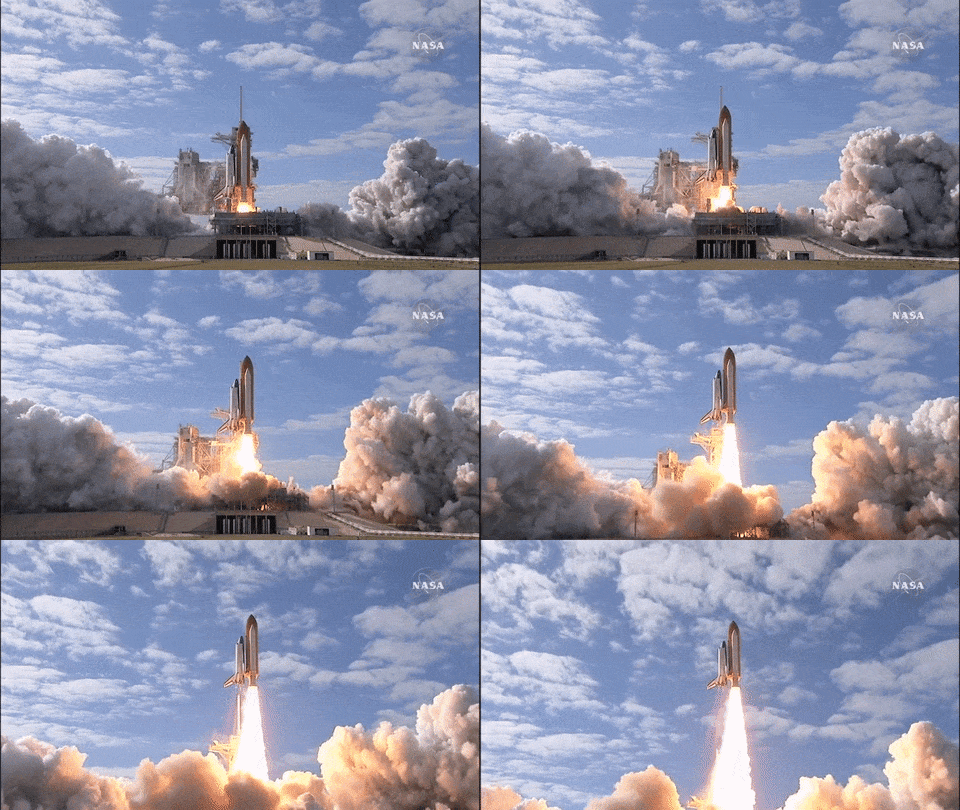
Hello astronauts! Are you ready for your mission? You’re getting ready to blast off! In 3,2,1, GO! Using this link, travel to each of the planets to answer the following questions! You may hop back and forth between the planets to answer the questions. Click on the planets underneath the words “Solar System” to leap through space! Good luck space explorers!
Questions:
-
Which planet is a gas giant?
-
Which planet is sideways?
-
Which planet has no moons or atmosphere?
-
How long is a day on Jupiter? Is it shorter or longer than on Earth?
-
How can Venus stay so hot?
-
What planet is cold, dark, and windy?
-
How many moons does Neptune have?
Fill in the Blank:
-
_______was discovered in 1846 by Urbain Le Verrier, John Couch Adams, and Johann Galle.
-
_______has big storms like the Great Red Spot, which has been going for hundreds of years.
-
Like Earth, _______has seasons, polar ice caps, volcanoes, canyons, and weather.
-
Saturn is a gas giant like Jupiter. It is made mostly of ________ and ________.
-
Neptune’s atmosphere is made of _______, _______, and methane.
-
Mercury takes _______ Earth days to make one full rotation.
-
Water covers ______ of Earth's surface.
Evaluation
|
Teacher: Class: |
Excellent 4 Stars |
Good 3 Stars |
Fair 2 Stars |
Needs Improvement
1 Star |
Mark |
|
Planet Facts |
Information is comprehensive and accurate. Cover all of the required elements. Elements being; the features of the planets, the discovery of the plant, the climates, the elements, and the percentage of Earth's water. |
The Information is good. Covers most if not all of the required elements. |
The information is appropriate and covers over half of the required elements. |
Not enough information was recorded and covered less than half the required elements |
|
|
Technology |
The student was able to navigate through the page using the link provided, click through the planets. |
The student was able to navigate through the link with little assistance required. |
The student was able to use the link but had some difficulty with the link. |
The student needed help with the link and how to navigate through the link. Some development in using technology is required. |
|
|
Spelling |
The Student spells everything correctly with no errors. |
The Student spells most words correctly with little errors. |
Half of the words are correctly written. |
The student spells few or no words correctly. |
Conclusion
Good job today, explorers! Thanks to you, NASA has recovered all the missing information about the planets! How was space? Did you enjoy visiting new planets? Or are you keeping your land feet? Now that you’ve analyzed the planets within our solar system, you all are pros at space exploration!