
Introduction
 Welcome.
This Webquest will help teachers explore the best methods at teaching the whole child by following the teachings of many great influential educators.
Task
The task for this Webquest is to explore and implement the teachings of the whole child as represented by the following influential educators in Early Childhood Education.
1) Identify the teachings of Piaget, Dewey and Brown
2) How has their teachings influenced the educational foundation for young children
3) Explore the meaning of "teaching the whole child". How does this change your current lesson plan.
Process
1. Piaget: His particular insight was the role of maturation (simply growing up) in children's increasing capacity to understand their world: they cannot undertake certain tasks until they are psychologically mature enough to do so. He believed that each child growth comes in different developmental stages.
2. Dewey philosopy was that "even when a standard curricula is presented using established pedagogical methods, each student will have a different quality of experience."
3. Bowman belief that "every child comes to school to learn" (Bowman, 1993). Yes, children come to school to learn but much of the learning has to do with a child's environment. Is the classroom have a positive learning environment? Is the lesson plan implemented in a way that it reaches every child and does it reach the differences that each child has?
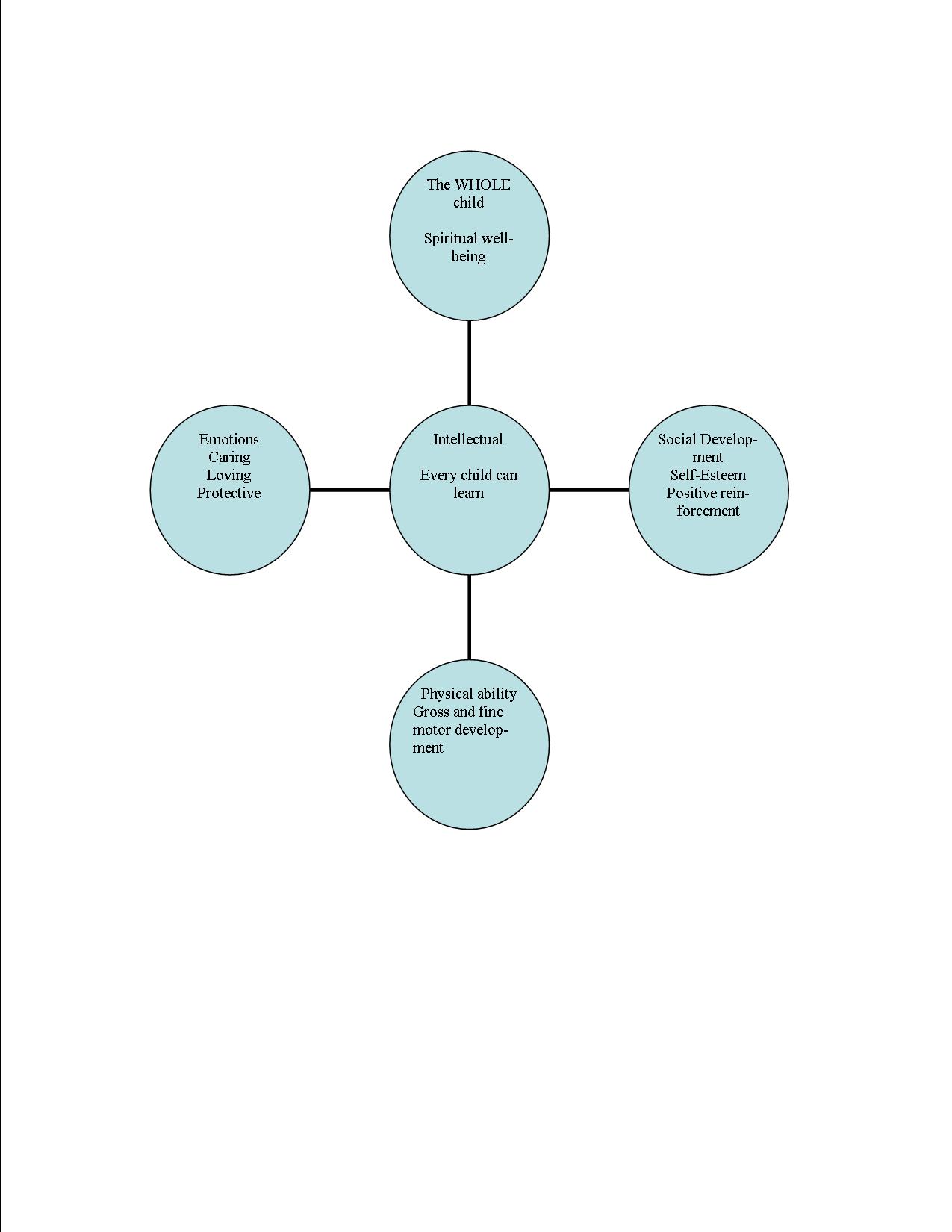
Exploring the theory of educating the whole child: What does this really mean and how will this assist a teaching in planning and implementing curriculum.
- Education is so much more than just opening a book or teaching the ABC's. Its about understanding that each child is his/or her own individual. They think, learn, act and explore differently. They have emotions that are valuable to their learning style and can sometimes be easily looked over.
- Children are social beings and must learn how to play, share and get along with one another.
- Children should be allowed to explore.
Evaluation
 How to create a lesson plan that embodies the teaching of 3 chosen educators. How to implement those teachings in a lesson plan that builds up the whole child.
The basic belief from all 3 educators is that "All children are capable of learning".
As teachers you have an obligation to make the bright visions that others have had for children your vision as well. After all, if we don't have bright visions for children, who will?
Conclusion
Children are so pure and full of love. They are little scientist with the methodology to experiment, test, explore and believe. As a teacher our job is to assist and guide them in order to make those experiments a reality. We have to nurture, love and believe in them.
Each lesson plan should embody all of the above. Children are like little sponges ready to soak up knowledge. Lesson plans should be creative, exploratative, positive and suitable for their age development.
Credits
References
Bowman, B. (1993). Early childhood education. In L. Darling-Hammond (Ed.), Review of research in education, Vo. 19, pp. 101-134.
Morrison, George S. "History and Theories Foundations for Teaching and Learning". 2nd ed. Upper Saddle River, N.J.; Merill, 2000. 71-105
Atherton J S (2013) Learning and Teaching; Piaget's developmental theory [On-line: UK] retrieved 3 November 2014 from http://www.learningandteaching.info/learning/piaget.htm