
Introduction
Before written history, people were aware of some of the elements in the periodic table;elements such as gold (Au), silver (Ag), copper (Cu), lead (Pb), and tin (Sn).It wasn't until 1649,however, the first element was discovered through scientific inquiry by Hennig Brand .That element was (P) phosphorous. By 1869, 63 elements had been discovered.

Task
3 Quick Questions ...
1. What do you think they used those first couple elements for?
2. Who was the last person to discover the last known element?
http://education.jlab.org/qa/discover_ele.html
3.Who was the first person to discover the first known element?
Process
Credit for the first Periodic Table,published in 1862, is a French geologist named A.E.Beguyer de Chancourtois. He transcribed a list of the elements positioned on a cylinder in terms of increasing atomic weight and when the cylinder was constructed so that 16 mass units could be written on the cylinder per turn, closely related elements were lined up vertically. This led him to propose that the properties of the elements are the properties of numbers. He was the first to recognize that elemental properties reoccur every seven elements, and using this chart, he was able to predict the stoichiometry of several metallic oxides but,his chart included some ions and compounds in addition to elements.
Evaluation
In 1944, Glenn T. Seaborg created the modern version of the periodic table.He stated,
- "In 1944, I formulated the “actinide concept” of heavy element electronic structure.This concept predicted that the fourteen actinides, including the first eleven transuranium elements, would form a transition series analogous to the rare-earth series of lanthanide elements and therefore show how the transuranium elements fit into the periodic table.I was warned at the time that it was professional suicide to promote this idea, which has since been called one of the most significant changes in the periodic table since Mendeleev’s 19th century design. Luckily, I stuck to my guns and have seen the actinide concept become the foundation for many significant discoveries in heavy element research."
Conclusion
The Perioidic Table is like a big grid.Each element is placed based on its atomic structure.Like every grid,it has rows,(left to right,) and columns (up and down) and each row has specific characteristics.Such as beryllium (Be) and magnesium (Mg) are found in column two and share certain similarites while potassium (K) and calcium (Ca) from row four share different characteristics.Each of the elements in a row is called a period(left to right) have the same number of electron shells; the number of electrons in these shells (the element's atomic number) increases from left to right.Plus, each veritcal column is called groups..They are the electrons involved in chemical bonds with other elements.
Credits
I used these 5 websites....
http://www.bpc.edu/mathscience/chemistry/history_of_the_periodic_table…
https://www.wou.edu/las/physci/ch412/perhist.htm
https://www.chem.tamu.edu/class/majors/tutorialnotefiles/periodic.htm
http://www.chem4kids.com/files/elem_pertable.html
http://www.enchantedlearning.com/chemistry/periodictable.shtml
Teacher Page
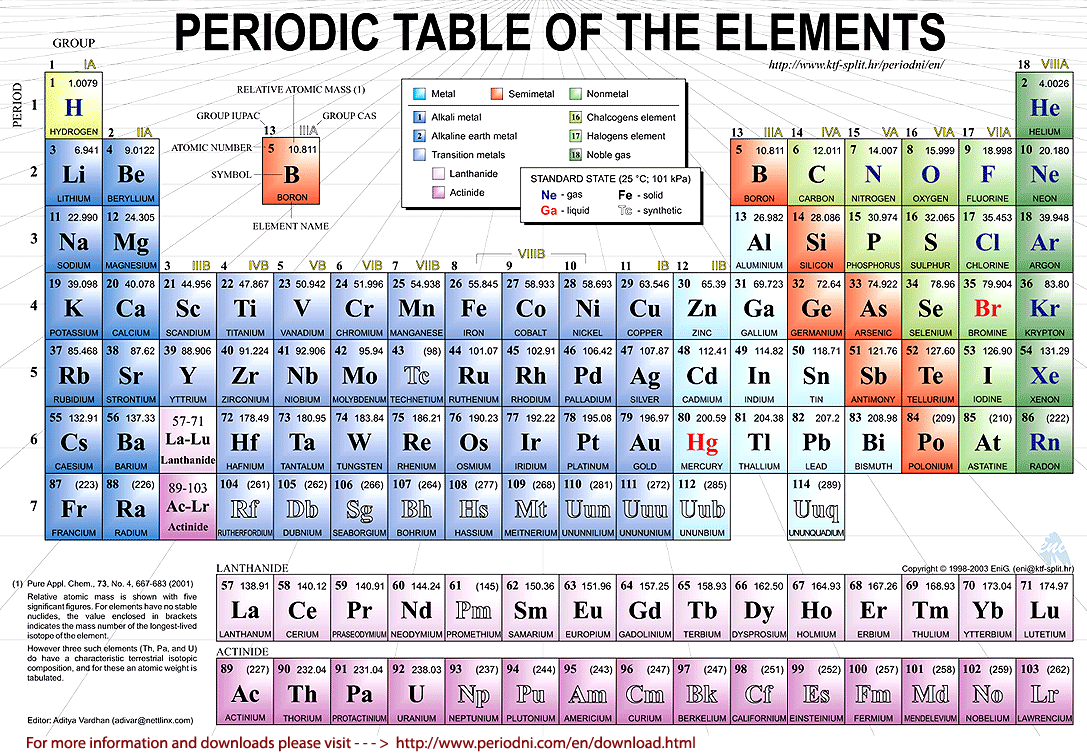 USE THIS TABLE FOR THESE FEW QUESTIONS:
1.What group is Carbon (C)?
2.Which elements are the noble gases?
3.What are the period numbers?
4. What are the group numbers?
5.How many elements are metals?
6.Can you give a guess of why you think the elements that are non-metals are that and why there not metals?