
Introduction
From a young age, I was rubbing elbows with a very different kind of person and social class, and I felt a lot of tension and conflict in my identity because of that. -David Lindsay Abaire (http://www.brainyquote.com/quotes/keywords/social_class.html)
The social classes that we are very familiar with today go way back to the Victorian Era, except during this period of time it was a bad thing if a person from one class was caught mingling with someone of a different class. Class is a very complex term, in use since the late eighteenth century, and employed in many different ways. Classes are more or less distinct social groupings which, at any given historical period, constituted British Society.
Through this assignment, you will learn about the different social classes of the victorian era and what things distinguished the different classes. You will also be shown how many classes existed and the features that made up the different classes. (victorianweb)
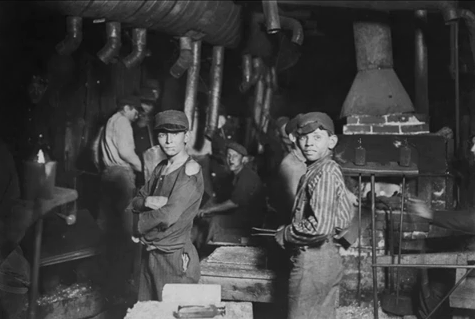
http://www.victorianchildren.org/wp-content/uploads/2012/12/Victorian_C…
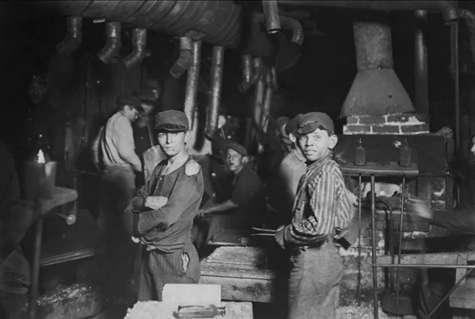
Task
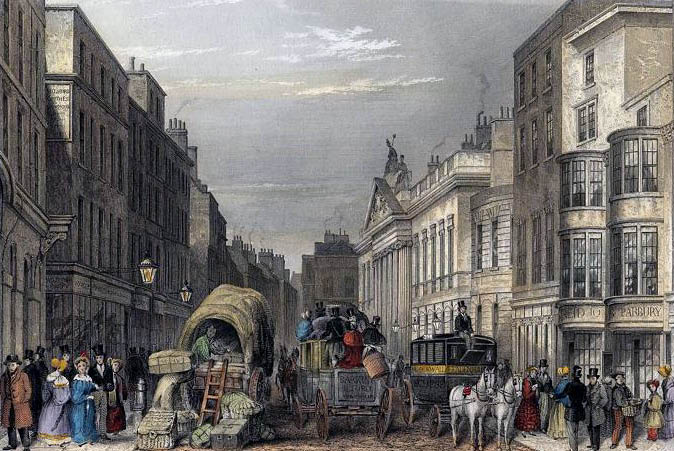
http://upload.wikimedia.org/wikipedia/commons/a/a7/Leadenhall_Street_J_…
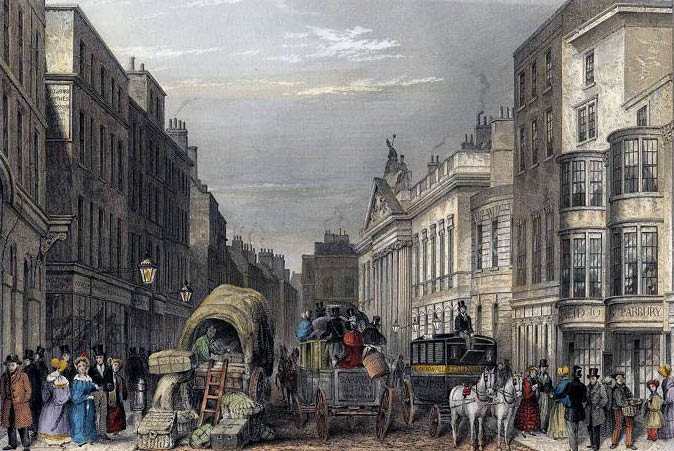
After learning about the social class system of the Victorian Era, you should be able to do these few things by the end of this webquest:
1) Identify the 4 different social classes.
2) Describe some of the things that made up each individual class.
3) Fill out an activity sheet (fill in the blank worksheet) about the social class system.
Process
Different social classes can be distinguished by inequalities such as power, authority, wealth, working and living conditions, life-styles, life-span, education, religion, and culture. In the early nineteenth century, the labels "upper class", "middle class", "working class", and "under class" devoloped to describe the social statuses of people.
The Upper Class:
- Was also known as the aristocracy.
- Included the Church and nobility.
- Had greater power and wealth.
- Maintained control over the polotical system (depriving the working and middle classes of a voice in the political process).
- Consisted of about 2% of the population who were born into nobility and who owned the majority of the land.
- Included the royal family, lords spiritual and temporal, the clergy, great officers of state, and those above the degree of baronet.
- The class was privileged and avoided taxes.
The Middle Class:
- Class was in between rich and poor.
- Did not have a voice in politics.
- The passage of the Reform Act of 1832 and the abolition of the Corn Laws in 1846 strengthened the middle class and made them more successful.
- Consited of the bourgeoisie (the middle working class).
- Made up of factory owners, bankers, shopkeepers, merchants, lawyers, engineers, businessmen, traders, and other professionals.
- They could sometimes be extremely rich, but in normal circumstances were not privileged.
- There was a very large gap between the middle class and lower class (or working class).
*The lower class was split into two groups: the working class and the under class (the poor class).
The Working Class:
- Were still shut out from the political process (after the Reform Act of 1832 and Corn Laws in 1846).
- Is the poor class.
- Were hostile towards both the upper and middle classes.
- Also known as the "labourers".
- Consited of men, women, and children who were skilled labourers.
- Performed many types of labor, including factory work, seamstressing, chimney sweeping, mining, and other jobs.
- Endured a large burden of tax.
The Under Class:
- The class living in poverty.
- Consisted of men, women, and children who were unskilled labourers.
- Performed factory work, seamstressing, chimney sweeping, mining, and etc.
- Also consisted of people who wer not working, or not working regularly, and were recieving public charity.
- Ebdured a large burden of tax.
- They were exploited.
*The middle, working, and under (poor) classes made up about 85% of the population combined, but owned less than 50% of the land.
Industrialisation changed the class structure dramatically in the late eighteenth century and hostility developed between the upper and lower classes. As a result of the industrialisation, there was a huge boost of the middle and working class, but as it progressed there was further social division. For example: Capitalists employed industrial workers, but would only employ the ones who were skilled. The unskilled workers would recieve lower incomes than the skilled workers.
The government consisted of a "constitutional monarchy", and was ruled by Queen Victoria. This meaning that only the royalty could rule and other politicians came from the aristocracy. The system of the government was criticised to be in favour of only the upper classes, and during the late eighteenth century philosophers and writers began to question the social status of the nobility.
(victorianweb, wikipedia)
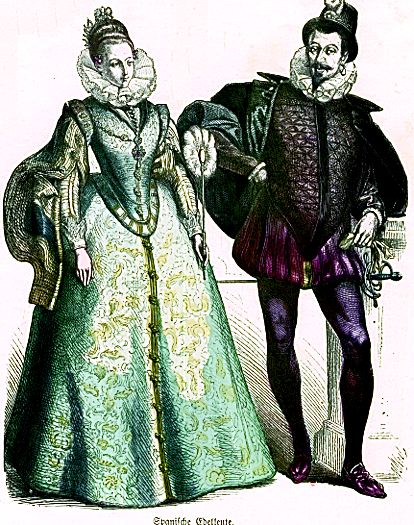
http://www.vjw.biz/ebook/PLATE46BXSpanishmid16th.jpg

Evaluation
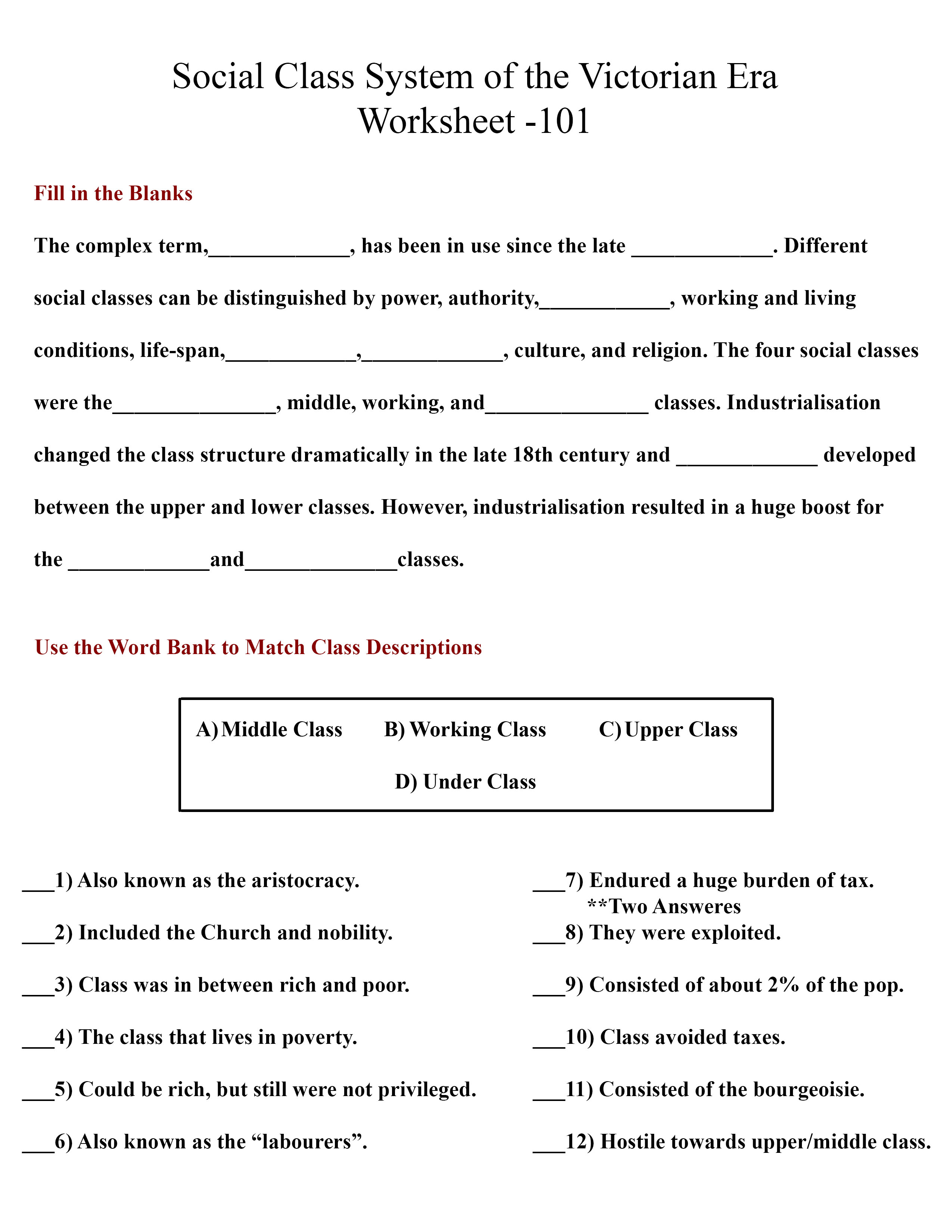
Now that you have learned some of the background of the social class system during the Victorian Era, you will be given a worksheet to complete and turn in at the end of class. This worksheet will test you on what you should now know about the social class system and will prove to me who did and didn't learn the material. You will be graded and the highest possible points to earn is 22pts.
Here is what the worksheet looks like:
Conclusion
That is the end of our webquest. We hope you learned important information about the social class system during the Victorian Era. If you wish to learn more about how the social class system worked during the Victorian Era, there are books that will explain more and go further into detail in your library.
Thank you for your participation!
Credits
Credits:
http://www.victorianweb.org/history/Class.html
http://www.brainyquote.com/quotes/keywords/social_class.html
http://answers.yahoo.com/question/index?qid=20070308154831AAhRLP0
http://en.wikipedia.org/wiki/Victorian
http://www.vjw.biz/ebook/PLATE46BXSpanishmid16th.jpg
http://upload.wikimedia.org/wikipedia/commons/a/a7/Leadenhall_Street_J_…
http://www.victorianchildren.org/wpcontent/uploads/2012/12/Victorian_Children_in_Factory.png

Webquest By:
Dominique Whitney, Danielle Harris, Taylor Hood, and
Kaitlyn Bogdanowich
Period 3