
Introduction
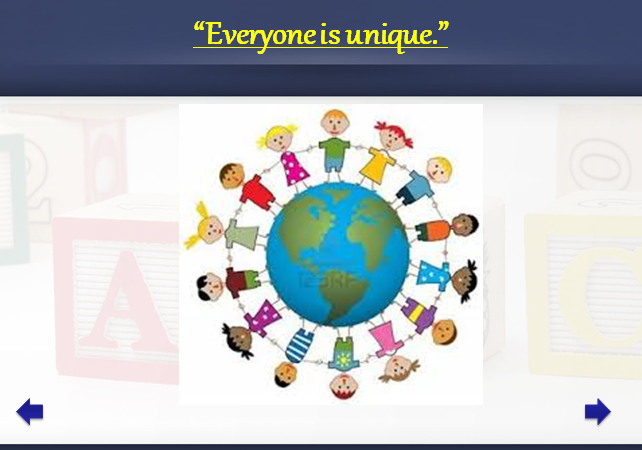
This lesson is about the Individual Differences which will help the learners understand the different knowledge, skills, values or attitude or even physical differences of individual and how to develop it or improve it and how to deal with each others' "uniqueness".
The learners will be able to see and review again the topic discuss in the classroom since it entails other explanation and information of the sub-topic under the Individual differences. The only difference is that is has more information and more details that will give the learners more ideas about the topic. They will be redirected to different topics that is related to the main topic with the use of the hyperlinks.
The learners will able to answer the following questions:
- What is an individual difference?
- What are the actors that bring about student diversity?
- How student diversity enriches the learning environment?
- What are the tips on student diversity?
Task
 Expectations are:
- After the discussion, the learner will be able to identify the different factors that bring about the diversity in the classroom by participating in threaded discussions.
- At the end of the topic, the learners will be able to demonstrate a positive attitude towards an enriching element in the learning environment by sharing an experience.
Process
As to the procedure, here are the steps to be done:
A. Preliminary Activity
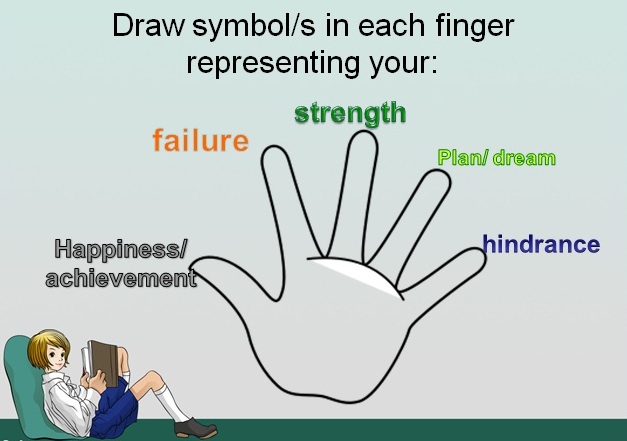
a. The learners will get a piece of paper, draw a hand or trace their right hand if they are right-handed or left hand if they are left-handed. Then put their name in the center of it or in the palm. After this, label each finger as; thumb for achievements, index finger for failures, middle finger for things or person to whom or which you draw strength, ring finger for your dreams or plans and pinky or baby finger for hindrance. Compare with your seatmate.
b. Unlocking Vocabulary
- self-esteem
- cognitive development
- agreeableness
- personality development
- traits
- Learning disorders
- Socio-economic
- Learning style
- exceptionalities
c. Objectives
- Give the students idea about the topic.
- Prepare them for the discussion and get their attention.
B. Developmental activities are;
- With the use of the inquiry approach, let them formulate questions after presentation of the outlined topic.
- With the questions the class will create an interactive discussion about their ideas and analysis of the topic.
__________________________________________________________________________________________________________
Individual Differences
- It is the variations from one person to another on variables such as self-esteem, rate of cognitive development or degree of agreeableness.
- Historically, psychological science has overlooked individual differences in favor of focusing on average behavior.
- For instance, we know that, on average, girls first experience signs of puberty around 10.5 years of age. While this is important information, it's also valuable to consider differences in pubertal development. Some girls experience puberty very early or very late. Psychologists have realized that either situations can have major consequences for the girl's future. If we only studied the average-in other words, if we overlooked individual differences-we would miss out on key information about child development.
- •Individual differences have been most often studied in the area of personality development. Psychologists have collected vast amounts of data on how people vary from one another in terms of their traits. For instance, they have noted thatindividual differences on the "Big Five" personality traits first strongly appear during the tween years.
- •All in all, the study of individual differences helps us to understand not only what makes humans similar to one another, but also what makes them different. By considering the variations that can occur from one person to another, we can best understand the full range of human behavior. We can also come to understand what constitutes normal variation-such as starting puberty at 9 years of age instead of 10.5 years-and which developmental rates may be red flags for intervention, such as in the case of learning disorders.
Refer to this video and discussion from CAST-Teaching Every Student
- [video:http://www.youtube.com/watch?v=-PpDq1WUtAw]
- http://www.cast.org/teachingeverystudent/ideas/tes/chapter7_3.cfm
______________________________________________________________________
Factors that Bring about Student Diversity
ØSocioeconomic status- the millionaire’s lifestyle differs from that of the middle income or lower income group
http://www.apa.org/pi/ses/resources/publications/factsheet-education.aspx
ØThinking/Learning style- some of you learn better by seeing something, others by listening, and still others by manipulating something
http://www.ldpride.net/learningstyles.MI.htm
ØExceptionalities- in class there maybe one who has difficulty in spoken language comprehension or in seeing, hearing, etc.
http://www.peelschools.org/parents/specialed/sep/Documents/B7categories.pdf
______________________________________________________________________
How Student Diversity Enriches the Learning Environment
•Students’ self-awareness is enhanced by diversity.•Exposing students to others with diverse backgrounds and experiences also serves to help students focus on their awareness of themselves.•Student diversity contributes to cognitive development.•The depth and breadth of student learning are enhanced by exposure to others from diverse backgrounds. Student diversity in the classroom brings about different points of view and varied approaches to the learning process.•Student diversity prepares learners for their role as responsible members of society.•The classroom can provide more than just theory given by the teacher in a lecture. With the student diversity, the classroom becomes a “public place” where community can be practiced.•Student diversity can promote harmony.•When student diversity is integrated into the classroom teaching and learning process, it can become a vehicle for promoting race relations.
Evaluation
Time to Evaluate
1. Individual Differences
Exemplary 4 pts
Proficient 3 pts
Developing 2 pts
Beginning 1 pts
| Respect for self and others | Exemplary | Proficient | Developing | Beginning |
Consistently demonstrates exceptional awareness of self and others through word and deed. Models self control and respect for others. Celebrates differences among people and viewpoints. Expects others to act respectful. |
Understands and respects personal abilities and beliefs of self and others. Demonstrates self control and appropriate interactions with peers, staff, and other community members. |
Limited appreciation for personal abilities and beliefs of self and others. May need prompting or directions to maintain appropriate interaction with others. |
Does not recognize the personal abilities and beliefs of others. Has an overly critical view of self. Does not maintain self control. Rarely interacts appropriately with others even with prompting. |
|
| Appreciation of differences | Exemplary | Proficient | Developing | Beginning |
| Exhibits a high level of cultural understanding and respect for the uniqueness of others, their practices, and perspectives. Guides discussions to facilitate others' understanding of differences. Offers opinions in a positive and rational manner. Engages in activities that promote appreciation of differences at all levels. |
Demonstrates an appreciation and respect for cultural understanding of the uniqueness of others, their practices, and perspectives. Participates in a dialogue of cultural or other differences. Presents opinions and views in a respectful manner when prompted. |
Limited appreciation and respect for others, their practices and perspectives. May appear indifferent to the ordeals of others or inflexible to resolve differences through dialogue. |
Demonstrates a superficial awareness of others, their practices and perspectives. Demonstrates intolerance and lacks social interaction skills. |
2. Objective Type of Exam
 |
|||
| 1 | |
If everyone in a group scores two points higher on a measure of conscientiousness taken one year after the first measure, the group shows high |
|
|
A) |
mean level stability. | |
|
B) |
rank order stability. | |
|
C) |
personality coherence. | |
|
D) |
validity coefficients. | |
|
|||
|
|||
| 2 | |
Which of the following would be considered personality development? |
|
|
A) |
bodily changes during illness | |
|
B) |
personality changes due to the effects of a drug | |
|
C) |
decreasing activity level over time | |
|
D) |
a new career | |
|
|||
|
|||
| 3 | |
The tendency for sensation seeking to decrease over time is an example of personality change at the _____ level of analysis. |
|
|
A) |
population | |
|
B) |
group differences | |
|
C) |
individual differences | |
|
D) |
individual uniqueness | |
|
|||
|
|||
| 4 | |
Which of the following has not been considered a temperament? |
|
|
A) |
self-esteem | |
|
B) |
activity level | |
|
C) |
smiling and laughter | |
|
D) |
soothability | |
|
|||
|
|||
| 5 | |
The trait of _____ tends to increase over time. |
|
|
A) |
extraversion | |
|
B) |
agreeableness | |
|
C) |
neuroticism | |
|
D) |
openness | |
|
|||
|
|||
| 6 | |
When considering self-esteem, adolescence seems harder on |
|
|
A) |
males. | |
|
B) |
females. | |
|
C) |
extraverts. | |
|
D) |
people who view themselves as physically attractive. | |
|
|||
|
|||
| 7 | |
Which of the following traits has been found to decrease over time? |
|
|
A) |
impulsivity | |
|
B) |
ambition | |
|
C) |
sensation seeking | |
|
D) |
all of the above | |
|
|||
|
|||
| 8 | |
Couples who score high on _____ are more likely to get divorced. |
|
|
A) |
neuroticism | |
|
B) |
extraversion | |
|
C) |
agreeableness | |
|
D) |
dominance | |
|
|||
|
|||
| 9 | |
Men who had many temper tantrums as young boys |
|
|
A) |
had personalities that were similar to others when measured at age 30. | |
|
B) |
continued to have temper tantrums as adults. | |
|
C) |
achieved lower levels of academic success compared to calmer boys. | |
|
D) |
were more likely to be military leaders as adults. |
Conclusion
- The learners will form a big circle then at least 5 of the learners will discuss about themselves and give idea or anything that they know about their classmate, at least 3 of his co-learners to emphasize the uniqueness of each of them and facilitate them what they have learned from the topic.
- To reinforce them, they will do an assignment to look for the videos and links for the review of the topic and additional ideas and topics with the hyperlink available in the presentation.
http://www.youtube.com/watch?v=yA9ZKn5wMqg
http://www.youtube.com/watch?v=lldmkrJXQ-E
[video:https://www.princeton.edu/~achaney/tmve/wiki100k/docs/Individual_differ…]
Credits
http://www.rcampus.com/rubricshowc.cfm?code=YA548W&sp=true
http://highered.mcgraw-hill.com/sites/0070366055/student_view0/chapter1…
http://tweenparenting.about.com/od/physicalemotionalgrowth/a/Individual…
Priciples of Teaching I, Brenda B. Corpus, Ph. D, Gloria G. Salandanan, Ph. D.
Efren Gaveria, Ph.D., BUCE Professor
Gerard Protacio, Ed.D., BUCE Professor
Teacher Page
I consider this topic as one of the most important thing for students to understand on how to deal with others and how to improve themselves with what they have and what they are. It will help further develop their relationship with their co-learners, teachers and other stakeholders surrounding them. Individual differences is the topic that is fun to study and even an encouraging to students to go further with the details.
This topic can be teach for high school and college students.