
Introduction
WELCOME TO OUR WEBQUEST
THE NAME OF THIS UNIT IS
LET'S CELEBRATE!
IN THIS DIDACTIC UNIT, YOU WILL FIND INFORMATION AND ACTIVITIES ABOUT HOLIDAYS, FESTIVALS, CUSTOMS AND CELEBRATIONS.
THE IDEA IS TO LEARN AND UNDERSTAND MORE OF THE ENGLISH LANGUAGE TAKING INTO ACCOUNT THE CONTEXT. THEREFORE, YOU WILL INCREASE ALL OF YOU LINGUISTIC ABILITIES. BY KNOWING IMPORTANT ASPECTS OF CULTURE.
HERE, WE PROVIDE YOU WITH AN INFORMATIVE CHART. IN THIS CHART, YOU WILL FIND A DESCRIPTION OF THE SKILLS THAT YOU WILL BE WORKING ON.
|
FUNCTION |
GRAMMAR |
LISTENING/ PRONUNCIATION |
WRITING/ READING |
|
Describing holidays, festivals, customs, and special events. |
Relative clauses of time, adverbial clauses of time:before, when, after. |
Listening to descriptions of special days and customs. Stress and rhythm |
Writing about a holiday or festival. “Unusual customs”: reading about holiday and unusual customs |
IMPORTANT: In the following section, there some activities for you to practice, you need to deliver all of them. In the next class we will discuss about the celebrations presented. Then, for following you will have to present the activities in TASK. The last activity is in Process.
| NEXT CLASS ON TUESDAY (21/MAY) | CLASS OF THURSDAY (23/MAY) | CLASS OF TUESDAY (28/MAY) |
| READING ABOUT CELEBRATIONS | ACTIVITIES FROM TASK | FINAL ACTIVITY FROM PROCESS |
BUT FIRST:
LET'S TAKE A LOOK TO THIS WEBPAGE:http://www.flip-book-online.com/Documents/FlipBooks/%7Ba729dcb2-a647-47…;
DO NOT FORGET TO COME BACK!!! YOU WILL HAVE TO COMPLETE THE ACTIVITIES.
Task
HANDS ON!!
FIRST: You will have to be prepared for writing, so please have next to you a piece paper, where you will write all of the information requested.
Here, there are some activities for you to reflect upon.
Then, go to process where you will find the task you will find to deliver at the end of the term.
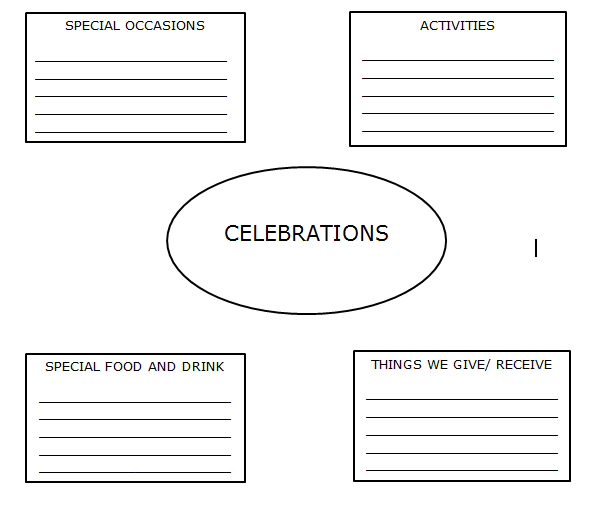
ACTIVITY 1: Complete the word map. Add two more words to each category.
|
Anniversary – Cake – Cards – Champagne - Dancing- Fireworks – Flowers – Parade – Party – Presents - Roast turkey- Wedding.
|
GRAMMAR FOCUS
|
RELATIVE CLAUSES OF TIME Halloween is a day when kids in the United States dress up in masks and costumes. November 2 is the day when Mexicans observe the Day of the Dead. Fall is the season when people in the United States and Canada celebrate Thanksgiving. |
ACTIVITY 2:
How much do you know about these days and months? Complete the sentences in column A with information from column B.
|
B
|
|
A
|
ACTIVITY 3: Complete these sentences with information of your own.
- Winter is a season…
- Spring is a time of the year…
- Mother’s day is the day…
- A birthday is a day…
- A wedding anniversary is a time…
|
ADVERBIAL CLAUSES OF TIME Before a Japanese couple gets married, they send wedding announcements. When they get married, they usually wear kimonos. After they return from the honeymoon, they move into their own home.
|
ACTIVITY 4: Read this information about marriage in North America. Match the clauses in column A with information from column B.
|
A
|
|
B
|
READING
UNIQUE CUSTOMS
|
Look at the photos below. What do you think is happening in each picture? |
- January 17 is St. Anthony’s Day in Mexico. It’s a day when people ask for protection for their animals. They bring their animals to church. But before the animal go into the church, the people usually dress them up in flowers and ribbons.
- On august 15 of the lunar calendar. Koreans celebrate Chusok to give thanks for the new harvest. It’s a day when people honor their ancestors by going to their graves to take them food and wine and clean their gravesites. Also on Chusok, a big meal with moon-shaped rice cakes is eaten.
- One of the biggest celebrations in Argentina is New Year’s Eve. On the evening of December 31, families get together and have a big meal. At midnight, fireworks explode everywhere and continue throughout the night. Friends and families meet for parties, which last until the next morning.
- Long ago in India, a princess who needed help sent her silk bracelet to an emperor. After he helped the princess, the emperor kept the bracelet as a sign of the loyalty between them. Today in India, during the festival of Rakhi, men promise to be loyal to their women in exchange for a bracelet of silk, cotton, or gold thread.
- On the evening of February 3, people in Japanese families take one dried bean for each year of their age and throw the beans around their homes and shrines, shouting “Good luck in! Evil spirits out!” this is known as “Setsubun,” a time to celebrate the end of winter and the beginning of spring.
ACTIVITY 1: Read the article. Make five correct sentences using and item from each column.
|
A On January 17, During Rakhi, On Chusok, On New Year’s Eve, On February 3, |
|
C visit the graves of their ancestors. bring their animals to church. stay up all night celebrate the end of winter. promise loyalty to their women.
|
|
B people in Japan people in Argentina people in India people in Mexico people in Korea |
Process
ACTIVITY 2: Is there a holiday or custom in your country that is similar to one described?
Describe the holiday or custom you liked the most?
Evaluation
This is how your work will be evaluated.
| Beginning 1 |
Developing 2 |
Qualified 3 |
Exemplary 4 |
Score |
|
|---|---|---|---|---|---|
| Stated Objective or Performance | Description of identifiable performance characteristics reflecting a beginning level of performance. | Description of identifiable performance characteristics reflecting development and movement toward mastery of performance. | Description of identifiable performance characteristics reflecting mastery of performance. | Description of identifiable performance characteristics reflecting the highest level of performance. | |
| Stated Objective or Performance | Description of identifiable performance characteristics reflecting a beginning level of performance. | Description of identifiable performance characteristics reflecting development and movement toward mastery of performance. | Description of identifiable performance characteristics reflecting mastery of performance. | Description of identifiable performance characteristics reflecting the highest level of performance. | |
| Stated Objective or Performance | Description of identifiable performance characteristics reflecting a beginning level of performance. | Description of identifiable performance characteristics reflecting development and movement toward mastery of performance. | Description of identifiable performance characteristics reflecting mastery of performance. | Description of identifiable performance characteristics reflecting the highest level of performance. | |
| Stated Objective or Performance | Description of identifiable performance characteristics reflecting a beginning level of performance. | Description of identifiable performance characteristics reflecting development and movement toward mastery of performance. | Description of identifiable performance characteristics reflecting mastery of performance. | Description of identifiable performance characteristics reflecting the highest level of performance. | |
| Stated Objective or Performance | Description of identifiable performance characteristics reflecting a beginning level of performance. | Description of identifiable performance characteristics reflecting development and movement toward mastery of performance. | Description of identifiable performance characteristics reflecting mastery of performance. | Description of identifiable performance characteristics reflecting the highest level of performance. | |
| Stated Objective or Performance | Description of identifiable performance characteristics reflecting a beginning level of performance. | Description of identifiable performance characteristics reflecting development and movement toward mastery of performance. | Description of identifiable performance characteristics reflecting mastery of performance. | Description of identifiable performance characteristics reflecting the highest level of performance. | |
| Stated Objective or Performance | Description of identifiable performance characteristics reflecting a beginning level of performance. | Description of identifiable performance characteristics reflecting development and movement toward mastery of performance. | Description of identifiable performance characteristics reflecting mastery of performance. | Description of identifiable performance characteristics reflecting the highest level of performance. |