
Introduction

Computing devices and electronics have become involved in every area of our lives. Some kind of digital electronics are involved in the circuitry. Have you ever wondered what is going on inside of these devices? What are they made of?
Well, this WebQuest will guide you to answer some of these questions.
Task
This webquest will introduce students to vocabulary used in chemistry and electronics.
Chemistry is used everywhere improve our lives. Elements are necessary for our bodies to work effectively, to make all sorts of electronic devices, and to create alloys of metallic elements used in buildings, transportation, and many other modern objects
Discussing and explaining the chemistry requires a certain familiarity with the vocabulary of chemistry and electronics. So you will start your webquest by defining the some terms used in chemistry and electronics
Students will also investigate the functions of electronic components. Students will investigate how and why certain elements and chemicals are used to produce these different electronic components which form the basis of computing devices. Students will then fill in a table and provide a picture, a function and the material used to produce several electronic components.
Lastly students will write a summery that describes what each of the components does in an electronic device and describe which property of the material makes it suitable to create that component.
Process
Open a Word document to record what you found for each section. Label them Task 1, Task 2, Task 3, and Task 4.
Task 1: Define the following terms and answer the questions that relates to them (in the Word document you already created!)
Question 1: What is primarily used in a computer chips: Metals, Non-metals, or Metalloids? Give a brief explanation as to why you think so.
Define: Metal, Non-metal, Metalloid, Conductor, Semiconductor
Helpful links: http://www.dummies.com/how-to/content/the-periodic-table-metals-nonmetals-and-metalloids.html
http://chemistry.about.com/od/periodictables/ss/Metals-Nonmetals-and-Metalloids-Periodic-Table.htm
http://www.semiconductors.org/semiconductors/about_semiconductors/
Question 2: How are alloys and compounds similar? How are they different?
Define: Compound, alloy
Helpful links: http://www.differencebetween.com/difference-between-alloy-and-vs-compound/
Question 3: What three electrical properties does Ohm's Law relate?
Define: Electricity, Resistor, Capacitor, Transistor, LED, Fuse
Helpful Links: http://www.resistorguide.com/materials/
http://www.capacitorguide.com/
http://www.electrical4u.com/electrical-fuse-hrc-fuse-high-rupturing-capacity/
Or google!
Define: Printed Circuit Board (PCB), Breadboard, and Solder
Helpful links: https://learn.sparkfun.com/tutorials/how-to-use-a-breadboard#history
http://www.sciencebuddies.org/science-fair-projects/project_ideas/Elec_primer-solder.shtml#overview
https://learn.sparkfun.com/tutorials/pcb-basics
Question 4: Why is it advantageous to use a breadboard?
Task 2: For each component listed below, answer "What is it?" "What is it made of?" and include a picture (a google search will work fine) of what it looks like.
Example: A resistor is ...
A resistor is made of ....
And it looks like ...
Components to look up:
Resistor
Capacitor
Transformer
LED
Breadboard
PCB (Printed Circuit Board)
Solder
Task 3: Use your defined vocabulary terms, completed component table and knowledge gained during your investigation to write an essay that describes what each of the eight components are used for in electronics. Then describe what properties the materials used to create the component have that allow the component to function.
Task 4: Now that you’ve gotten a little more comfortable with what each component does, we can start building our own circuits.
Visit the website:
http://phet.colorado.edu/en/simulation/circuit-construction-kit-dc
and click on the green button that says “Run Now!” to open the Java program.
We are going to construct two types of circuits: a series and a parallel circuit and measure the current and voltage through each. In the program, construct a circuit as pictured below (the 1 and 2 will be for referring to the resistors later).
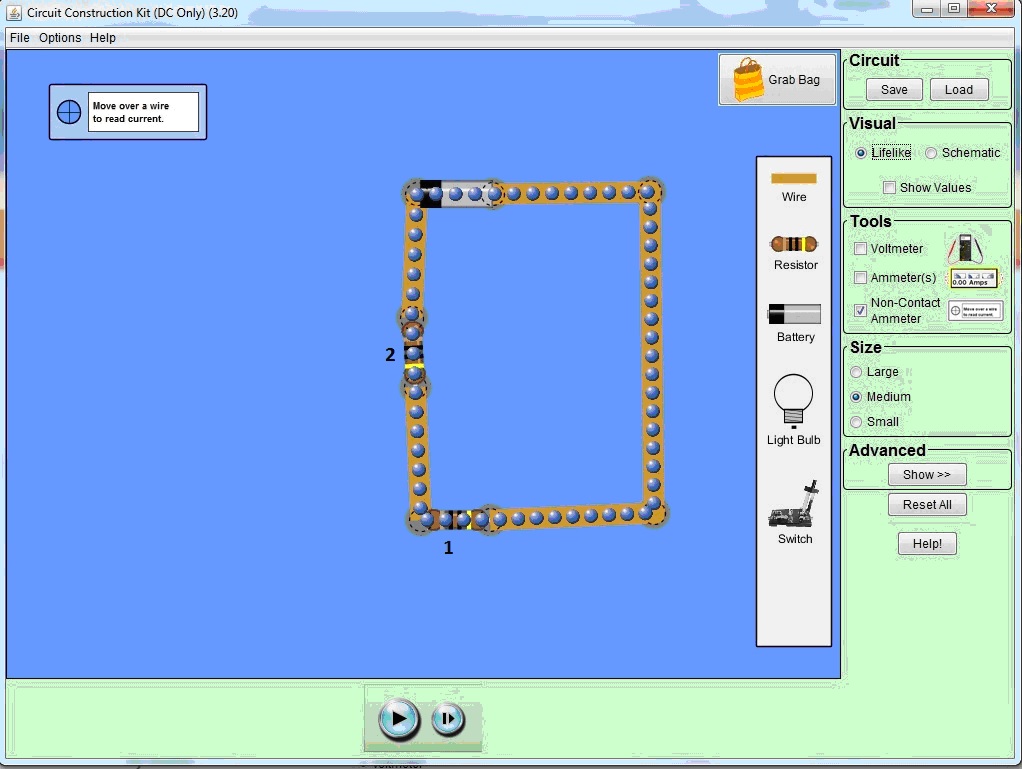
Is this a series or parallel circuit? If you’re not sure, check out this link:
http://edwardcho-sph3u.blogspot.com/2010/09/what-is-difference-between-parallel.html
The default for the battery is 9V and for the resistors is 10 Ω. We don’t need to change anything (yet). Under the “Tools” section, click the “Voltmeter” box and a device will pop up that looks like this.
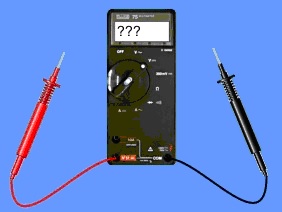
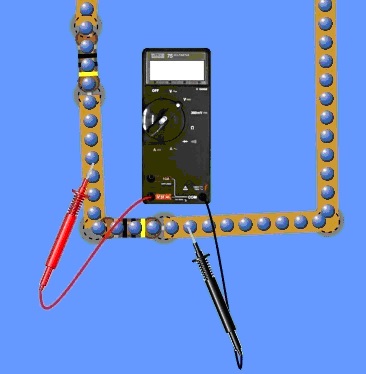
Place the black and red lead on the wire to read the voltage (the picture below shows how … but the reading is erased. Discover for yourself!)
The last step is to click “non-contact ammeter.” Hover the ammeter above the wire to read what the current is.
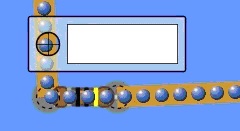
For Circuit 1, your resistors are both 10 Ω.
For Circuit 2, resistor 2 will be changed to 20 Ω (right click the resistor to change).
For Circuit 3 and 4, construct a circuit that looks like this:
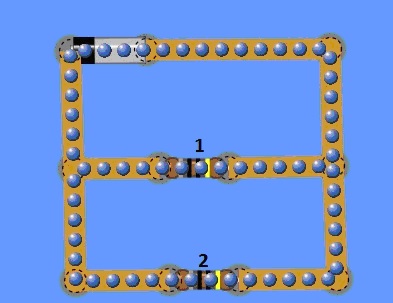
Circuit 3, your resistors will both be 10 Ω.
Circuit 4, resistor 1 will stay 10 Ω but resistor 2 will be 20 Ω.
Copy and Paste the table below into your OWN Word Doc and fill it in with the readings gathered from your circuits.
|
Circuit |
V across R1 |
V across R2 |
V across battery |
Current out of battery |
Current before R1 |
Current before R2 |
|
1 |
|
|
|
|
|
|
|
2 |
|
|
|
|
|
|
|
3 |
|
|
|
|
|
|
|
4 |
|
|
|
|
|
|
In a series circuit, the ___________ is the same at all points throughout the circuit.
In a parallel circuit, the ___________ is the same at all points throughout the circuit.
In a series circuit, the voltage across each resistor adds up to ________________________________.
In a parallel circuit, the current through each resistor adds up to _______________________________.
Evaluation
Product Rubric
|
|
Beginning |
Developing |
Accomplished |
Exemplary |
Score |
|
Vocabulary |
Some definitions were not provided or the definitions did not match the meaning of the word as used in electronics or chemistry |
All definitions were provided. Some definitions did not match the meaning of the word as used in electronics or chemistry |
All definitions were provided. All definitions match the meaning of the word as used in electronics or chemistry. Some of the vocabulary words are used in a sentence. |
All definitions match the meaning of the word as used in electronics or chemistry. Vocabulary words are correctly used in a sentence, The context and part of speech are used correctly |
|
|
Component composition and use |
Some component or usage details were not provided or the component or usage details did not match the details as used in electronics or chemistry. Some vocabulary words used did not match the definition |
Most component or usage details were provided but some of the component or usage details did not match the details as used in electronics or chemistry. Most vocabulary words used match the definition |
All component or usage details were provided and the component or usage details did match the details as used in electronics or chemistry. All vocabulary words used match the definition |
All component or usage details were provided and the component or usage details did match the details as used in electronics or chemistry All vocabulary words used match the definition and were used to explain the concepts. |
|
|
Essay |
Not complete or missing some part of the assigned information. Does not use the vocabulary. Sentence and paragraph structure is disorganzed |
Completes the assigned information but some of the vocabulary or information is incorrector missing. Most sentence and paragraph structure is organized. |
Complete with the assigned information and the vocabulary and information is correct. Sentence and paragraph structure is organized. |
Complete with the assigned information and the vocabulary and information is correct. Sentence and paragraph structure is well organized and easily understood. |
|
Process Rubric
|
|
Beginning |
Developing |
Accomplished |
Exemplary |
Score |
|
Group work |
One or more students in the group cannot clearly explain what information they are responsible for locating. |
Each student in the group can, with minimal prompting from peers, clearly explain what information s/he is responsible for locating. |
Each student in the group can clearly explain what information s/he is responsible for locating. |
Each student in the group can clearly explain what information is needed by the group, what information s/he is responsible for locating, and when the information is needed. |
|
|
Completion of stated webquest objectives |
The one or more tasks assigned are not complete. Student cannot identify the tasks required. |
Tasks are completed but one or more of the definitions or use and composition do not match. |
Tasks are completed and the definitions, use and composition do match. Student can explain and apply most of the definitions and concepts. |
Tasks are completed. Student can identify all of the tasks required. Student can explain and apply the all definitions and concepts. |
|
Conclusion
By completing this webquest you should have gained a better understanding of the electronics in the world around you including some of the components that are used to create them. You will have also increased your scientific and electronic vocabulary.
Credits
We all benefit by being generous with our work. Permission is hereby granted for other educators to copy this WebQuest, update or otherwise modify it, and post it elsewhere provided that the original author's name is retained along with a link back to the original URL of this WebQuest. On the line after the original author's name, you may add Modified by (your name) on (date). If you do modify it, please let me know and provide the new URL.
Teacher Page
Name: ________________________________
Task 1
Define the following terms and answer the questions that relates to them (in the Word document you already created!)
Question 1: What is primarily used in a computer chips: Metals, Non-metals, or Metalloids? Give a brief explanation as to why you think so.
Define: Metal, Non-metal, Metalloid, Conductor, Semiconductor
Question 2: How are alloys and compounds similar? How are they different?
Define: Compound, alloy
Question 3: What three electrical properties does Ohm's Law relate?
Define: Electricity, Resistor, Capacitor, Transformer, LED, Fuse
Question 4: Why is it advantageous to use a breadboard?
Define: Printed Circuit Board (PCB), Breadboard, and Solder
Task 2 Answer sheet
Component | What is it? | What is it made of | Picture (one picture of each component) |
Resistors | A resistor is a passive two-terminal electrical component that implements electrical resistance as a circuit element. | carbon, metal, or metal-oxide film | [img_assist|nid=19942|title=Resistor|desc=|link=none|align=left|width=640|height=426] |
Capacitors | A capacitor is a passive two-terminal electrical component used to store energy in an electric field. | Aluminum ceramics | [img_assist|nid=19943|title=Capacitor|desc=|link=none|align=left|width=640|height=480] |
transistor | A transistor is a semiconductor device used to amplify and switch electronic signals and electrical power. | Metalloids such as Silicon and Germanium and alloys | [img_assist|nid=19944|title=Transistor|desc=|link=none|align=left|width=640|height=488] |
LED | A light-emitting diode (LED) is a semiconductor light source.[4] LEDs are used as indicator lamps in many devices and are increasingly used for other lighting. | Silicon Carbide | [img_assist|nid=19945|title=LED|desc=|link=none|align=left|width=640|height=474] |
Solder | Solder is a fusible metal alloy used to join together metal workpieces and having a melting point below that of the workpiece(s). | [img_assist|nid=19946|title=Solder|desc=|link=none|align=left|width=640|height=480] | |
Breadboard | A breadboard (protoboard) is a construction base for prototyping of electronics | Non Conductive Plastic with imbedded copper or silver leads | [img_assist|nid=19947|title=Breadboard|desc=|link=none|align=left|width=640|height=428] |
PCB (printed circuit board) | is used to mechanically support and electrically connect electronic components using conductive pathways, tracks or signal traces etched from copper sheets laminated onto a non-conductive substrate. | Non conductive laminate with imbeded copper traces | [img_assist|nid=19948|title=PCB|desc=|link=none|align=left|width=640|height=333] |
Fuse | a fuse is a type of low resistance resistor that acts as a sacrificial device to provide overcurrent protection, of either the load or source circuit | zinc, copper, silver, aluminum, or alloys | [img_assist|nid=19949|title=Fuse|desc=|link=none|align=left|width=497|height=640] |
Task 4 Answer Page
It's a series circuit.
Circuit | V across R1 | V across R2 | V across battery | Current out of battery | Current before R1 | Current before R2 |
1 | 4.5 V | 4.5 V | 9 V | 0.45 A | 0.45 A | 0.45 A |
2 | 3 V | 6 V | 9 V | 0.30 A | 0.30 A | 0.30 A |
3 | 9 V | 9 V | 9 V | 1.8 A | 0.90 A | 0.90 A |
4 | 9 V | 9 V | 9 V | 1.35 A | 0.9 A | 0.45 A |
In a series circuit, the current is the same at all points.
In a parallel circuit, the voltage is the same at all points.
In a series circuit, the voltage across each resistor adds up to be the total battery voltage.
In a parallel circuit, the current through each resistor adds up to be the total current coming from the battery.