
Introduction
Copyright protects the intellectual property of authors or creators of original works ,as soon as they are expressed in a tangible form. Copyright does not protect ideas or concepts. To understand copyright the concepts of fair use, intellectual property, personal rights and privacy, and violations of those rights need to be understood.
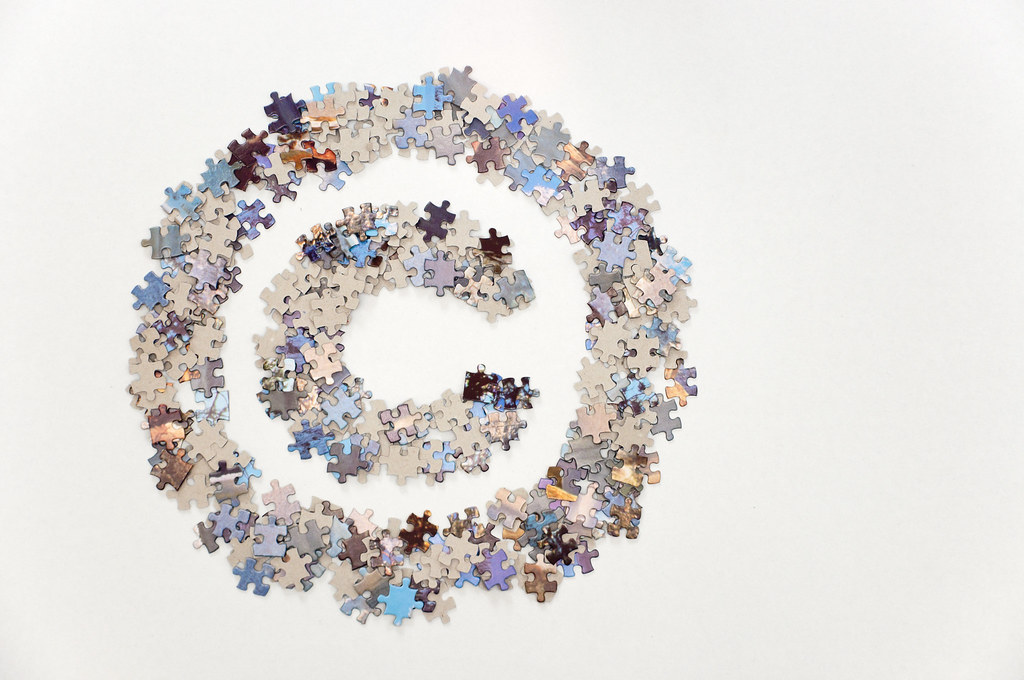 "Large copyright sign made of jigsaw puzzle pieces" by Horia Varlan is licensed under CC BY 2.0.
Fair use occurs when someone uses a source, without the author’s permission, but does not seek credit for the use of the work and does not seek monetary gain from using it (Ciszek, 2017). There are four factors that help determine when fair use covers the use of a source: 1) the purpose and character of the use, 2) the nature of the copyrighted work, 3) the amount of the work being used, and 4) and the effect of using the work on the marketability of that work (UT Permian Basin, 2022).
 "fair use classroom poster draft" by tvol is licensed under CC BY 2.0.
Intellectual property (IP) is anything created from mental processes, such as a piece of artwork, an invention, literary works, and musical compositions, for which the creator can apply for a patent, copyright, or trademark. Intellectual property is shared readily currently because of the rise of social media platforms and the constant usage of the internet. It is important to educate oneself on how to protect intellectual property, as well as ensuring that another’s intellectual property is not misused.
A derivative work is a new work created based upon a preexisting material (U.S. Copyright Office, 2011). For a work to be copyrightable as a derivative work, there must be substantial new material created for the preexisting material. The old work must be transformed or adapted.
Students expect to have their personal information protected, just like everyone does. It can be difficult for educational institutions to protect this information entirely because they have not only the right to protect the institution but are expected to provide a safe learning environment for these students, as well as teachers and staff. Therefore, a dilemma can arise between balancing the privacy of the students and the safety of the school. A law was passed that helps protect currently enrolled students. FERPA, or the Family Educational Rights and Privacy Act, is a federal law that regulates the confidentiality of student’s personal information and education records (McKie, 2020). FERPA requires that the student or parent provide written consent before a student’s personal information can be shared. The exception to this is if a safety issue arises, such as a medical emergency, surveillance videos, personal knowledge/observation of a teacher or fellow student, request for law enforcement records, and transfer of records (U.S. Department of Education, 2007).
Task
The resources on this page have been chosen to help provide information on copyright and the laws governing it, fair use, intellectual property, and student privacy rights/violations. Some of the resources require interaction and others can just be read or viewed. Each section provides an explanation of what those resources contain.
These resources provide a basic overview of copyright and fair use and their impact on higher education:
- Stanford University Copyright & Fair Use Center--https://fairuse.stanford.edu/
- United States Copyright Office, Library of Congress--http://lcweb.loc.gov/copyright/
- Copyright Society of the USA--http://www.csusa.org/
- Indiana University Online Copyright Tutorial--Copyright tutorial: File sharing & copyright: Personal Preparedness: Information Security & Policy: Indiana University (iu.edu)
- University of Texas Crash Course in Copyright--https://guides.lib.utexas.edu/copyright
- Copyright Basics with Jim the Librarian--https://youtu.be/Uiq42O6rhW4
These resources provide a more in-depth look at fair use:
- Fair Use Online--http://cyber.law.harvard.edu/fairuse/
- The Law of Fair Use--The Law of Fair Use and the Illusion of Fair-Use Guidelines - Association of Research Libraries (arl.org)
- Columbia University Fair Use Checklist--https://copyright.columbia.edu/basics/fair-use/fair-use-checklist.html
These resources provide information on intellectual property:
- Statements on Intellectual Property--Statement on Intellectual Property | AAUP
- Teaching Intellectual Property--crop.pdf (cambridge.org)
These resources discuss student privacy rights and violations:
- Faculty Views on Student Privacy--https://doi.org/10.1007/s12528-022-09320-7
- Protecting Student Privacy (sources from the U.S. Department of Education)-- Protecting Student Privacy | U.S.Department of Education
- Student Privacy 101--
Process
Creating a toolkit is a fun but daunting task. When creating a toolkit, the most important thing is ensuring that the information in the title of the toolkit is what is included inside. For example, this toolkit is titled "...Copyright, Fair Use, and Personal Rights and Privacy Toolkit". Therefore, the information provided needs to educated people on copyright, fair use, and personal rights and privacy. First, an introduction was written that the author felt encapsulated the most important information regarding these concepts. The second step was to research and find different sources that would educate students on these concepts. The creation of the toolkit was a new experience because of the formatting. The author tried using Microsoft Word and copy and pasting, but the formatting would not stay when it was pasted into WebQuest. However, there are some interesting features in WebQuest such as being able to insert links to videos, pictures, and html code. These features were used to add YouTube videos and images for this toolkit. A variety of sources was provided, as it is important to remember that students learn in different ways and so it is a good idea to provide something for each type of learning (auditory, visual, etc.). Lastly, an evaluation into the author's personal experience in creating this toolkit has been provided, as well as some tips that might help other students and/or educators in learning about these concepts and learning how to create toolkits.
Evaluation
The method used for creating this toolkit was a personal evaluation and reflection of the tools and resources that helped the author in learning about these important concepts. The introduction was written to provide a basic overview of some of the concepts that are central to understanding copyright: intellectual property, fair use, personal rights and privacy violation. The resources that were chosen should provide good information relating to these concepts, as well as allowing students to do additional research and learning. There are a variety of resources chosen, including .pdf files, YouTube videos, and educational websites.
When viewing the resources, some of them are a single article or video, while others allow the viewer to choose from a list of articles or sources, depending on the information the student is looking for. It is beneficial to read and gain a better understanding of these concepts. The author is still learning and has benefitted from different viewpoints and sources, each of which give different information. The resources chosen should help anyone who is learning about copyright. Also, it is the wish of the author that this toolkit can help someone better understand copyright, and the different concepts relating to it. Hopefully, this will spark some interest and inspire students through the use of this toolkit.
Conclusion
This toolkit provides information on copyright, fair use, intellectual property, and student's privacy rights. Websites with various articles relating to these concepts have been provided. Also, YouTube videos and .pdf articles have been provided to give additional information and various methods of learning these concepts. Learning about copyright and the different issues related to it, especially where education is concerned, is essential for completing a degree in higher education. This will also help prepare students who wish to teach or work in the field of education for knowing what is allowed and what liabilities might arise. The most important thing to remember is there are resources available to help. It is the author's wish that the resources provided in this toolkit will help educate and assist students in their educational journey.
Credits
AAUP (2022). Statement on intellectual P\property. American Association of University Professors. https://www.aaup.org/report/statement-intellectual-property
Association of Research Libraries (2022). The law of fair use and the illusion of fair-use guidelines. Association of Research Libraries. https://www.arl.org/resources/the-law-of-fair-use-and-the-illusion-of-f…
Ciszek, M.C. (2017). Copyright, fair use, and free use for US K-12 educators: A legal perspective. A Journal of Educational Strategies, Issues and Ideas, 90(5-6), pp. 214-217.
Columbia University Libraries (2022). Fair use checklist. Copyright Advisory Services. https://copyright.columbia.edu/basics/fair-use/fair-use-checklist.html
Copyright Clearance Center (2011). Copyright basics with Jim the librarian. [Video]. YouTube. https://youtu.be/Uiq42O6rhW4
CSUSA (2022). The Copyright Society of the USA. http://www.csusa.org/
Harvard University (2022). Fair use online. Harvard University. http://cyber.law.harvard.edu/fairuse/
Indiana University (2022). Information security & policy: Copyright tutorial. Indiana University. https://informationsecurity.iu.edu/personal-preparedness/file-sharing/t…
Jones, K., VanScoy, A., Bright, K., Harding, A., & Vedak, S., (2022). A measurement of faulty views on the meaning and value of student privacy. Journal of Computing in Higher Education: Research & Integration of Instructional Technology, 50(6), pp. 1-21.
Minow, M. (2017, April 11). Copyright & fair use. Stanford Libraries. https://fairuse.stanford.edu/
Takagi, Y., Allman, L., & Sinjela, M.A. (2008). Teaching of intellectual property: Principles and methods. Cambridge University Press. https://assets.cambridge.org/97805217/16468/frontmatter/9780521716468_f…
U.S. Copyright Office (2022). What is copyright? United States Copyright Office. http://lcweb.loc.gov/copyright/
U.S. Department of Education (2022). Student privacy at the U.S. Department of Education. U.S. Department of Education. https://studentprivacy.ed.gov/
U.S. Department of Education (2014). Student privacy 101: FERPA for parents and students. [Video[ YouTube. https://www.youtube.com/watch?v=nhlDkS8hvMU
University of Texas (2022). Copyright crash course. https://guides.lib.utexas.edu/copyright
UT Permian Basin (February 25, 2022). Copyright and fair use. J. Conrad Dunagan Library. Fair Use - Copyright and Fair Use - LibGuides at University of Texas Permian Basin (utpb.edu)
Teacher Page
Educating others is a rewarding thing. The best help we can give others is to help them learn how they can find information to educate themselves. Being an educator is about helping students succeed on their journey and guiding them in self-learning. Students are the captain of their own ship; educators are the compass that helps them steer in the right direction. There are so many resources available that educators can provide to help students learn how to find their own sources to use in their educational experience. The author recommends helping students find what they need but providing resources that help them be involved in the learning process. Hopefully, this WebQuest will provide useful information on copyright to students and educators alike.