
Introduction
Welcome, Body Defenders! 🛡️
Every day, invisible invaders like bacteria and viruses try to sneak into your body. If they manage to get in, they can cause colds, fevers, or other illnesses. But here’s the good news : your body has its own powerful defense system called the immune system.
Think of the Immune system like an army inside you:

- The innate defense works fast, using barriers like skin and mucus.
- The adaptive defense takes longer but is very effective and smart ;it remembers germs and makes sure they don’t attack again.
- And the best part is that vaccines are like training camps that get your defenders ready before the enemy even arrives.
❌ Photo unavailable
In this WebQuest, you’ll step into the role of an Immune System Explorer 🔍. Your mission is to investigate how the body stays safe, discover the “soldiers” of the immune system, and understand why vaccines are so important for health.
Big Questions to Think About:
1. How does your body protect you from germs every day?
2. What’s the difference between innate immunity and adaptive immunity?
3. How do vaccines give your immune system a head start?
Task
In this webquest your mission is to explore the immune system step by step.
You will:
1• Identify the enemies (pathogens) and the body’s defenders.
2• Compare the two defense forces.
3• Investigate how vaccines train your immune system.
4• Create a short poster or mini-summary at the end showing what you discovered.
❌ Photo unavailable
Process
Step 1 – Meet the Germs
Germs are tiny invaders and troublemakers like bacteria and viruses. They are everywhere, but not all of them make us sick.When they do succeed , they can damage cells by leaving behind harmful things that make us feel ill ( they cause fevers and coughs..).
• Watch this video to understand how the immune system works:
• Write down two ways germs can make people sick.
• Look at the picture that is inserted here showing germs trying to attack the body.
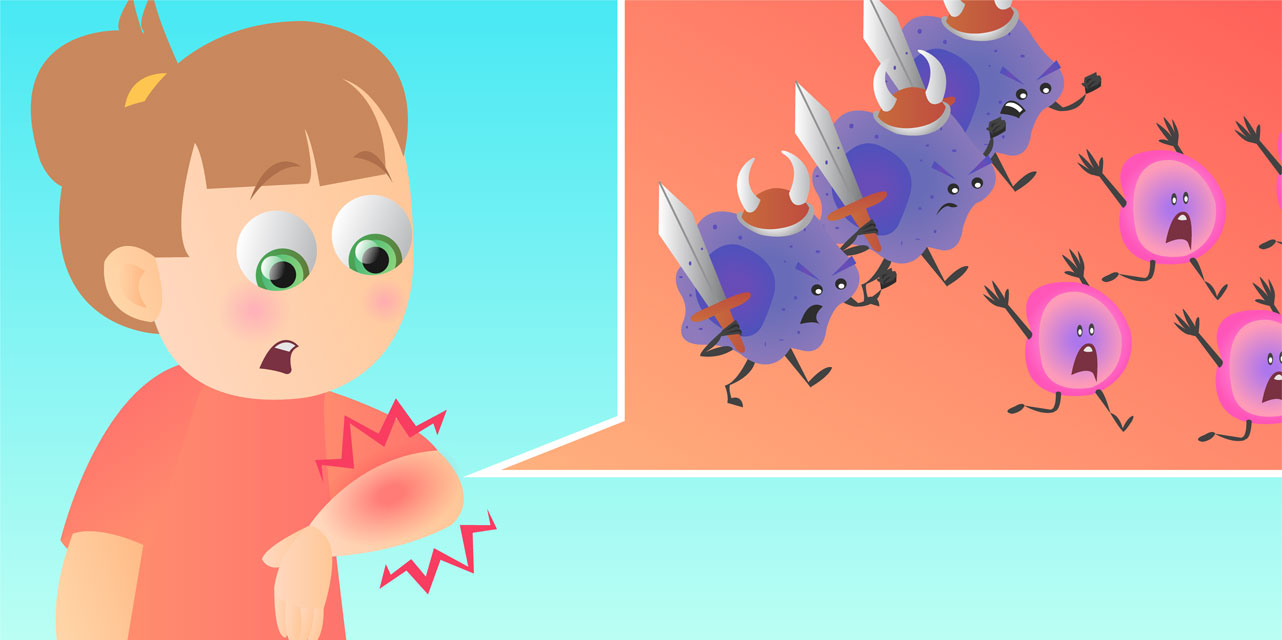
Step 2 – Meet the First Defenders: Innate Immunity
The body’s first defenders act fast. Your skin blocks germs from getting in , and mucus traps the germs that sneak inside. Mucus is a sticky liquid that is thick , it is in your nose and throat . It traps germs so your body can push them out by coughing or sneezing. When germs still get inside, your body can raise its temperature with a fever or cause inflammation to fight them off quickly.
• Look at the picture that is inserted here
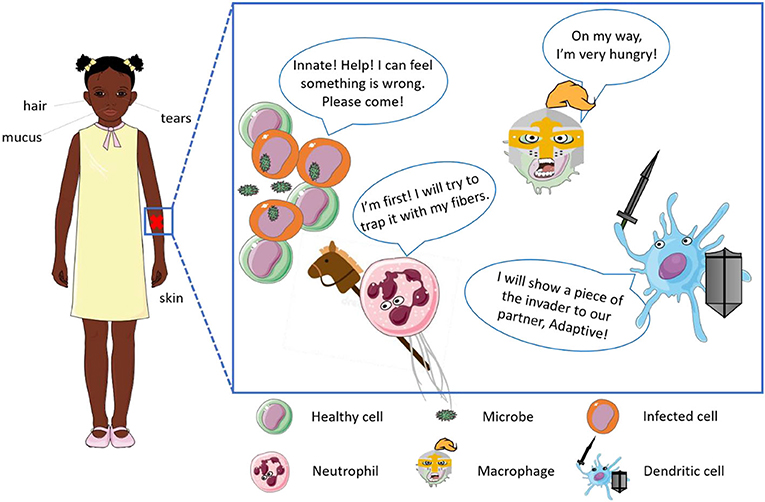
• Write down two defenses the body uses right away.
Step 3 – The Smart Army: Adaptive Immunity
Sometimes germs get past the first defenders. That's when your body calls in its "smart army". This army uses special fighters called white blood cells (like T-cells and B-cells). They don't just attack germs but they also remember them . If the same germ comes back, your body is ready.
• Look at the picture that is inserted here showing white blood cells attacking germs.
❌ Photo unavailable
• Write down one way adaptive immunity is different from innate immunity.
Step 4 – Vaccines in Action
Vaccines prepare your defenders before the enemy even arrives.They are like training camps for your immune system . They teach your immune system to recognize germs quickly and vaccines give your body a safe preview of the germ. This way , your immune system can practice and learn how to fight it.

It is also encouraged that you watch this video:
• Write 2–3 sentences explaining why vaccines are important.
• Draw a picture showing how a vaccine trains the immune system.
Step 5 – Final Challenge
Create a mini-poster titled “My Immune System Army” that includes:
• At least One enemy germ 🦠
• At least two defenders (skin, white blood cells, mucus) 🛡️
• A short sentence about vaccines as training 💉
Your poster should include colors , labels and creativity.
Evaluation
| Criteria | Excellent | Satisfactory | Needs improvement |
|---|---|---|---|
|
Understanding of the Immune system (30 points) |
Shows strong knowledge of innate and adaptive defenses and vaccines. | Shows some knowledge but with gaps or mistakes. | Shows little or no understanding. |
|
Written work (25 points) |
Answers are complete, clear and correct. | Answers are partly complete or unclear. | Answers are missing or incorrect. |
|
Poster project (25 points) |
Poster is colorful, neat and includes all required parts. | Poster is somewhat nest but there are missing details. | Poster is incomplete or lacks effort. |
|
Creativity and effort (20 points) |
Work is original , engaging , and shows full effort. | Work shows some creativity and effort. | Work shows little creativity or effort. |
Conclusion
Well done, Immune Explorers! 🎉
You discovered how your body fights back against germs, how the innate and adaptive defenses work together, and why vaccines are like secret training programs for your immune army.
By the end of this mission, you can see that your immune system is not just science, it’s also your everyday superhero team, keeping you strong and safe. 💪🧬
Credits
Pictures
https://thumbs.dreamstime.com/b/businessman-clipboard-checklist-43070858.jpg

https://msgallagherlhs.weebly.com/uploads/3/8/6/9/38694679/486824.jpg?461

https://pbs.twimg.com/media/Cg4eiPCWMAAoMEs.jpg
https://www.frontiersin.org/files/Articles/609074/frym-09-609074-HTML/image_m/figure-2.jpg
Text
Nemours KidsHealth. (2023). How the immune system works. KidsHealth. https://kidshealth.org/en/kids/immune.html
Centers for Disease Control and Prevention (CDC). (2024, January 5). How vaccines work. CDC. https://www.cdc.gov/vaccines/basics/how-they-work.html
Mayo Clinic. (2024). Immune system: Function and disorders. Mayo Clinic. https://www.mayoclinic.org/diseases-conditions/autoimmune-diseases/in-depth/immune-system/art-20044600