
Introduction
What is genetic screening and testing?
Genetic screening is defined as a methodical search of populations for people with inactive, early, or symptomatic disease. Genetic testing is the study of a humans DNA to be able to identify genetic similarities or differences to see whether they are susceptible to a particular disease or abnormality. Scientists say that genetic screening & testing are interchangeable; meaning that they are basically the same concept.

This is a diagram of the DNA structure which is the basis of genetics and genetic testing which is why it is so important to know all of the components of a 'normal' persons DNA so that scientists can test for variations in the DNA.
Task
Why do we use genetic screening/testing?
Genetic screening/testing is used to diagnose genetic diseases and subsequent intervention as early as possible in someone's lifetime. Doing this minimises the frequency of diseases throughout subsequent generations. Genetic testing also gives an insight to partners who are wanting to produce offspring but don't want to pass down the genetic disorder. This may involve tough decisions for parents and they may need to see genetic councillors who clarify situations but can NOT make decisions.
When might I think about genetic testing?
- If there is a condition that runs in your family that could possibly be passed down.
- If your child is severely affected by problems with their growth, development and their health
- If you have been exposed to chemicals, drugs or radiation (may lead to genetic abnormalities)
Process
What does a Genetic test look for?
A genetic test looks for variations from what genes should normally look like. Genetic tests are typically blood tests or a sample of saliva may be taken from your mouth which is called a buccal smear. Although, genetic testing is not always accurate.
Types of genetic screening
There are five different types of genetic screening which vary to suit certain people and/or situations. These include:
- Parental screening: finds out whether a foetus is at risk for various identifiable genetic diseases or traits. This began in 1966.
- Newborn screening: involves the analysis of blood or tissue samples taken in early infancy to avoid serious health problems later in life and to avoid the risk of death.
- Carrier screening: identifies individuals with a gene or a chromosome abnormality which could cause issues for offspring or that person.
- Forensic screening: seeks to find a genetic linkage between suspects and evidence discovered in criminal investigations.
- Susceptibility screening: involves screening of populations which are selected for genetic susceptibility or environmental hazards. This can be used for workers who could likely be susceptible to toxic substances; may cause future disabilities.

Although, there is also a new embryo test (shown in this diagram) which represents the process of pre-implantation genetic haplotyping. Preimplantation genetic haplotyping (PGH) is a clinical method of preimplantation genetic diagnosis (PGD) used to determine the presence of single gene disorders throughout offspring. PGH can provide a more practical method of gene location than whole-genome association experiments, which are expensive and time-consuming.
Evaluation
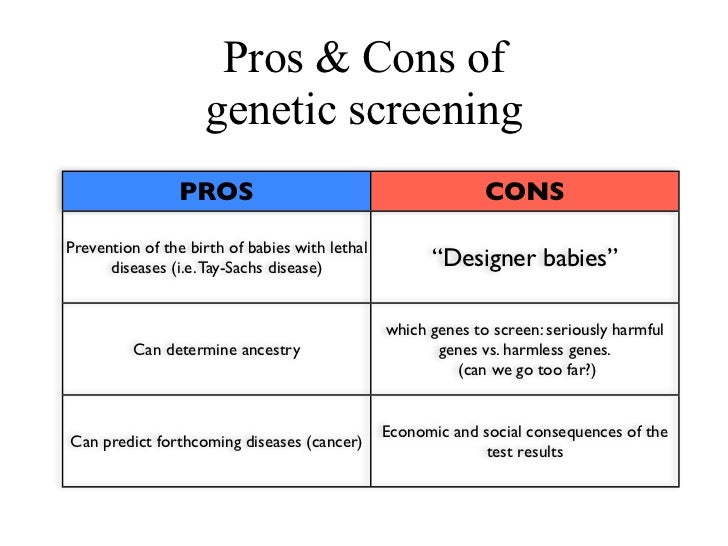
This table represents the pros and cons of genetic screening and highlights that even though genetic screening is looked over as a positive thing yet as always, with most things there are also negative effects. This suggests that maybe the use of genetic screening, may help prevent diseases but choices made by parents or doctors may be extremely fussy when it comes to having the 'ideal baby'.
Conclusion
Monitoring and surveillance, reproductive info, medical intervention and research, enumeration and registries of genetic disorders/diseases is what genetic screening can be used for. Systematic searches, through genetic screening & testing, for persons with a particular genotype is extremely important. This is important as it provides information to furthermore create preventative medicine.
Credits
- Zhang, J., Filan, S., Hopley, S., Morante, R., Stanger, J., & Tilley, C. Oxford insight science 10 (p. page 49).
- Wikipedia. (2019). Retrieved from https://www.wikipedia.org/
- Genetic testing. (2019). Retrieved from https://www.healthdirect.gov.au/genetic-testing
- Chandan Saha, M. (2019). Human Genetic Screening. Retrieved from https://www.ndsu.edu/pubweb/~mcclean/plsc431/students98/saha.htm