
Introduction
The Philippines (officially the Republic of the Philippines) is an archipelagic country in Southeast Asia. Situated in the western Pacific Ocean, it consists of about 7,641 islands that are broadly categorized under three main geographical divisions from north to south: Luzon, Visayas, and Mindanao. It is also known for its rich culture and tradition, including the different traditional games. Due to limited resources of toys, Filipino children usually come up with inventing games without anything but the players themselves. The flexibility of humans to think and act makes the game more fascinating and challenging. Because it is a tradition for Filipinos to play in a bigger and spacious area, most games were played outside the house. There are over thirty-eight known Filipino games and many of these are as challenging and competitive as Western-style games.
Task
First to give me the list of our report will receive 15 pesos load,
And if you answer all of the following questions you will have a chance to receive a hundred peso load.
Process
Let the game begin … Bulong Pari!
"Bulong Pari" is a customary Philippine game which implies in English "Whisper It To The Priest." As the name suggests, it is a whispering game prevalently referred to in the Visayan district as "Honghonganay".
It requires two teams with no less than 5 individuals each. The more members, the better. Two individuals will serve as the Leaders of each group while one player assumes the role of the Priest who should remain at around 5 meters away from the two groups.
The leader of Team A will approach the priest and whisper the name of one of the individuals from Team B. The priest at that point gets out "Lapit!" or "Approach!" to summon one player from Team B.
In the event that it happens to be a same individual specified before by the leader of Team A, the priest will say "Bang!" and he or she turns into a detainee. If not, the player who moved toward the priest will get a chance to specify the name of one of the players of Team A.
The group with few or no players left becomes the loser.

BAHAY-BAHAYAN
Bahay-bahayan, or playhouse, is a role-playing game where the participants play the roles of the family members (father, mother and children) and the extended family members (grand-parents, parent's siblings, house helpers and even pets).
•Preparation
Players build their "house" using mattresses, tables, chairs, and any thing around the house when played inside. When played outside, they build it with planks tied on trees, leaves, etc. They also use tin cans, sticks, etc. as their kitchen utensils. In general, children use their imagination in using regular things as house items.
•Choosing role
The characters that each of the players play is freely chosen by those who are part of it.
•Game play
The participants now play the role of the assigned characters. The house helpers will clean the house; the father will try to get money (sometimes leaves, candy wrappers, bottle crowns, etc.); the mother will cook; the children plays and follow their parents; etc.


Stealing Bases (Agawan Base)
English: Stealing Bases
Filipino: Agawan Base
Agawan Base Participants are divided into two teams with equal number of team members. The object of the game is for one team to try & capture the base of the other by reaching the other's home base first & tagging a pre-decided item (e.g., a tree trunk, a rock, etc) symbolizing the opposite team - without getting tagged by the defending members of the opposite team. A safety line is drawn between the two teams. A member of an opposing team who crosses the safety line into the territory of the other team can be chased & tagged by the team that owns that base. If the attacker gets tagged before he/ she manages to get back to his/ her safety zone or home base, he/ she becomes a prisoner (POW) of the opposite team. He/ she can be rescued by his/her teammates if one of his/ her teammates manage to get close to the base & tag the POW without getting tagged himself/ herself by the guard or one of the defenders in the opposing team. The game ends when a member of an opposing team manages to tag the symbol of the other team or when all the members of one team are captured by the other leaving their homebase free for the opposite team to attack & capture. This game is similar to the Capture the Flag game which is the basis for the 90s adult game called Paintball Combat Game which has gained popularity over recent years. Tagging has been substituted for air pistols/ guns with water-soluble paint as ammunitions for the guns.
Equipment: markers to be used as the base, 2 pcs. (you can use two trees or two slippers or two chairs as your bases)
Number of players: minimum 4, two in each team (more players for more fun recommended) Minimum age: 5 years old
There will be 2 bases. Each base has equal members.
Mark your base with the base markers.
Assign a member to guard your base.
To capture the opponents, you must tag them.
The captured opponent will be the other team's prisoner.
To steal the base of the opponent and win, you must touch their base.
The game can be as small-scale as teams just facing each other and trying to tap the opponents to catch them or as large as team members hiding and strategising whom to catch first – for example, the weakest links or the slowest runners. If there are no more members at large, meaning all opponents have been captured, all members of the stronger team will have to try and get the base from the “guard” by tagging it. The one left must try not to leave the base lest it be overtaken by the opponents. In this case, the stronger team wins.


Chinese Garter - A Traditional Philippine Game
Chinese Garter - a game requiring flexibility, adjust and coordination, is a famous game for Filipino kids, most particularly among young ladies amid their elementary years. The game rotates around a normal garter, around a few yards in length, which be brought from sewing store at around twenty pesos or less.
This is the way the game played. Initially, there ought to be two individuals holding the two ends of the garter which is extended on a level plane while others are attempting to transfer over to the opposite side of the garter. The primary objective of this game is to crosswise over the garter without being tripped. In each round, the stature of the garter increases. The garter by and large begins from the lower leg – level and after that knee – level, et cetera until the point that the garter is situated overhead. Higher rounds request agility since players jump with their feet first noticeable all around and they traverse the strap and wind up arriving as an afterthought. This implies players ought to be dexterous, rationally gifted and should have beauty keeping in mind the end goal to complete the game. Also, doing cartwheels (to cross the strap) in higher levels is allowed.
Mechanics of the game
Players are divided into at least two groups, with a base number of two individuals for every group. Amid the game, two individuals from the "it" group will fill in as "game posts" as they remain inverse each other and hold each end of the garter. The goal of the game at that point is to have the capacity to effectively bounce over the garter as it is step by step held higher by the “game posts”. Much the same as in the game ten – twenty, each group likewise has its own team leader, all the more ordinarily known as the "Mother". Once a colleague either contacts the strap or neglects to seize a specific level, the Mother can even now spare her group by taking her colleague's turn. Inability to do as such will prompt the group's end by making them the new “game posts” and will take the game back to the primary level.
The Chinese Garter game is generally subdivided into ten levels. More often than not, notwithstanding, the players may choose for their coveted number of levels for their game. Here is a case of the levels being utilized to give you a thought of the game:
Level 1 – The garter is being held by the posts closer to the ground.
Level 2 – Knee high
Level 3 – Around the height of their hips
Level 4 – Waist high
Level 5 – Chest high
Level 6 – Shoulder high
Level 7 – Head high
Level 8 – At the tip of the head
Level 9 – A couple of inches over the head
Level 10 – Also known as the Father/Mother Jump, as high as a child raising his arms high on tip toes.
Along these lines, in the wake of knowing the background and the Mechanics or Rules of the game, we should make sense of by what means will this game end.
All things considered, the game normally closes after the most astounding bounce. Be that as it may, a few children would keep playing the game in reverse. Rather than raising the garter higher, the posts will keep the strap down to its lower position. The game currently has another goal: to have the capacity to achieve the garter by bowing in reverse. The game proceeds with along these lines until the point when the player comes to back to the least level.

TIYAKAD/ Kadang kadang
Tiyakad is a Philippine cultural game and recreation. It is a racing game that uses bamboo hewn or tree branches that intersect floors prominent in the legs and rest intervals on the ground. The game is played using up to 10 feet high bamboo trees while 20th-century Filipino recreation exaggerates it by using higher tree branches while playing. About Spanish centennial recreation, the new player uses half of coconut shells which have had widow with a mole in its hole for its fortress. This was called Kadang-Kadang means “simple play”.
MECHANICS
Each team has 10 members or depend on how many are agreed. The first players on each team will use two stilt / kadang with one each per foot. Participants align behind the line first whipping in facing beam. Two or more teams with contrasting as many will be involved.
Methods
In the signal, the first players to walk with using stilt / kadang, whip to pole and back, pass the next player standing in line proceeding.
The first players walk in the back of the lane members without stilt which he pass to next player, while the second player will go forward.
The first team return in the usual place or position players are considered to be champion.


CALAHOYO
Calahoyo, or Hole-In in english equivalent, is an outdoor game by two to ten players. Precise focusing on is the ability created in this game on the grounds that the goal of every player is to hit the anak (little stones or objects) with the utilization of the pamato (big, flat stone), attempting to send it to the hole.
A little hole is dug in the ground, and a throwing line is drawn inverse the hole (roughly 5 to 6 meters away from the said hole). A longer line is drawn between the gap and the throwing line. Every player has a pamato and an anak. All the anak are set on the throwing line, and players attempt to throw their pamato into the hole from the throwing line. The player whose pamato is in the hole or closest to the hole will have the shot for the first throw. Utilizing the pamato, the first thrower tries to hit the anak, endeavoring to send it to the hole. Players alternate in hitting their anak until the point when one of them gets into the hole, with the players alternating an entire round and so on. The game goes on until just a single anak is left outside the hole. All players who get their anak inside the hole are the champs or winners, while the one with the anak left outside the hole is the alila (loser) or muchacho.
Alila or Muchacho will be "punished" by all the winner/s as follows:
Winners stand at the throwing line with their anak past line A-B (longer line between hole and throwing line). The champs hit their anak with their pamato. The muchacho gets the pamato and returns it to the owner. The victors continue throwing as the muchacho keeps on getting and returning the pamato as a form of punishment. Champs who fail to hit their particular anak will quit throwing. The goal is to tire the loser as punishment. At the point when all are through, the game begins once more.

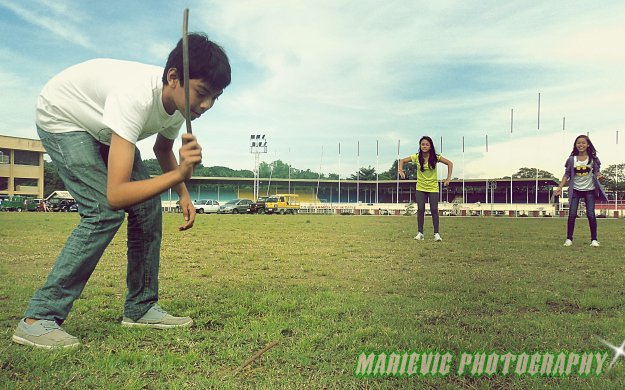
BATI-COBRA
Bati-Cobra is a classic but popular game among the kids in the province. It is a hitting and catching game. This game is played outside just by at least two players.
To play this game, two bits of bamboo sticks (one long, one short) are required. The long one fills in as the bat and the short one fills in as the ball. Furthermore, a little ground hole is required that makes a permanent base.
At least two players can play the game. To decide the main hitter, the player that strikes the smaller stick farther from the base will be the first to hit.
A player acts as a hitter and stands inverse from the others players at a distance. Tossing the smaller stick upwards and striking it hard plays the game. The other player from a far distance tries to get the stick. Whoever gets it turns into the next hitter. In the event that no one gets the stick the non-hitter may get the stick and strike the more extended stick set around the hitter close to the base. A player turns into the following hitter if the more drawn out stick is struck, however in the event that not, the main hitter keeps playing.
Points can be score by measuring the distance from the base up to where the smaller stick landed. The longer stick is used to measure the distance. Every length of the stick is proportionate to one point. A layer that gets 100 points or more is the champ.
WHAT IS THE DIFFERENCE BETWEEN BATI- COBRA AND SHATO?

Evaluation
Each question is worth regular 15 load.
1. What is the title of the background music of Ms. Jane's video about Bulong Pari?
2. Complete name of the reporter about Bahay-bahayan?
3. How many times did the guy wearing black shirt fell while playing tayakad?
4. Major of the second to the last reporter?
Credits
Ms. Jane Perez for Bulong pari
https://drive.google.com/file/d/1qUygdr3pmUKtUwyYlZr9zzrm7E0DLmR6/view
https://mail.google.com/mail/u/0/#inbox/FMfcgxwLsmlpSrmWDnKxNsKXfwHrcHxL?projector=1&messagePartId=
Ms. Kristel Mae Abrigo for Bahay-bahayan
https://www.facebook.com/messages/t/100005756283181
Ms. Jean Kaula NOmbrefia for Chinese Garter
agawan base video retrieved from:
Ms. Maridel Lipon For Tayakad/Kadang-kadang
Mr. Jonas Gabog for Calahoyo
Jellyn Balotcopo anD Marcus Inigo Zarsuela for Agawan base.
Agawan base video retrieved from:
Bati-cobra video retrieved from:
Shato video retrieved from: