
Introduction
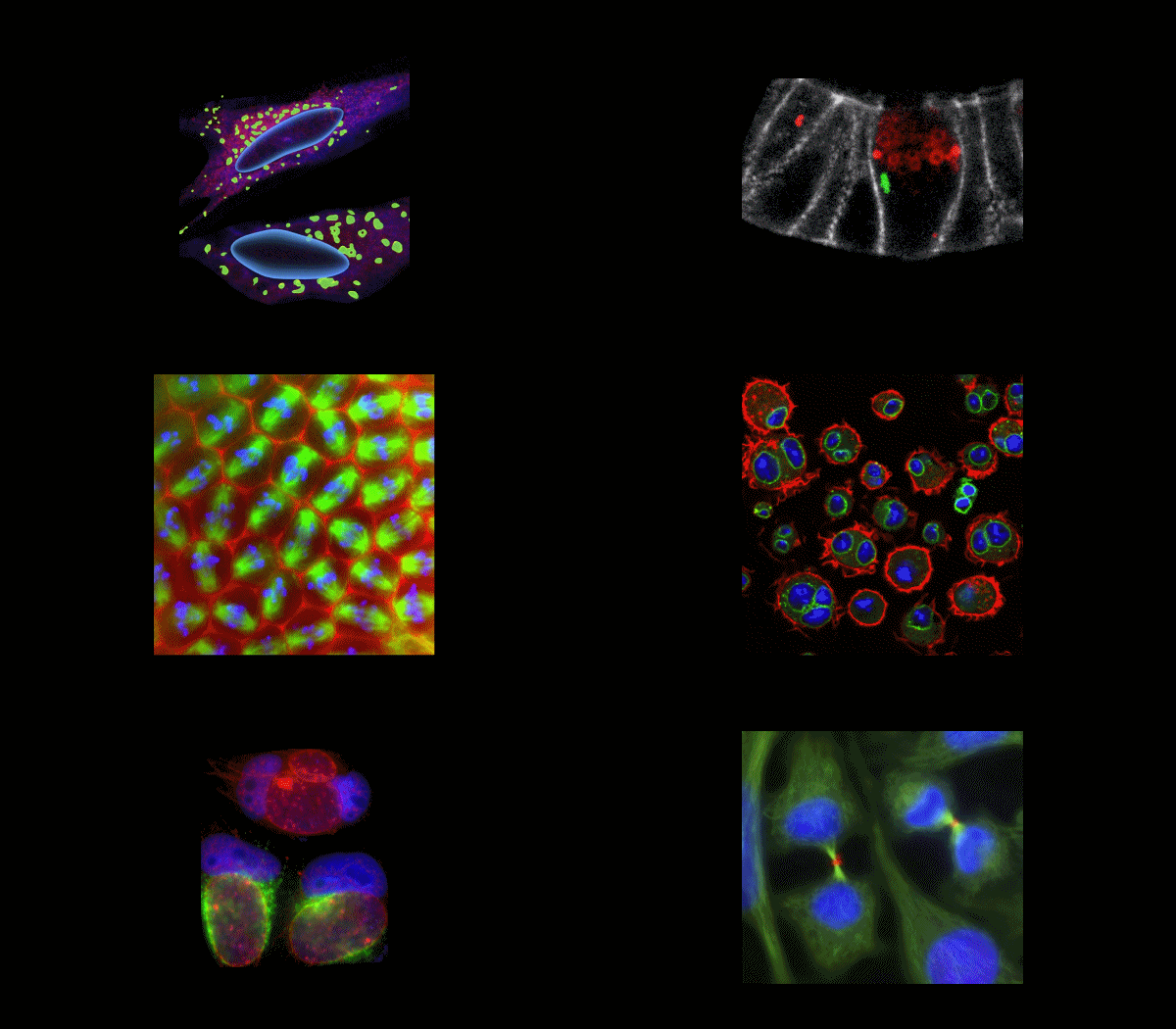

Introduction to Cell Biology
Cell Biology is the study about the structure and functions of cells. It also includes on how the cells becomes the fundamental unit of life. It also study about the different types of cell, it components, the metabolic process of cell,its signaling pathways and anything that explains about cell.
Cell Biology started in the year of 1830s when scientists had discovered the cell. It started when a Scientist name Robert Hooke discovered something when he put a piece of cork in his microscope. He described it like a "Honeycomb" and by that he named it to what we are all known the "Cells". The discovery of Hooke about the cell lead to other discoveries suchas Anton Van Leeuwenhoek who discovered the first Protozoa and Bacteria. Also Robert Brown who discovered the nucleus in plant cells, Matthias Jakob Schleiden propose that all plant tissues are made up of cells, Theodor Schwann who says that not only plant tissues but also the animal tissues were made up of cells, Carl Heinrich Braun says that cells are the basic unit of life and RudolfVirchow who said that cells comes only from pre-existing cells.Based on their given statement about cells, it developed the concept about Cell theory.
All living things are made up of cells. Thus, Cells are said to be the basic unit of life because it keeps living organisms alive and functioning.Cells are divided into two classifications: prokaryotic cells and eukaryotic cells. Prokaryotic cells are found in bacteria and Archaea. Eukaryotic cells are found in organisms from the domain Eukaryota which includes animals, plants, fungi and protists.In the next contents, we may encounter the different organelles, its structure and function, and other major areas about cell.
Task
Lets try it!
Activity 1: Cell Riddle
Directions:
Read each cell riddle below. Identify what organelles describe on the riddle.Put your answer on the given blanks below the picture.
Note: All possible answers are listed in the top box.

Activity 2: CHECK ME!
Directions:
For the chart below, please check in the box if the cell has that components.
|
ORGANELLES |
PLANTS |
ANIMALS |
BACTERIA |
|
Vacuole |
|
|
|
|
Chloroplast |
|
|
|
|
Ribosome |
|
|
|
|
Mitochondria |
|
|
|
|
DNA |
|
|
|
|
Endoplasmic Reticulum |
|
|
|
|
Cell Wall |
|
|
|
|
Golgi Apparatus |
|
|
|
Activity 3: MATCH ME!
Match the Set A that contains thetransport mechanisms across membrane to set B that contains its meaning. Write the letter on the provided space.
Set A
___1. Simple diffusion
___2. Osmosis
___3. Facilitated Diffusion
___4. Passive Diffusion
___5. Diffusion
___6. Active Transport
Set B
- A process by which an ion or molecule passes through a cell wall via a concentration gradient or from an area of high concentration to an area of low concentration.
- It requires the expenditure of energy to transport the molecule from one side of the membrane to the other
- A process of diffusion that occurs without the aid of an integral membrane protein. Allows substances to pass through cell membranes without any energy.
- A process that occurs when molecules or ions pass through a cell membrane with the assistance of an integral protein.
- A process of passive transport in which molecules move from an area of higher concentration to one of lower concentration.
- The tendency of a fluid to pass through a membrane into a solution where the solvent concentration is higher, thus equalizing the concentrations of materials on either side of the membrane.
Activity 4: Cell Division
Direction:
Draw how the division of cell occurs and explain it.
Activity 5: Timeline
Direction:
Create a timeline about the History of Cell Biology and explain how it contributes in the science field.
Process
For you to be able to finish the task given, you need to have the following materials:
Lesson 1: Cell Biology
Objectives:
- Define the cell
- Identify the differences of the two types of cell: Prokaryotic and Eukaryotic cell
A cell is the smallest living thing in the human organism, and all living structures in the human body are made of cells. Its responsible for keeping a living organisms alive and functioning. all cells have three main parts, the plasma membrane, the cytoplasm and the nucleus.
Cell theory is a basic principle in biology that was formulated by Theodor Schwann, Matthias Schleiden and Rudolph Virchow after they discovered the Cell. It states that:
- Cells are the fundamental unit of structures and functions of living things.
- All living things are made up of one or more cells.
- Cells come from pre-existing cells through cell division.
In modern Cell theory, they have added three more theory about cell:
- Energy flow takes place within cells
- Heredity information passes from one cell to another
- All cells have the same basic chemical composition
Two type of Cells
Prokaryotic cell
- Cells without nucleus are classified as the Prokaryotic cells
- It lacks membrane bound organelles and their genetic material is suspended in cytoplasm.
- Organisms that contains prokaryotic cells are bacteria and cyanobacteria
Eukaryotic cell
- Cells contains nucleus
- Well defined membrane-bounded organelles and genetic material is enclosed within the nucleus
- Animals, plants, protists, and fungi are all made up of Eukaryotic cells.
The main difference between prokaryotic cells and eukaryotic cells is the presence of a nucleus and organelles. Prokaryotic cells do not have either a nucleus or organelles. The word prokaryotic can be translated to mean ‘before nucleus’. Eukaryotic cells have both a nucleus and a range of different organelles. The nucleus is a structure found in eukaryotic cells that contains the cell’s DNA.
Lesson 2: Cell structure and Functions
Objectives:
- Identify the different structure and functions of cell
Cells contain a variety of internal structures called organelles.An organelle is a cell components that performs a specific functions in the cells.Organelles are a common feature of eukaryotic cells.
The following are the structure and functions of cell:
|
Cell Organelles |
LOCATION |
DESCRIPTION |
FUNCTION |
|
Cell wall
|
Plant, not animal |
outer layer rigid, strong, stiff made of cellulose |
support (grow tall) protection allows H2O, O2, CO2 to pass into and out of cell |
|
Cell membrane
|
both plant/animal |
plant - inside cell wall animal - outer layer; cholesterol selectively permeable |
support protection controls movement of materials in/out of cell barrier between cell and itsenvironmentmaintainshomeostasis |
|
Cytoplasm
|
both plant/animal |
clear, thick, jellylike material and organelles found inside cell membrane |
supports /protects cell organelles |
|
Nucleus
|
both plant/animal |
large, oval |
controls cell activities |
|
Nuclear Membrane |
both plant/animal |
surrounds nucleus selectively permeable |
Controls movement of materials in/out of nucleus |
|
Endoplasmic Reticulum
|
both plant/animal |
network of tubes or membranes |
carries materials through cell |
|
Golgi Apparatus
|
both plant/animal |
Stacks of dislike membrane |
Sorts, packages and routes cells that synthesize products |
|
Lysosome
|
plant - uncommon animal - common |
small, round, with a membrane |
breaks down larger food molecules into smaller molecules digests old cell parts |
|
Ribosome
|
both plant/animal |
small bodies free or attached to E.R |
produces proteins |
|
Mitochondria
|
both plant/animal |
bean-shaped with inner membranes |
breaks down sugar molecules into energy |
|
Vacuole
|
plant - few/large animal - small |
fluid-filled sacs |
store food, water, waste (plants need to store large amounts of food) |
|
Chloroplast
|
Plant, not animal |
green, oval usually containing chlorophyll (green pigment) |
uses energy from sun to make food for the plant (photosynthesis) |


%2Fwhat-are-prokaryotes-and-eukaryotes-129478-v41-5b69b4c546e0fb0025628d06.png&imgrefurl=https%3A%2F%2Fwww.thoughtco.com%2Fwhat-are-prokaryotes-and-eukaryotes-129478&tbnid=4Zn-Lk3szb2e5M&vet=12ahUKEwjuh9GR65LsAhXwx4sBHc-JAaIQMygBegUIARC1AQ..i&docid=OxPzXb37MzhHjM&w=1333&h=1000&q=eukaryotic%20cell%20and%20prokaryotic%20cell%20differences&ved=2ahUKEwjuh9GR65LsAhXwx4sBHc-JAaIQMygBegUIARC1AQ)
Lesson 3: Cell Cycle and division
Objectives:
- Define each stages of cell cycle
- Describe how the two division of cell occurs
Cell cycle refers to a sequence in actively dividing cells where the cells pass through several stages before ultimately dividing.
The stages of cell cycle include:
- Two gap phases (G1 and G2)
- The S phase (synthesis)
- The M phase
At GI, the metabolic changes take place preparing the cell for the division process. At a given point known as the restriction point, the cell is committed to cell division and moves to the next phase.
S - The S phase involves DNA synthesis. It is during this phase that the replication of genetic material starts with each of the chromosome having two chromatic sisters.
G2 - During this phase, there are metabolic changes that assemble the necessary cytoplasmic materials for the mitosis process and splitting of the mother cell.
M - The M phase is where nuclear division takes place and followed by the division of the cell.
For most animals, cells may divide by mitosis or meiosis. While the two processes result in the production of new cells, they are different and produce different daughter cells.
Mitosis
Mitosis is the type of cell division that occurs in all somatic cells. These are the types of cells that make up the body tissues (apart from gametes/sex cells). Therefore, the primary role of mitosis is growth and replacing worn out cells.
Essentially, mitosis results in diploid cells from one cell. Here, the chromosome is copied followed by the separation of the copies on different sides of the cell before the cell ultimately separates into two. In the end, each of the new cells has a copy of the chromosome.
Mitosis has 5 major phases, which include:
Interphase - Here, the DNA strand is replicated/copied to produce what is known as a bivalent chromosome (consisting of two chromatids or DNA strands that are replicas of each other). During the interphase stage, the new strand is attached to the original one at a point known as the centromere.
Prophase - This is the second stage of mitosis. Here, the bivalent chromosomes formed during interphase condense to form tight packages.
Metaphase - This is the third stage where each of the chromosome line up at the center of the cell. The nucleus membrane has already started dissolving with each of the mitotic spindles attaching themselves to each of the chromatids. Here, it appears as if the chromatids are being stretched towards either pole of the cell.
Anaphase - During anaphase, the fourth stage of mitosis, the chromatids that had attached to the spindles are separated (the chromatids are separated from their copies) and pulled to either side of the cell. This results in two groups of monovalent chromosomes.
Telophase - At the end of anaphase, another stage starts where nuclear membranes start to form around the two formed groups of chromosomes. The spindle fibers that attached to the chromatids get disassembled. Here, the chromosomes also condense.
Eventually, the cytoplasm divides/splits with a cell membrane forming on each of the two daughter cells. This process is known as cytokinesis. Each of the new cells has 46 monovalent chromosomes and has identical genetic information as the other.
In mitosis, it is important that the same genetic information is copied when forming new cells. This is because the chromosomes have all the information concerning the function of the cell.
Mitosis Stages

Meiosis
Unlike mitosis, meiosis produces haploid cells
Diploid - Two new daughter cells from the original cell with the same number of chromosomes.
Haploid - With meiosis (a reductive type of cell division) the resulting cells will have less number of chromosomes.
Stages
Meiosis is also different from mitosis in that there are two phases of cell division. These are meiosis I and meiosis II.
Prophase 1 - Here, the homologous chromosomes pair and exchange DNA form recombinant chromosomes. This stage ends with the spindle fibers starting to form to attach to the chromosomes.
Metaphase 1 - The bivalent chromosomes arranges double row having attached to the spindle fibers.
Anaphase 1 - The homologous chromosomes (in each bivalent) are separated and move to opposite poles of the cell.
Telophase 1 - With the separation of the chromosomes, a nuclear membrane starts to form around the two groups of the chromosomes. This is followed by cytokinesis where the cell splits to form two new cells. This is again followed by meiosis II. Meiosis II follows the same process as meiosis I. However, this halves the number of chromosomes.
* Meiosis is an important process that results in genetic diversity.
Meiosis Stages

Lesson 4: Cellular Transport Mechanism
Objectives:
- Identify and describe how to Transport materials across cell membrane.
*READ AND UNDERSTAND EACH LESSON TO ANSWER THE TASK PROPERLY.
*In answering the task, you can submit through PDF file.
| Criteria | Percentage |
| Content | 50% |
| Creativity | 25% |
| Overall Impact | 25% |
Evaluation
Evaluation
Activity: What I’ve learned?
Directions: On the lines below, write about what you’ve learned about the Fundamental concepts of Cell Biology. Be as specific as possible and use complete sentences.
- Let me tell you about some of the important things I’ve learned about cells. First, I’ll start with…
__________________________________________________________________________________________________________________________________________________________________________
__________________________________________________________________________________________________________________________________________________________________________
- Next, I’ll tell you about…
__________________________________________________________________________________________________________________________________________________________________________
__________________________________________________________________________________________________________________________________________________________________________
- Something else I learned was…
__________________________________________________________________________________________________________________________________________________________________________
__________________________________________________________________________________________________________________________________________________________________________
- Lastly, I now really know about and understand…
__________________________________________________________________________________________________________________________________________________________________________
__________________________________________________________________________________________________________________________________________________________________________
| Criteria | Percentage |
| Content | 50% |
| Creativity | 25% |
| Overall Impact | 25% |
Conclusion
Cell Biology is really important in science field. it serves as their bases to discovered lots of things about cell and how it can help us humankind such understand the mechanism of cell, determine different diseases and its medicine that is associated with the cell malfunctioning.
With the advancement of technology and various cell biology techniques. It is now easy to learn and discover about cell and its processes that can help our scientist to create lots of developments. Cell is very unique and broad which it helps living organisms to function. This website may help lots of students to better understand the mechanisms, processes and structure of Cell and how it can help us human to live.
Teacher Page
Other sources/materials that can help students to understand better the concepts of Cell Biology:
https://www.britannica.com/science/cell-biology
https://microbenotes.com/category/cell-biology/
https://www.microscopemaster.com/organelles.html
https://byjus.com/biology/cell-organelles/
https://www.nature.com/scitable/topic/cell-cycle-and-cell-division-14122649/
https://courses.lumenlearning.com/nemcc-ap/chapter/3204/https://chem.libretexts.org/Bookshelves/Biological_Chemistry/Supplemental_Modules_(Biological_Chemistry)/Proteins/Case_Studies%3A_Proteins/Membrane_Transport
References:
Sources of the articles
https://www.microscopemaster.com/cell-biology.html
https://www.nature.com/scitable/topic/cell-biology-13906536/
https://www.google.com/amp/s/basicbiology.net/biology-101/introduction-to-cells
https://www.thoughtco.com/diffusion-and-passive-transport-373399
https://biologydictionary.net/passive-transport/#
https://courses.lumenlearning.com/boundless-ap/chapter/transport-across-membranes