
Introduction
Welcome to a WebQuest designed exclusively for high school students eager to enhance their communication skills. You will embark on a journey to unravel the art of becoming novice writers; from addressing potential employers, school administration to communicating with public officials, the ability to construct a written piece effectively is a plus. Throughout this quest, you will learn to navigate structure, tone, and etiquette as well as real-world examples, interactive activities, and constructive feedback await you on this educational expedition, ensuring that by the end, you'll not only understand the intricacies but also be ready to apply these skills confidently in various aspects of your academic and personal life. Let the quest begin!
Task
By the culmination of this Formal Letter Writing WebQuest, learners will have developed a comprehensive understanding of the essential elements, structure, and etiquette associated with crafting formal letters. They will be able to differentiate between various types of formal letters, such as those for job applications, requests, and expressions of concern. Learners will have honed their skills in tailoring the tone and language of their letters to suit diverse audiences and purposes.
-
Select a Purpose: Choose the purpose of the formal letter, such as a job application, request, or expression of concern.
-
Identify the Recipient: Determine the appropriate person or entity to whom the formal letter will be addressed.
-
Gather Information: Conduct research to collect relevant data or supporting information for the chosen purpose.
-
Understand Formal Letter Structure: Familiarize yourself with the standard structure of a formal letter, including salutations, body paragraphs, and closing remarks.
-
Craft the Letter: Compose the formal letter, ensuring clarity, coherence, and adherence to the chosen purpose.
-
Review and Revise: Review the initial draft, focusing on language, tone, and overall effectiveness. Revise as needed.
-
Peer Review: Exchange letters with a peer for constructive feedback on content, structure, and presentation.
-
Finalize the Letter: Make necessary revisions based on peer feedback and ensure the letter is polished and error-free.
-
Submit or Share: Submit the final formal letter through the designated channels, whether that be email, traditional mail, or other specified means.
-
Reflect: Reflect on the process, considering what was learned and how the skills acquired can be applied in future formal letter writing scenarios.
-
Youtube videos, Microsoft word or notes will be used.
Process
Phase 1: Introduction and Exploration
As you embark on this WebQuest journey for formal letter writing, your first task is to delve into the purpose and significance of crafting effective formal letters. You'll be introduced to the key characteristics, structure, and conventions that make up a well-composed formal letter by watching and doing note taking from the following Youtube video:
Fell free to navigate through online resources, including educational websites, style guides, and sample letters, to deepen your understanding. The goal is to ensure that you gain a solid foundation in the principles of formal letter writing and start identifying the crucial components that make a letter impactful.
Phase 2: Guided Practice and Skill Development
Now that you've laid the groundwork, it's time to roll up your sleeves and engage in guided practice to sharpen your formal letter writing skills. Dive into interactive activities, online tutorials, and collaborative exercises designed to reinforce your understanding of formal letter elements, such as salutations, body content, and closing remarks. Take part in analyzing and critiquing the following sample letters in groups to identify effective communication strategies.

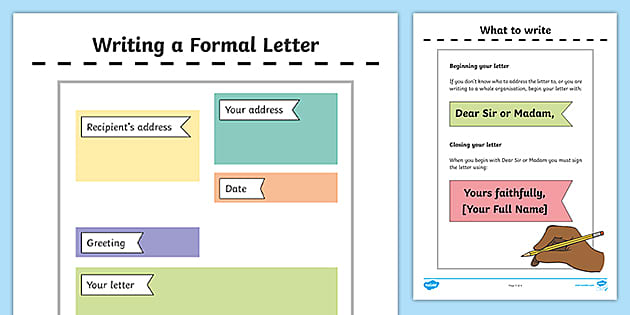
Throughout this phase, expect to receive constructive feedback from your peers and instructor, fostering a supportive learning environment where you can refine your skills.
Phase 3: Application and Assessment In the final phase
It's your time to shine as you practically apply your newfound formal letter writing skills. Using the given scenario: "As a student advocating for a change in your school's cafeteria menu to include healthier food options. Write a formal letter to the school principal expressing your concerns, providing evidence supporting the need for healthier choices, and proposing specific changes to improve the overall well-being of students". Utilize the knowledge and skills you've acquired in the previous phases to compose your own formal letters. Engage in peer review and self-assessment to encourage reflection and continuous improvement. This phase not only evaluates your mastery of formal letter writing but also reinforces the practical application of these skills in authentic contexts. Get ready to showcase your ability to communicate effectively through the art of formal letter writing!
Evaluation
Formal Letter Writing Rubric: Advocacy for Healthier School Cafeteria Options
| Criteria | Excellent (4) | Proficient (3) | Basic (2) | Limited (1) |
|---|---|---|---|---|
| Format and Structure | The letter follows a formal structure with a clear introduction, body paragraphs presenting arguments coherently, and a strong conclusion. Each section adheres to proper formatting for a formal letter. | The letter mostly follows a formal structure with an introduction, organized body paragraphs, and a conclusion. There may be minor deviations in formatting. | The letter attempts a formal structure, but there are noticeable issues with organization and flow. Formatting may lack consistency. | The letter lacks a clear formal structure, making it challenging to follow arguments. Formatting is inconsistent or entirely absent. |
| Clarity and Tone | The language is sophisticated, conveying ideas clearly and concisely. The tone is formal, respectful, and appropriate for the intended audience. | The language is clear, with well-articulated ideas. The tone is mostly formal, maintaining a respectful and appropriate demeanor. | The language is somewhat clear, with occasional lapses in expression. The tone may waver between formal and informal. | The language is unclear, with significant difficulties in conveying ideas. The tone is inappropriate or inconsistent throughout. |
| Content and Argumentation | Arguments are compelling, well-supported with evidence, and demonstrate a thorough understanding of the issue. The content is highly relevant to the advocacy for healthier cafeteria options. | Arguments are convincing and supported with evidence, demonstrating a good understanding of the issue. The content is relevant to the advocacy for healthier cafeteria options. | Arguments are present but lack depth or may be weakly supported. Some content may be only marginally related to the advocacy for healthier cafeteria options. | Arguments are unclear, unsupported, or irrelevant to the advocacy for healthier cafeteria options. |
| Mechanics and Grammar | The letter is virtually free of grammatical, spelling, and punctuation errors. Language usage is exemplary. | The letter contains minor grammatical, spelling, or punctuation errors that do not significantly detract from comprehension. Language usage is mostly correct. | The letter has noticeable grammatical, spelling, or punctuation errors that may impact comprehension. Language usage may be awkward at times. | The letter is riddled with grammatical, spelling, or punctuation errors, hindering comprehension. Language usage is often confusing. |
| Overall Impression | The letter makes a powerful, persuasive case for healthier cafeteria options. It effectively communicates the student's advocacy with a high level of professionalism. | The letter presents a strong case for healthier cafeteria options and effectively communicates the student's advocacy in a professional manner. | The letter communicates the student's advocacy for healthier cafeteria options, but improvements in professionalism are needed. | The letter lacks a strong case for healthier cafeteria options and is not presented in a professional manner. |
This rubric provides a comprehensive evaluation of the formal letter, considering key elements such as format, tone, content, mechanics, and overall impression.
Conclusion
As you wrap up this WebQuest adventure on formal letter writing, take a moment to celebrate the strides you've made in mastering the art of effective communication. You've navigated through the intricacies of formal letters, honing your skills from understanding the basics to applying them in a real-world scenario. The journey was more than just learning; it was about crafting your voice and expressing your thoughts with precision and impact. As you step away, carry the confidence to tackle any written communication challenge that comes your way. Remember, the ability to articulate your ideas through a well-crafted formal letter is a lifelong skill, and you now possess the tools to make your words not just heard but truly impactful. That's all the time we have for this topic, but if you'd like to pursue it more on your own check these resources out: https://www.twinkl.com/resource/t2-e-241-formal-letter-writing-checklist OR https://www.tes.com/teaching-resource/formal-letter-writing-lesson-and-resources-11457365
Cheers to your newfound expertise in the world of formal letter writing!
Teacher Page
Dear Teachers, Get ready to transform your classroom into a hub of communication wizards with our Formal Letter Writing WebQuest! Dive into an adventure where teaching meets tech, and your students become master wordsmiths. This WebQuest is not just a curriculum checkbox; it's a journey that injects energy and relevance into your lessons. Explore with your students using Youtube videos and watch their skills blossom. Witness the magic as they craft powerful formal letters through peer work or online work. Equip your classroom with a dose of creativity and real-world application by fostering collaborative learning activities. Ready to turn your students into communication rockstars? Let the WebQuest magic begin – it's time to make learning formal letter writing effective and meaningful for all.