
Introduction
Why does a ball keep rolling until something stops it? What makes it easier to push an empty cart than a full one? In this WebQuest, you will explore how Newton’s Three Laws of Motion explain the behavior of objects in everyday life. By investigating real examples and analyzing forces, you will build your understanding of physics in action.
https://photos.app.goo.gl/C6DLKxMo3pj4FR4UA
(Image of football player stopping ball with his leg)
Task
Your mission is to become a physics detective and explore the invisible forces that affect how things move in the real world. Using your knowledge of Newton’s Three Laws of Motion, you will investigate real-life situations where these laws apply.
You will work individually or in pairs to complete the following:
1. Find one real-life example for each of Newton’s Three Laws (three total). These can be from daily life (e.g., sports, transport, playgrounds, household items).
https://photos.app.goo.gl/PYtGmkDc6cV4JtiF7
(Illustrated real-life example of Newton’s Laws in action demonstrated in braking)
2. For each example:
-
Clearly describe what is happening.
-
Identify which Newton’s Law is demonstrated.
-
Create a labeled force diagram (you can draw it or find one online).
-
Explain how the law applies using key terms like force, motion, acceleration, mass, and inertia.
https://photos.app.goo.gl/mdPrC6bMS9AkXvjMA
(Free-body diagram with labeled forces)
3. Put your work together in a digital poster or slide presentation (Google Slides, Canva, or PowerPoint). It must include:
-
A title slide
-
One slide per law/example
-
One slide with all three laws summarized
-
Images and clear explanations
-
A reference slide with APA-style citations
4. You will present your poster/presentation briefly in class to explain your examples.
Your goal is to show that you not only understand Newton’s Laws but can recognize and explain them in the world around you. Get ready to apply physics to everyday life!
Process
Follow these steps carefully to complete your project:
Step 1: Learn the Basics
-
Watch this short video to review Newton’s Three Laws of Motion:
CrashCourse Physics #5 – Newton’s Laws -
Take notes on key terms like: inertia, net force, acceleration, mass, reaction force, and motion.
Step 2: Select Real-World Examples
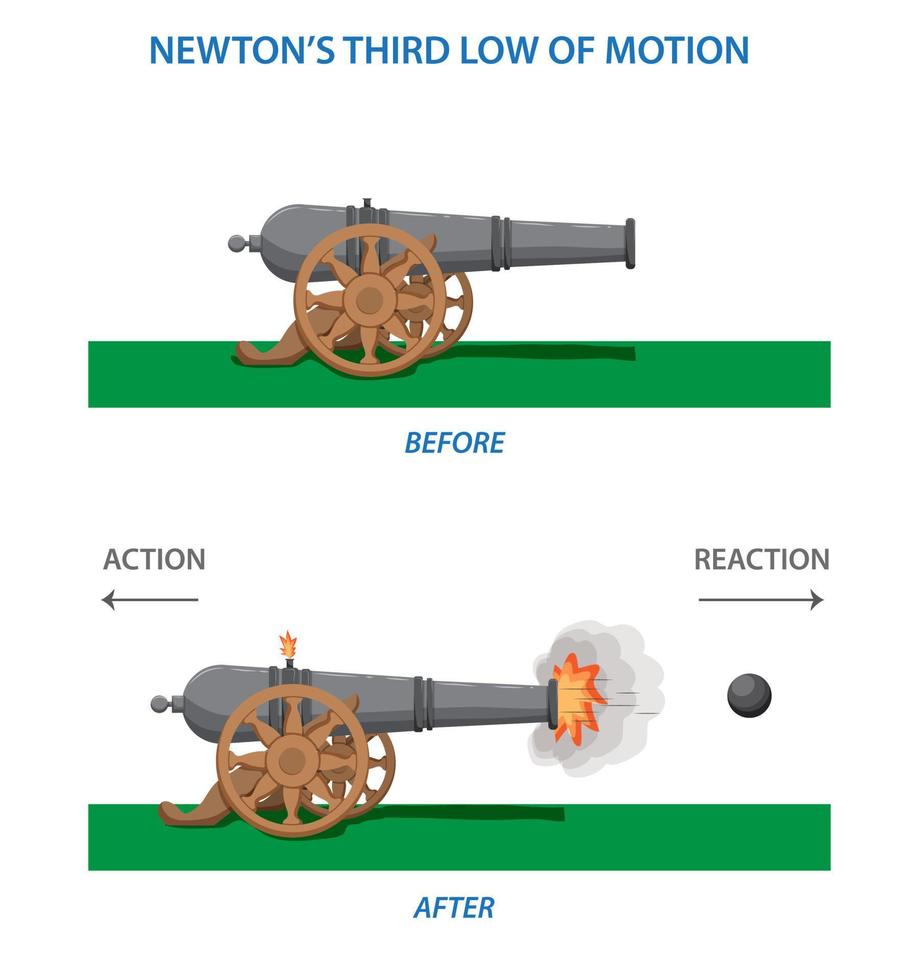
https://photos.app.goo.gl/kN3FANX58KaQN59a6
(Real world example demonstrating cannon’s backward recoil is the reaction to the forward motion of the cannonball)
-
Choose 3 real-life examples, each representing one of Newton’s Laws.
Examples include:-
First Law: A passenger lurching forward in a sudden stop.
-
Second Law: A heavier object requiring more force to accelerate.
-
Third Law: A person jumping off a boat and the boat drifting back.
-
Step 3: Analyze Each Example
For each example, write:
-
A brief description of the situation.
-
Which law it demonstrates and why.
-
A labeled force diagram showing all forces acting on the object (you may draw diagrams digitally on your computer or scan diagrams drawn on a piece of paper)
Step 4: Create Your Presentation
Choose one of the following formats:
-
Google Slides, PowerPoint, or Canva poster
Include the following slides/pages:
-
Title slide with your name/names and grade
-
One slide per law (3 total), each with:
-
Example description
-
Force diagram
-
Explanation of how the law applies
-
-
Summary slide reviewing all 3 laws
-
Credits slide in APA format
Make sure:
-
Text is clear and concise
-
Images are resized appropriately
-
All force diagrams are labeled
Step 5: Submit & Present
-
Submit your completed presentation to the teacher’s platform (email or shared drive)
-
Be ready to present your work to the class and explain how Newton’s Laws are shown in your examples
Evaluation
|
Conclusion
Newton’s Laws aren’t just equations in a book. They’re the rules that govern how everything moves around you. After completing this WebQuest, you will be able to recognize how forces act in sports, vehicles, playgrounds, and more. Now you’re ready to see the world through the eyes of a physicist!
https://photos.app.goo.gl/Zm4jmn4we6N5QzJX9
(Visual summary of Newton’s Three Laws with illustrated real-life examples)
Credits
References
Brighterly. (2022, May). Newton’s first law educational graphic. https://k3h3a8r8.delivery.rocketcdn.me/wp-content/uploads/2022/05/1st-law-768x1086.png

CrashCourse. (2016, April 11). Newton’s Laws: Crash Course Physics #5 [Video]. YouTube. https://www.youtube.com/watch?v=kKKM8Y-u7ds
Medium. (n.d.). Illustration of Newton’s Laws. https://miro.medium.com/v2/resize:fit:3840/1*BgMqLwum0iPbImmZdeSYMg.jpeg

OpenStax College Physics. (2015). Free-body diagram of forces acting on a skier. https://s3-us-west-2.amazonaws.com/courses-images-archive-read-only/wp-content/uploads/sites/1322/2015/12/03205847/Figure_04_07_08.jpg

Vecteezy. (n.d.). Newton’s third law infographic: cannon and cannonball. https://static.vecteezy.com/system/resources/previews/021/967/743/non_2x/newton-third-law-of-motion-infographic-diagram-showing-action-reaction-force-direction-example-of-cannon-and-cannon-ball-vector.jpg
VectorMine. (n.d.). Law of motion infographic diagram with examples. Shutterstock. https://www.shutterstock.com/image-vector/law-motion-infographic-diagram-examples-260nw-2289453973.jpg
