
Introduction
Have you ever wondered how the food we eat is categorized? Food classification helps us understand where our food comes from, how it is processed and what nutritional value it provides. Food can be divided into plant-based (derived from plants) and animal-based (derived from animals). However, there are many additional categories of food¨according to the food group to which they belong, to the processing they have undergone, to the size and type of processing, to their certification type achieved, as well as in accordance totheir chemical property, to their function, to their essentiality, to their concentration and to their nutritive value.In this WebQuest you will focus on these classifications as understanding them is essential for making healthy choices and appreciating the diversity of what we eat.
Task
In this WebQuest students will research different food classification systems. Using the provided resources, they will collect and organize information about how foods are categorized, then collaboratively create a digital presentation. Finally, they will share and discuss their findings with the class, comparing insights and reflecting on the importance of food classification for health, nutrition and food safety.
Process
Step 1- Research
A first simple food classification scheme is described in the following photo:
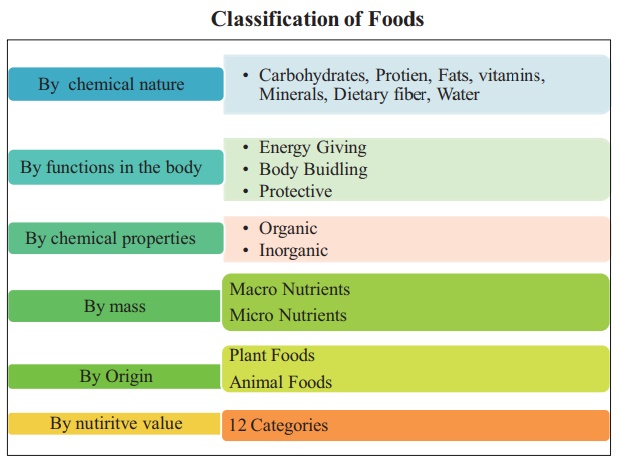
source: https://www.brainkart.com/article/Classification-of-Food_37944/
Most complicated schemes of food classification have been developed so to include classification based to the processing foods have undergone and the size and type of processing. The most well known are the IFSAC (https://www.cdc.gov/ifsac/media/pdfs/2024/07/IFSAC-FoodCategorizationHierarchy_HighRes_Poster_2024.pdf) and NOVA (https://ecuphysicians.ecu.edu/wp-content/pv-uploads/sites/78/2021/07/NOVA-Classification-Reference-Sheet.pdf) schemes. Collect more information regarding the food classification so as to make a collaborative presentation.
Useful links:
http://www.fao.org/3/ca5644en/ca5644en.pdf
http://www.fao.org/gsfaonline/foods/index.html
https://www.cdc.gov/foodsafety/ifsac/projects/food-categorization-scheme.html
Step 2 - Group formation and instructions
Choose your group and see instructions in the following Google Doc: https://docs.google.com/document/d/1MDUmg9yknW3w4l4DBX6y7sCJhKGi5_sS_VhTRboTVSQ/edit?usp=sharing
Step 3 - Create a presentation
Use the following template to create a colaborative presentation. https://docs.google.com/presentation/d/1gEaAPm77hJ7JIRBtfSld7Oe2ZIM6FH-ErSCB9uL4KDA/edit?usp=sharing
Step 4 - Discussion
Share your findings and discuss them in your classroom.
Evaluation
- Webquest evaluation: https://docs.google.com/forms/d/e/1FAIpQLSe2m3dT0f6kti9lZH3EaWc03TCk0xM9GU40V1k3NbjPoIsSgg/viewform?usp=sf_link
- Students will be evaluated according to the following rubric:
| Criteria | 5 - Excellent | 4 - Proficient | 3 - Satisfactory | 2 - Developing | 1 - Beginning |
|---|---|---|---|---|---|
| Research Quality | Thorough and accurate research on multiple food classification systems (simple and complex). Uses all provided resources and additional credible sources. | Good research covering key classification systems with minor omissions; uses most provided resources. | Basic research covers simple classification and one complex system; limited use of provided resources. | Research is incomplete or superficial; misses key classification systems or relies on few sources. | Research is minimal or inaccurate; fails to address food classification systems adequately. |
| Understanding of Concepts | Demonstrates deep understanding of food classification categories, including plant/animal-based, processing levels, certification, and nutrition. | Shows clear understanding of major classification categories but lacks depth in some complex areas. | Understands basic categories (plant/animal-based) with limited insight on processing or nutrition aspects. | Shows limited understanding; confuses categories or misses important classification criteria. | Does not demonstrate understanding of food classification concepts; major misconceptions present. |
| Collaboration & Presentation | Presentation is well-organized, visually engaging, and demonstrates effective collaboration; all group members contribute equally. | Presentation is organized and clear; good collaboration with minor imbalance in group participation. | Presentation is somewhat organized but lacks clarity or cohesion; uneven group participation. | Presentation is disorganized or incomplete; poor collaboration evident. | Presentation is incomplete, unclear, or off-topic; little or no collaboration among group members. |
| Use of Classification Schemes | Accurately explains and compares multiple complex classification schemes (IFSAC, NOVA, etc.) with examples. | Explains at least two classification schemes with some comparison and examples. | Describes one classification scheme adequately; limited examples or comparison. | Mentions classification schemes but explanations are inaccurate or incomplete. | Fails to explain or compare classification schemes adequately; no examples provided. |
| Discussion & Reflection | Insightful discussion reflecting on importance of food classification for health, nutrition, and safety; actively engages peers. | Clear reflection on food classification’s relevance; participates well in discussion. | Basic reflection on importance; limited engagement in class discussion. | Minimal reflection; participates little in discussion or does not connect classification to real-world use. | No reflection or discussion; does not engage in sharing or discussing findings. |
Conclusion
By completing this WebQuest, students will have explored how foods are classified across different systems, ranging from simple categories such as plant-based and animal-based to more complex frameworks like IFSAC and NOVA. Gaining an understanding of food classification enables them to make healthier choices, support food safety and better appreciate the diversity and complexity of the foods.
Credits
Teacher Page
This WebQuest was edited by a teacher of Gymnázium Cyrila Daxnera vo Vranove nad Topľou, Slovakia, as part of the activities of the "Mediterranean Diet for Overall Health" (MedDiet4Health) Erasmus+ project (Project number: 2023-2-EL01-KA210-VET-000183592).
By engaging in these activities, students not only gain theoretical knowledge but also develop practical skills that are useful for future careers in food technology, health, nutrition and related fields. They strengthen their research and analytical skills by exploring different food classification systems and comparing international frameworks. Their digital literacy and creativity are enhanced through the design of the collaborative presentation, while teamwork and communication skills grow as they work together to share and present findings. In addition, they cultivate critical thinking by evaluating the importance of food classification for health and safety and they practice problem-solving by connecting classification schemes to real-world applications.
This WebQuest reflects only the author’s views. The European Commission’s support for the production of this WebQuest does not constitute an endorsement of the contents which reflects the views only of the authors, and the Commission cannot be held responsible for any use which may be made of the information contained therein.