
Introduction
Welcome learners! Today you are going to learn about the different phases of the moon and be able identify them. We discover some interesting facts about the Earth's moon. The moon is the satellite of the earth that moves around the earth. We see it shining at night by the light which the sun reflects on it. The moon is a beautiful satellite that everyone admires for its beauty. Moreover, the bright moonlight is soothing for all of us. It makes the earthly objects shine like silver in the moonlight. Thus, discover and learn some interesting facts about the Earth's moon will help us learn more about its enchanting beauty. Have you noticed that the moon keeps changing shape? What makes it seems to change like this? How do you feel when there is no moon at night time.
Task
At the end of this WebQuest, the students are expected to:
- Identify the phases of the moon.
- Describe the changes in the moons light as seen from night to night.
- Appreciate the importance of the moon to mankind.
Group Activities
(The class will be divided into 4 groups)
All groups will perform the:
OREO COCKIE MOON PHASES ACTIVITY
PROCEDURES
1. Gently separate the Oreos so all filling is on one side. (Be careful as you separate your Oreos, full moon and new moon are already done when you pull apart your Oreo).
2. Scrape off filling to resemble each phase of the moon. Use your plastic knife to carve the cream so it matches one of the moon phases.
3. Place Oreo phases in the plate ( correct order) in relation to the earth and sun.
4. Label the Oreo phases starting with the new moon.
6. Finally, think a good way in presenting your work in front of the class.

![Oreo Cookie Moon Phases Activity [Free Worksheet] | Moon phases activities, Oreo moon phases, Moon phases](https://i.pinimg.com/736x/fa/d3/d3/fad3d3cd363f4b35cf9192812a277067.jpg)
Process
Part I: Review
1. First, you will watch a videos that tells you about the moon and its phases.
Now, the different shapes of the moon that you see are what we called the “The Phases of the Moon”, and that is our topic for today.
Let’s have this diagram…
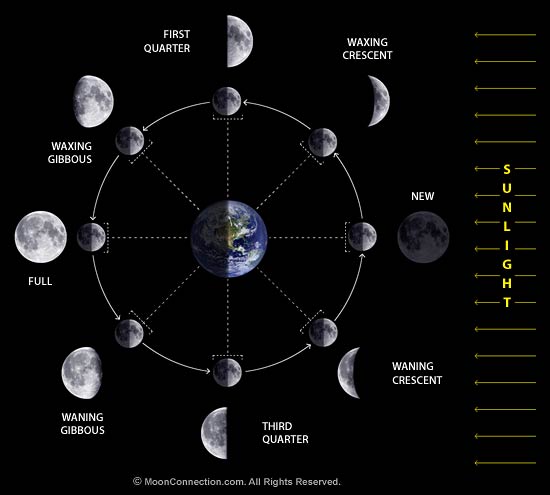
The diagram shows the different positions of the moon around the Earth with reference to the Sun.
Have you noticed that the moon keeps changing shape?
It starts as a thin crescent which grows bigger every night until it is a bright ball in the sky.
What makes it seems to change like this?
Just like the Earth, the moon does not have its own light. It reflects light from the sun. The phases of the moon you see depend on its position in relation to the sun and earth.
And in fact, the shape of the moon does not change, only its lighted part. Then we see less and less of its lighted part. That is why its shape appears to change, this is what we call, “Phases of the Moon”.
Concepts (gaining knowledge)
- The phases of the moon are known as the lunar phase.
- The Moon changes it shapes because of its revolution around the moon.
- The different shapes of the moon are called the phases of the moon.
- The different phases of the moon are produced because of the alignment with the earth, sun, and moon.
- The moon shines because it reflects the light from the sun.
- The part of the moon facing the sun is always lit up and the part facing away from the sun is always in darkness.
- The Lunar phase is the amount of moon we can see from the earth depending upon how much is lit up by the sun.
- The amount of moon we see changes every day. As the moon makes its way around the Earth, we see the bright parts of the moon’s surface at different angles. And these are called the phases.
Phases of the Moon/Lunar Phases – are the different moonlight shapes of the moon during a month.
New Moon – is when the moon is all dark and located between the Earth and Sun.
Crescent Moon – is when the moon is in between new moon and quarter moon stages, appears to be partly but less than one-half illuminated. If the moon’s light is increasing, it is called waxing crescent, if it is decreasing, it is waning crescent.
Quarter Moon – is when half of the moon is visible. If the moon’s light is waxing, it is called first quarter, if it is waning; it is called the last quarter.
Gibbous Moon – is between the quarter and full moon stages, appears to be more than one-half but not full illuminated. If the moon's light is increasing, it is called waxing gibbous. And if it is decreasing, it is called the waning gibbous.
Full moon - if the moon appears brightly and completely illuminated by direct sunlight. The earth is in between the moon and sun during this phase.
Waxing - means to increase gradually in size and is used to describe the moon's light as it grows from the new to full moon.
Waning - means to decrease gradually in size and is used to describe the moon's light as it gets smaller from full moon to new moon.
Part II: Application Your Knowledge
Draw the different phases of the moon and then arrange them in their order of appearance around the earth.
Part III: Assessment
Finally, you will take this assessment over what you have learned.
Match Moon Phases Assessment
Match the description with the corresponding moon phase and features. Write the correct letter of your answer at the space provided before the number.
|
____1. The entire right side of the moon is illuminated. ____2. The moon is less than half-lit. ____3. The moon is full and bright. Looks like a big circle. ____4. The moon is more than half-lit. ____5. More than ½ of the moon is visible. The right side is the bright side.
|
A. Full moon B. Waning gibbous C. First quarter D. Waxing gibbous E. Gibbous Crescent |
Evaluation
|
|
Emerging |
Developing |
Capable |
Strong |
|
Creativity |
Many cookie smudges and broken. |
Moon Phases are displayed adequately. One or two cookie smudges. |
Moon Phases are displayed neatly. Free of cookie smudges. |
Moon Phases are displayed excellently and very neatly. There are no cookie smudges or broken cookies. |
|
Following Directions |
Absence of too many steps because lack of understanding of the activities objectives. |
Made an effort to complete task accurately, however some of the work was unclear. |
Adequately completed all steps with few errors. Show understanding of activities expectations. |
Complete all steps without any errors. Gave careful attention detail. |
|
Punctuality |
Learners did not use time wisely. |
Learners had difficulty completing most of the cookie moon on time. |
Learners not able to complete 1-2 parts of the cookie moon on time. |
Learners completed task on time. |
|
Moon Phase Accuracy |
Learners 4 or more phases incorrect. |
Learners had 3 or more phases incorrect. |
Learners had 1 or 2 phases incorrect. |
All moon phases are correct. |
Conclusion
The moon is important to life on Earth because it plays a vital role in many areas like the weather, Earth’s magnetic field, evolution, and it is even one of the main reasons why day are 24 hours long. Students need to learn the reasons behind the different phases of the moon. This basic information opens the door and provides students with the academic foundation to learn about seasonal changes, varying length of daylight and darkness, how humans organize time, and many other important concepts in astronomy. In these WebQuest students can identify the name of the phases of the moon, describe the changes in the moons light as seen from night to night and value the importance of the moon to mankind.
Credits
Teacher Page
Phases of the Moon
Science in our World, K to 12 5 WORKTEXT