
Introduction
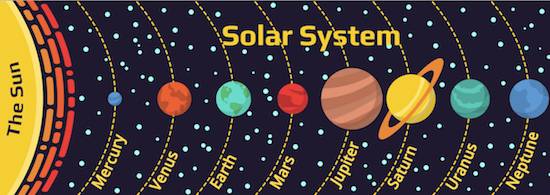
Our solar system is a space region. It lacks atmosphere. However, it contains many worlds, including Earth, with various atmospheres. It has hundreds of moons in its orbits. This includes the Sun and the objects that orbit it, as well as the eight planets and their moons, dwarf planets, and countless asteroids, comets, and other small, icy objects. In order of distance from the Sun, the largest eight objects that comprise a planetary system are four terrestrial planets, Mercury, Venus, Earth, and Mars; and four giant planets, which include two gas giants, Jupiter and Saturn, and two ice giants, Uranus and Neptune.
The Solar System is made up of the Sun and all of the smaller objects that move around it. Apart from the Sun, the largest members of the Solar System are the eight major planets. Nearest the Sun are four fairly small, rocky planets - Mercury, Venus, Earth and Mars.
Beyond Mars is the asteroid belt – a region populated by millions of rocky objects. These are left-overs from the formation of the planets, 4.5 billion years ago.
On the far side of the asteroid belt are the four gas giants - Jupiter, Saturn, Uranus and Neptune. These planets are much bigger than Earth, but very lightweight for their size. They are mostly made of hydrogen and helium.
Until recently, the furthest known planet was an icy world called Pluto. However, Pluto is dwarfed by Earth’s Moon and many astronomers think it is too small to be called a true planet.
An object named Eris, which is at least as big as Pluto, was discovered very far from the Sun in 2005. More than 1,000 icy worlds such as Eris have been discovered beyond Pluto in recent years. These are called Kuiper Belt Objects. In 2006, the International Astronomical Union decided that Pluto and Eris must be classed as “dwarf planets”.
Even further out are the comets of the Oort Cloud. These are so far away that they are invisible in even the largest telescopes. Every so often one of these comets is disturbed and heads towards the Sun. It then becomes visible in the night sky
Task
Creating a group presentation about our solar system is your main task. The presentation ought to contain the following:
The Names and Features of the Nine Planets
Title and properties of the stars
Names of the galaxies in the cosmos
Give proof that the solar system is real.

Process
To provide a presentation that is both imaginative and dependable, you must:
Conduct studies on our planets, stars, galaxies, and theories, among other things.
Verify the website's dependability.
Be precise, well-organized, trustworthy, informed, and creative.
Obtain some images and video clips to enhance the clarity of your presentation.
When giving your group presentation, be confident, well-read, and prepared.
Evaluation
The following standards will be used to assess and assign a grade to your group presentation:
Resourceful: You should be informed and imaginative in your group presentation.
Reliable: You should make your group presentation secure and dependable.
Creativity: Your crew gave a very imaginative and creative presentation.
Content: Exactness is required in the presentation.
Delivery: The speaker is assured and well-informed about the subject.
Structure: The presentation needs to be well-planned and executed.
Conclusion
After learning Our solar system is made up of eight planets that revolve around the Sun, which is at the center of our solar system. Students may conclude that these planets have been broadly classified into two groups: inner planets and outer planets. The inner planets are Mercury, Venus, Earth, and Mars. The inner planets are smaller in size and closer to the Sun than the outer planets. These are also known as the Terrestrial planets. The other four planets, Jupiter, Saturn, Uranus, and Neptune, are known as the outer planets. These four are massive in size and are known as Giant planets.
in this topic, Learners can elaborate on the following:
Mercury
The smallest planet in our solar system is Mercury, which is also closest to the Sun. The geological features of Mercury consist of lobed ridges and impact craters. Being closest to the Sun the Mercury’s temperature sores extremely high during the daytime. Mercury can go as high as 450 degree Celsius but surprisingly the nights here are cold. Mercury has a diameter of 4,878 km and Mercury does not have any natural satellite like Earth.
Venus
Venus is also said to be the hottest planet of our solar system. It has a toxic atmosphere that always traps heat. Venus is also the brightest planet and it is visible to the naked eye. Venus has a thick silicate layer around an iron core which is also similar to that of Earth. Astronomers have seen traces of internal geological activity on Venus planet. Venus has a diameter of 12,104 km and it is just like Mars. Venus also does not have any natural satellite like Earth.
Earth
Earth is the largest inner planet. It is covered two-third with water. Earth is the only planet in our solar system where life is possible. Earth’s atmosphere which is rich in nitrogen and oxygen makes it fit for the survival of various species of flora and fauna. However human activities are negatively impacting its atmosphere. Earth has a diameter of 12,760 km and Earth has one natural satellite that is the moon.
Mars
Mars is the fourth planet from the Sun and it is often referred to as the Red Planet. This planet has a reddish appeal because of the iron oxide present on this planet. Mars planet is a cold planet and it has geological features similar to that of Earth. This is the only reason why it has captured the interest of astronomers like no other planet. This planet has traces of frozen ice caps and it has been found on the planet. Mars has a diameter of 6,787 km and it has two natural satellites.
Jupiter
It is the largest planet in our solar system. Jupiter has a strong magnetic field Jupiter largely consists of helium and hydrogen. It has a Great Red Spot and cloud bands. The giant storm is believed to have raged here for hundreds of years. Jupiter has a diameter of 139,822 km and it has as many as 79 natural satellites which are much more than of Earth and Mars.
Saturn
Saturn is the sixth planet from the Sun. It is also known for its ring system and these rings are made of tiny particles of ice and rock. Saturn’s atmosphere is quite like that of Jupiter because it is also largely composed of hydrogen and helium. Saturn has a diameter of 120,500 km and It has 62 natural satellites that are mainly composed of ice. As compare with Jupiter it has less satellite.
Uranus
Uranus is the seventh planet from the Sun. It is the lightest of all the giant and outer planets. Presence of Methane in the atmosphere this Uranus planet has a blue tint. Uranus core is colder than the other giant planets and the planet orbits on its side. Uranus has a diameter of 51,120 km and it has 27 natural satellites.
Neptune
Neptune is the last planet in our solar system. It is also the coldest of all the planets. Neptune is around the same size as the Uranus. And it is much more massive and dense. Neptune’s atmosphere is composed of helium, hydrogen, methane, and ammonia and it experiences extremely strong winds. It is the only planet in our solar system which is found by mathematical prediction. Neptune has a diameter of 49,530 km and it has 14 natural satellites which are more than of Earth and Mars.
Credits
Reference
- https://solarsystem.nasa.gov/solar-system/our-solar-system/overview/
- https://www.toppr.com/guides/essays/solar-system-essay/
- https://solarsystem.nasa.gov/solar-system/our-solar-system/in-depth/
- https://www.britannica.com/science/space-exploration/Solar-system-exploration
- https://en.wikipedia.org/wiki/Discovery_and_exploration_of_the_Solar_System
- https://education.nationalgeographic.org/resource/resource-library-solar-system/
- https://education.nationalgeographic.org/resource/history-space-exploration/
- https://science.nasa.gov/solar-system/
- https://www.nationalgeographic.com/science/article/the-solar-system
- https://science.nasa.gov/solar-system/exploration/