
Introduction
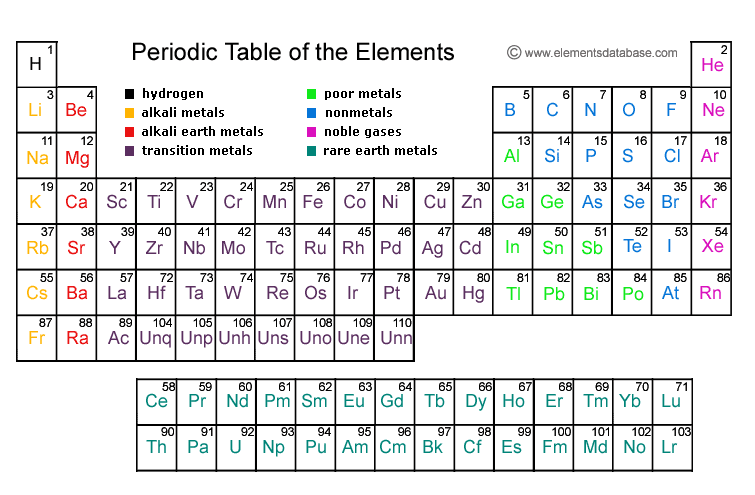 For many years scientists searched for a way to organize the known elements of the universe onto a useful chart or table. It was not until the mid-1800s that a Russian chemist by the name of Dmitri Mendeleev recognized hidden patterns that could be used to organize the elements.
Mendeleev wrote down many of the known properties of each element on small pieces of paper. By arranging the elements in order of their atomic mass he began to see patterns emerge. Although today's Periodic Table is different from Mendeleev's, his Periodic Table became the first useful system for the classification of the elements.
Each element on the Periodic Table has its own unique physical and chemical properties. Some of the elements have important uses. Some were discovered a long time ago and some are man-made.
In this WebQuest you and your partner will learn about one of these elements. You will also learn how it fits into the arrangement of elements on the Periodic Table.
Task
Your task will be completed in several parts.
In a random drawing you will be assigned one of the elements on the Periodic Table. Using the Internet and other resources you will research your element.
You and your partner(s) will then create:
- an Element Tile to be a part of a giant Periodic Table of Elements
- a PowerPoint presentation about your element
- an oral report about your element to your classmates.

Process
Part A: Element Tile
1. Using the Internet or other resources available in the library thoroughly research your element. Be sure to find all of the information listed in the Requirements.
2. Create an 11" x 11" inch Element Tile. Be creative!
Part B: PowerPoint Presentation 
You and your partner(s) will begin creating a PowerPoint presentation about your element. Be sure to check the Requirements section below before you begin. Use the Presentation Template to plan your PowerPoint presentation. This will help save time in the computer room.
Part C: Oral Report
You and your partner(s) will give a 3 - 5 minute oral report about your element. You will display the Element Tile that you made and use your PowerPoint presentation. Remember -be prepared for your presentation by rehearsing.
Evaluation
A special score sheet and grading rubric will be used to determine your grade.

Conclusion
Hopefully you have now learned a thing or two about how the elements in the periodic table are related, what the symbols and numbers mean, and some special properties of these elements are!
Credits
Resources
WebElements.com - Most complete reference but you have to follow all the links to find specific data.
Chemical Elements.com - Shockwave based interactive periodic table
Chemicool.com - One page for each element includes melting and boiling points
It's Elemental.com - Maintained by the Jefferson National Accelerator Facility