
Introduction
Literature course
Prepared by Jeniffer Sire and Emily Morales
Elements of short story.
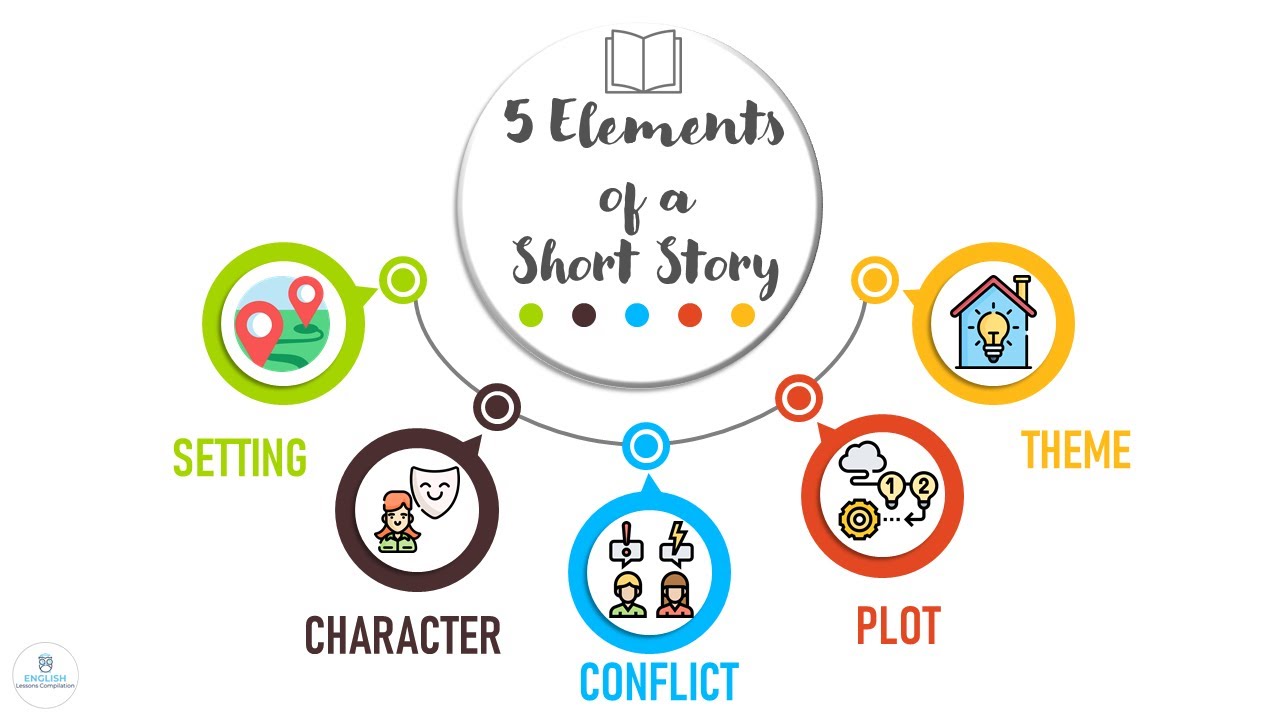
Shor stories often contain structural and character elements that should be familiar to students. These elements can be used as guides to help you think about the actions, themes and contexts of the story. These elements are plot, character, setting, conflict and theme. They are important because they provide a framework for the writer to tell their story and also they give the reader a way to follow the story and understand what is happening.
Check link to read more information
http://studentweb.cortland.edu/Janna.Fiermonte/Final%20Project/Elements.html
Elements of plot:
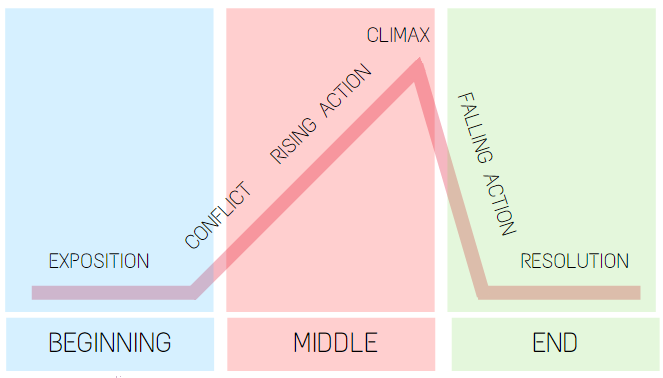
1. Exposition or Introduction
The exposition is the introduction to the story. The characters and setting are introduced. The background information provided by exposition helps connect to the audience to the emotional stakes of the narrative.
2. Rising action
In rising action, the story becomes complicated. The main character is in crisis and there are multiple moments of conflict that escalate and create tension.
3. Climax
The climax is the peak of the action. At this point, the main character confront the big conflict. The most action, drama, change, and excitement occurs here. A choice must be made that will affect the rest of the story.
4. Falling action
In falling action, the conflict that arose as a result of the climax can start being resolved. The story begins to slow down and complications begin to resolve.
5. Resolution
The resolution is the end of the story and it brings the story to its happy or tragic ending. The conflict from the climax has been resolved. There is a sense of finality and closure here, making the reader feel that there is nothing more they can learn or gain from the narrative.
Task
Read this short story.
Thank You, Ma'am (by Langston Hughes)
She was a large woman with a large purse that had everything in it but hammer and nails. It had a long strap, and she carried it slung across her shoulder. It was about eleven o’clock at night, and she was walking alone, when a boy ran up behind her and tried to snatch her purse. The strap broke with the single tug the boy gave it from behind. But the boy’s weight and the weight of the purse combined caused him to lose his balance so, intsead of taking off full blast as he had hoped, the boy fell on his back on the sidewalk, and his legs flew up. the large woman simply turned around and kicked him right square in his blue-jeaned sitter. Then she reached down, picked the boy up by his shirt front, and shook him until his teeth rattled. After that the woman said, “Pick up my pocketbook, boy, and give it here.” She still held him. But she bent down enough to permit him to stoop and pick up her purse. Then she said, “Now ain’t you ashamed of yourself?” Firmly gripped by his shirt front, the boy said, “Yes’m.” The woman said, “What did you want to do it for?” The boy said, “I didn’t aim to.” She said, “You a lie!” By that time two or three people passed, stopped, turned to look, and some stood watching. “If I turn you loose, will you run?” asked the woman. “Yes’m,” said the boy. “Then I won’t turn you loose,” said the woman. She did not release him. “I’m very sorry, lady, I’m sorry,” whispered the boy. “Um-hum! And your face is dirty. I got a great mind to wash your face for you. Ain’t you got nobody home to tell you to wash your face?” “No’m,” said the boy. “Then it will get washed this evening,” said the large woman starting up the street, dragging the frightened boy behind her. He looked as if he were fourteen or fifteen, frail and willow-wild, in tennis shoes and blue jeans. The woman said, “You ought to be my son. I would teach you right from wrong. Least I can do right now is to wash your face. Are you hungry?” “No’m,” said the being dragged boy. “I just want you to turn me loose.” “Was I bothering you when I turned that corner?” asked the woman. “No’m.” 2 “But you put yourself in contact with me,” said the woman. “If you think that that contact is not going to last awhile, you got another thought coming. When I get through with you, sir, you are going to remember Mrs. Luella Bates Washington Jones.” Sweat popped out on the boy’s face and he began to struggle. Mrs. Jones stopped, jerked him around in front of her, put a half-nelson about his neck, and continued to drag him up the street. When she got to her door, she dragged the boy inside, down a hall, and into a large kitchenettefurnished room at the rear of the house. She switched on the light and left the door open. The boy could hear other roomers laughing and talking in the large house. Some of their doors were open, too, so he knew he and the woman were not alone. The woman still had him by the neck in the middle of her room. She said, “What is your name?” “Roger,” answered the boy. “Then, Roger, you go to that sink and wash your face,” said the woman, whereupon she turned him loose—at last. Roger looked at the door—looked at the woman—looked at the door—and went to the sink. Let the water run until it gets warm,” she said. “Here’s a clean towel.” “You gonna take me to jail?” asked the boy, bending over the sink. “Not with that face, I would not take you nowhere,” said the woman. “Here I am trying to get home to cook me a bite to eat and you snatch my pocketbook! Maybe, you ain’t been to your supper either, late as it be. Have you?” “There’s nobody home at my house,” said the boy. “Then we’ll eat,” said the woman, “I believe you’re hungry—or been hungry—to try to snatch my pockekbook.” “I wanted a pair of blue suede shoes,” said the boy. “Well, you didn’t have to snatch my pocketbook to get some suede shoes,” said Mrs. Luella Bates Washington Jones. “You could of asked me.” “M’am?” The water dripping from his face, the boy looked at her. There was a long pause. A very long pause. After he had dried his face and not knowing what else to do dried it again, the boy turned around, wondering what next. The door was open. He could make a dash for it down the hall. He could run, run, run, run, run! The woman was sitting on the day-bed. After a while she said, “I were young once and I wanted things I could not get.” There was another long pause. The boy’s mouth opened. Then he frowned, but not knowing he frowned. The woman said, “Um-hum! You thought I was going to say but, didn’t you? You thought I was 3 going to say, but I didn’t snatch people’s pocketbooks. Well, I wasn’t going to say that.” Pause. Silence. “I have done things, too, which I would not tell you, son—neither tell God, if he didn’t already know. So you set down while I fix us something to eat. You might run that comb through your hair so you will look presentable.” In another corner of the room behind a screen was a gas plate and an icebox. Mrs. Jones got up and went behind the screen. The woman did not watch the boy to see if he was going to run now, nor did she watch her purse which she left behind her on the day-bed. But the boy took care to sit on the far side of the room where he thought she could easily see him out of the corner of her eye, if she wanted to. He did not trust the woman not to trust him. And he did not want to be mistrusted now. “Do you need somebody to go to the store,” asked the boy, “maybe to get some milk or something?” “Don’t believe I do,” said the woman, “unless you just want sweet milk yourself. I was going to make cocoa out of this canned milk I got here.” “That will be fine,” said the boy. She heated some lima beans and ham she had in the icebox, made the cocoa, and set the table. The woman did not ask the boy anything about where he lived, or his folks, or anything else that would embarrass him. Instead, as they ate, she told him about her job in a hotel beauty-shop that stayed open late, what the work was like, and how all kinds of women came in and out, blondes, red-heads, and Spanish. Then she cut him a half of her ten-cent cake. “Eat some more, son,” she said. When they were finished eating she got up and said, “Now, here, take this ten dollars and buy yourself some blue suede shoes. And next time, do not make the mistake of latching onto my pocketbook nor nobody else’s—because shoes come by devilish like that will burn your feet. I got to get my rest now. But I wish you would behave yourself, son, from here on in.” She led him down the hall to the front door and opened it. “Good-night! Behave yourself, boy!” she said, looking out into the street. The boy wanted to say something else other than “Thank you, m’am” to Mrs. Luella Bates Washington Jones, but he couldn’t do so as he turned at the barren stoop and looked back at the large woman in the door. He barely managed to say “Thank you” before she shut the door. And he never saw her again.
Process
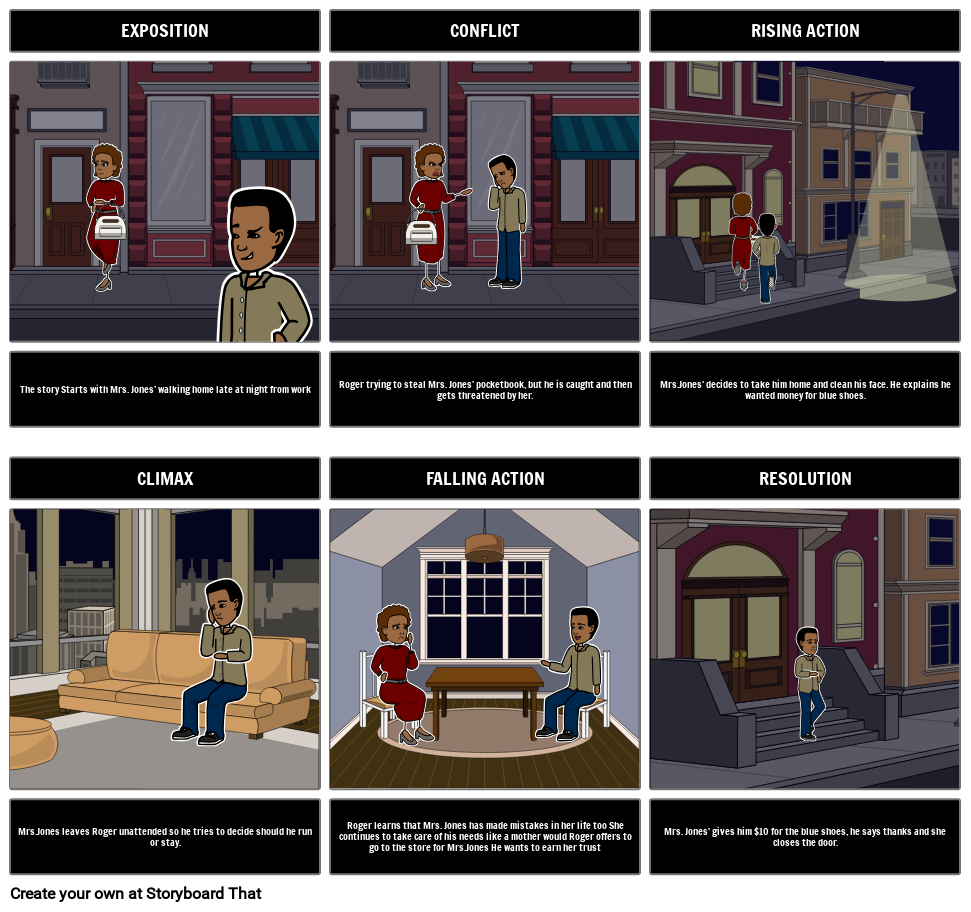
Create a comic where include the elements of this short story.
Look a example:
Use this tool
https://www.storyboardthat.com/storyboards/02e73c55/unknown-story
Evaluation
Rubric to evaluate the comic:
| Criteria |
Excellent 5 |
Satisfactory 3 |
Need improvement 1 |
|
Content/ elements of short story |
The comis has all elements of short story. (exposition, conflict, rising action, climax and falling action) |
The comic has 2 or 3 elements of short story. |
The comic has 1 or none element of short story. |
| Illustractions |
Comic has illutractions are detailed, atractive and creative related to the text on the page. |
Comic has illustractions to the text on the page. |
Illustractions are not presenting or they are not according to the text. |
| Grammar | No spelling errors. | No more than 3 spelling errors. | Several spelling errors. |
| Dialogue/ text |
The comic has an appropiate and clear dialogue and text. |
There is not quite enough dialogue or text in the comic but is always clear which character is speaking. |
It is not clear which character is speaking. |
Conclusion
Elements of a short story are useful in the literature course because provide an ability to understand and comprehend any topic . In the same way, help us to identify the main points of the determined story.
Here are some links to interesting stories:
https://www.sas.upenn.edu/~cavitch/pdf-library/Irving_RipVanWinkle.pdf
https://view.genial.ly/6172cbda5f220d0d5aef2210/presentation-portafolio-final-project-jeniffer-sire
Credits
The information presented in this WebQuest is collected from the following pages:
http://studentweb.cortland.edu/Janna.Fiermonte/Final%20Project/Elements.html
https://i.ytimg.com/vi/xcXRXwneFY0/maxresdefault.jpg
https://www.chino.k12.ca.us/cms/lib/ca01902308/centricity/domain/1689/thank%20you%20%20ma%20am.pdf
https://sbt.blob.core.windows.net/storyboards/nicole_cole/thank-you-ma-am-by--langston-hughes.png
https://www.juicyenglish.com/blog/parts-of-the-plot
Teacher Page
This lesson was designed for students of higher education in the literature course who are looking for information about short stories. Students always have an interest in telling stories and of course analyzing them. This WebQuest includes explanations about the Elements of the story with many examples and applications. Also, it includes links to important and interesting stories that will be useful for students to read and analyze.