
Introduction
Welcome to the exciting world of adjectives! In this WebQuest, you will explore how adjectives bring life, colour, and detail to our language. From describing people, places, animals or things to making writing more creative and interesting. Adjectives help us express ourselves clearly. Throughout this journey, you will complete fun activities, enjoy engaging resources, and practice using adjectives in sentences and stories. You will become more confident in identifying and using adjectives to improve your speaking and writing skills. Get ready to learn, explore, and have fun with words!
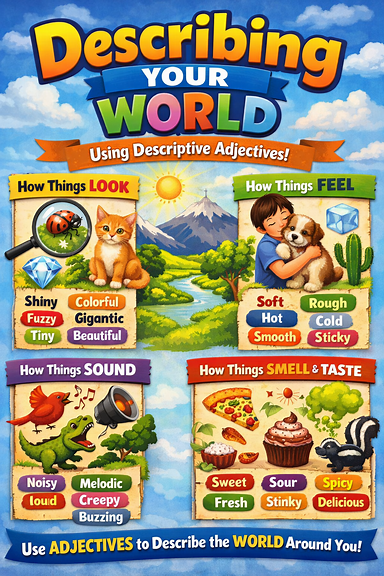
Watch this short Youtube video called "Adjectives for Kids | Parts of Speech Lesson" before you begin! Adjectives for Kids | Parts of Speech Lesson
Task
Your task is to become an “Adjective Explorer”!
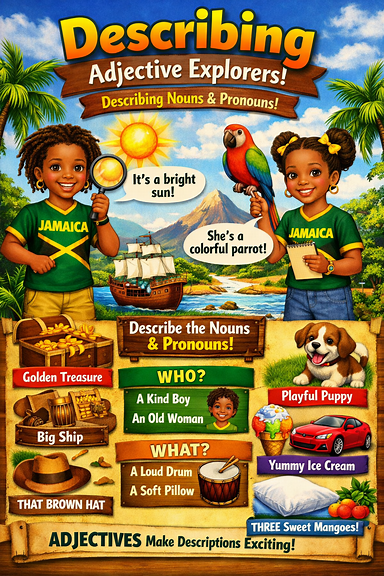
Use the following link to explore resources such as an interactive PowerPoint, a digital story and an audio.
https://drive.google.com/drive/folders/1C5fE6N5vBAh2QPNSSKd9Mj0mUoab3T0q?usp=drive_link
1. You will interact with the computer-based resources provided in the link above.
2. You will examine the importance of adjectives in oral and written communication.
3. Use adjectives to create your own descriptive writing.
Process
1. First, explore the provided resources provided (digital story, interactive powerpoint, audio ,short video, etc.) to learn what adjectives are and how they are used.
2.Practice using adjectives in sentences.
3. Create your own descriptive paragraph or story using at least 10 adjectives. Follow each step carefully and enjoy learning at your own pace. You can do it!
Evaluation
Explain in your own words what an adjective is and provide 5 examples. Complete this exercise in a paragraph.
Evaluation Rubric- Adjectives WebQuest
| Criteria | Excellent (4) | Good (3) | Satisfactory (2) | Needs Improvement (1) |
|---|---|---|---|---|
| Understanding of Adjectives | Shows a clear and complete understanding of adjectives; correctly identifies them in all activities. | Shows good understanding with few minor errors. | Shows basic understanding but makes several errors. | Shows little or no understanding of adjectives. |
| Use of Adjectives in Writing | Uses a wide variety of adjectives correctly and effectively in sentences or story. | Uses several adjectives correctly with minor mistakes. | Uses few adjectives and some are incorrect or repetitive. | Rarely uses adjectives or uses them incorrectly. |
| Creativity & Expression | Writing is highly creative, engaging, and vividly descriptive. | Writing is creative and mostly engaging. | Writing shows some creativity but is basic. | Writing is uncreative or unclear. |
| Completion of Tasks | All tasks are fully completed with great effort and detail. | Most tasks are completed with good effort. | Some tasks are incomplete or lack detail. | Few or no tasks are completed. |
| Organization & Clarity | Work is well-organized, clear, and easy to follow. | Work is mostly organized and clear. | Work is somewhat disorganized but understandable. | Work is disorganized and difficult to understand. |
Total Score: 20
Conclusion
You have completed the Adjectives WebQuest. Good Job! You have learned how adjectives make language more interesting and expressive. You can now confidently identify and use adjectives in your writing and speech. Keep practicing, because the more adjectives you use, the more powerful your communication becomes!
Credits
This WebQuest was created using information from educational grammar resources and online learning guides about adjectives. Appreciation is given to teachers and language experts who help make grammar learning engaging and accessible for students. Credits are as follows:
Short video entitled: Adjectives (Describing Words) - with Activities- https://www.youtube.com/watch?v=McdmXQz2_AE&t=88s
Short video called "Adjectives for Kids | Parts of Speech Lesson" - Adjectives for Kids | Parts of Speech Lesson
Teacher Page
This WebQuest was designed for Upper Primary students, particularly Grade 5, learning about descriptive adjectives in Language Arts. It supports interactive and student-centered learning through exploration, practice, and creative writing. Teachers are encouraged to guide students through each section, provide support where needed, and use the final writing task as an assessment of understanding. Differentiation strategies may be applied based on student ability levels.